
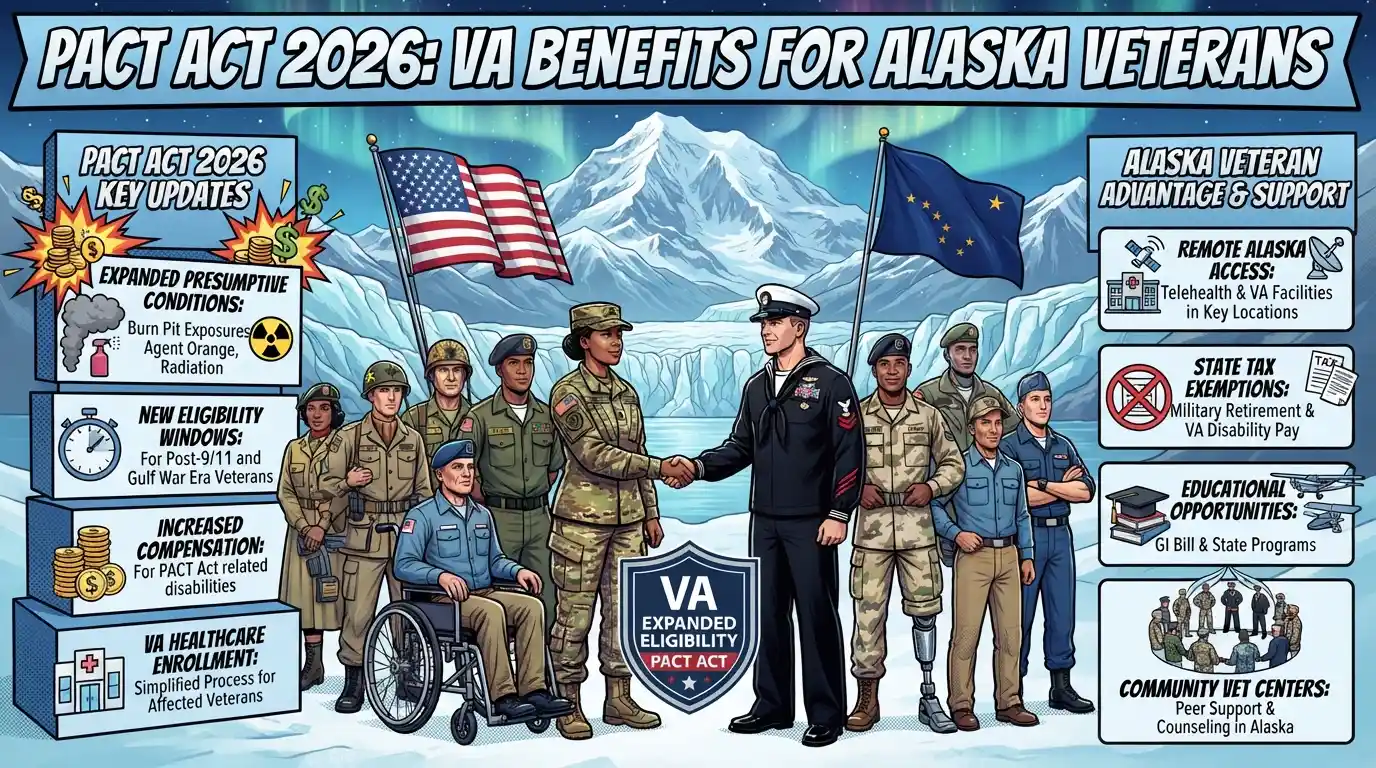
PACT Act 2026: VA Disability Benefits for Alaska Veterans
Last updated: November 2026. Benefits, rates, and contact details can change. Confirm current information with the official sources linked in this article.
The PACT Act of 2022 expands VA disability compensation and health care for veterans exposed to burn pits, Agent Orange, and other toxic substances. For Alaska veterans, a successful PACT Act claim can lead to tax-free monthly payments ranging from $180.42 at a 10% rating to $3,938.58 at a 100% rating in 2026. Alaska also offers a property tax exemption on the first $150,000 of assessed value for veterans rated 50% or higher, and the state has no income tax. You can see how this fits into the broader state-by-state veterans benefits guide.

Quick Facts
| Item | Details |
|---|---|
| Benefit | Tax-free monthly VA disability compensation and expanded VA health care for toxic-exposed veterans |
| Who Qualifies | Veterans with a current diagnosis of a PACT Act presumptive condition and qualifying service in a covered location or exposure category |
| How to Apply | Submit VA Form 21-526EZ online through VA.gov, by mail, or with an accredited Veterans Service Officer (VSO) |
| Processing Time | Varies by claim complexity; VA publishes current average processing times on its website |
| Official Agency | U.S. Department of Veterans Affairs (VA); Alaska Office of Veterans Affairs (OVA) |
| Required Forms | VA Form 21-526EZ (Application for Disability Compensation); VA Form 21-0966 (Intent to File) |
| Updated For | 2026 rates effective December 1, 2025 |
What the PACT Act Does for Alaska Veterans
VA Disability Combined Rating Calculator
Add each disability rating from your decision letter.

Estimate only. The VA makes the official rating decision. Not legal or financial advice, and not affiliated with the Department of Veterans Affairs.
The PACT Act is the largest health care and benefit expansion in VA history. It was signed into law on August 10, 2022, as the Sergeant First Class Heath Robinson Honoring our Promise to Address Comprehensive Toxics Act. The law does three main things: it expands VA health care eligibility for toxic-exposed veterans, adds more than 20 presumptive conditions for burn pits and other airborne hazards, and requires VA to provide a toxic exposure screening to every veteran enrolled in VA health care.
For Alaska veterans, the PACT Act matters because many service members deployed to Iraq, Afghanistan, and other Southwest Asia locations where burn pits were used. The law removes the burden of proving that a specific exposure caused a condition. Instead, VA presumes the connection if you meet the service requirements and have a current diagnosis.
The PACT Act does not create a separate state benefit in Alaska. All PACT Act compensation flows through the federal VA system. Alaska state benefits, such as the property tax exemption, are separate programs administered by local tax offices and the Alaska Office of Veterans Affairs.
PACT Act Presumptive Conditions: What Qualifies
A presumptive condition is an illness that VA automatically treats as service-connected if you served in a qualifying location or exposure category. You still need a current medical diagnosis, but you do not need a doctor to write a nexus letter linking your condition to service.
Army Fitness Test (AFT) Score Calculator
Formerly the ACFT. Five events, 500 points. Enter your results.
Estimate for training only. Points are interpolated from the official Army tables (effective 1 June 2025) and can differ by a few points. Your score of record comes from your unit graders. Official score tables (PDF). Not affiliated with the U.S. Army.
The PACT Act covers three main exposure groups. The table below summarizes the categories and examples of covered conditions. The list can change as VA updates its regulations; confirm the current list on VA.gov before filing.
| Exposure Category | Who Qualifies (Service Requirement) | Examples of Presumptive Conditions |
|---|---|---|
| Burn pits and airborne hazards | Veterans who served in Iraq, Afghanistan, Djibouti, Syria, Jordan, Egypt, Lebanon, Yemen, or other specified Southwest Asia locations after September 11, 2001, or in the Gulf War theater after August 2, 1990 | Brain cancer, gastrointestinal cancer, head and neck cancer, kidney cancer, pancreatic cancer, reproductive cancer, lymphoma, melanoma, asthma diagnosed after service, chronic bronchitis, COPD, chronic rhinitis, chronic sinusitis, constrictive bronchiolitis, emphysema, and others |
| Agent Orange (Vietnam-era) | Veterans who served in Vietnam, Laos, or Cambodia during specified dates; certain Korean DMZ service; certain Thailand service; C-123 aircraft crews | Bladder cancer (added by the PACT Act), hypertension (added by the PACT Act), hypothyroidism (added by the PACT Act), monoclonal gammopathy of undetermined significance (MGUS), and other conditions already recognized under Agent Orange rules |
| Radiation | Veterans who participated in radiation-risk activities or served in specified locations | Cancers previously covered under VA radiation rules, plus additional cancers added or clarified by the PACT Act |
The PACT Act also expanded eligibility for VA health care. Starting March 5, 2024, VA began enrolling veterans earlier than the law originally required. You can apply for VA health care even if you have not filed a disability claim.
How to Apply for PACT Act Benefits in Alaska
To apply for PACT Act-related disability compensation, submit VA Form 21-526EZ, Application for Disability Compensation and Related Compensation Benefits. The form revision date is January 2026. You can file online through VA.gov, by mail, or with free help from an accredited Veterans Service Officer (VSO).
Step-by-Step Application Process
File an Intent to File (ITF): Submit VA Form 21-0966 before you gather evidence. This establishes your effective date and preserves your right to back pay. An ITF is valid for one year.
Gather your evidence: Collect your DD-214, service records showing deployment locations or exposure, and current medical records with a diagnosis of a PACT Act condition.
Complete VA Form 21-526EZ: Apply online through VA.gov for the fastest processing. Hawaii is served by the VA Pacific Islands Health Care System; Alaska veterans are served by the Alaska VA Healthcare System. You can also mail the form or submit it in person.
Attend a C&P exam if requested: VA may schedule a Compensation and Pension exam to confirm your diagnosis and severity.
Receive a decision: If you disagree with the decision, you have appeal options (see below).
You can also work with the Alaska Office of Veterans Affairs (OVA) or a Veterans Service Officer for free assistance. OVA’s accredited service officers help veterans file claims and appeals at no charge.
2026 VA Disability Pay Scale for PACT Act Claims
PACT Act claims are rated on the same VA disability scale as any other service-connected condition. The 2026 rates below are for a veteran alone with no dependents, effective December 1, 2025. These amounts reflect a 2.8% cost-of-living adjustment. This amount can change; confirm the current rate on VA.gov before you apply.
| Disability Rating | 2026 Monthly Payment (Veteran Alone) |
|---|---|
| 10% | $180.42 |
| 20% | $356.66 |
| 30% | $552.47 |
| 40% | $795.84 |
| 50% | $1,132.90 |
| 60% | $1,435.02 |
| 70% | $1,808.45 |
| 80% | $2,102.15 |
| 90% | $2,362.30 |
| 100% | $3,938.58 |
Veterans rated at 30% or higher may receive additional amounts for a spouse, dependent children, or dependent parents. The full tables are available on the VA disability compensation rates page.
Alaska State Benefits for PACT Act-Eligible Veterans
Alaska does not provide a separate state payment for PACT Act conditions, but disabled veterans may qualify for several state and local benefits that supplement federal VA compensation. These benefits are administered by local tax offices and the Alaska Office of Veterans Affairs.
Alaska Property Tax Exemption for Disabled Veterans
Alaska offers a property tax exemption on the first $150,000 of assessed value of a primary residence for veterans with a 50% or higher service-connected disability rating from VA. The exemption transfers to a surviving spouse if the veteran passes away and the spouse is at least 60 years old. This is one of the broadest disability thresholds in the country: most states reserve property tax relief for 100% disabled veterans, but Alaska begins at 50%.
Key details:
Who qualifies: A veteran who owns and occupies the property as a primary residence and has a VA service-connected disability rating of 50% or more.
Surviving spouse: The exemption transfers if the spouse is at least 60 years of age at the time of the veteran’s death.
How to apply: Contact your local Alaska tax office. Application deadlines and forms vary by municipality. Some jurisdictions, such as the Matanuska-Susitna Borough, accept timely applications through April 30 for the exemption year. The City of Cordova requires applications by January 15 and a current VA letter dated within one year.
Municipal variation: The statewide framework sets the $150,000 exemption, but local offices administer the program. Confirm the current deadline and documentation with your local tax office.
This benefit is administered locally, so procedures can vary. Confirm the current process with your local tax office before filing.
Alaska Income Tax Treatment of VA Disability and Military Retirement
Alaska has no state income tax. As a result, VA disability compensation is not subject to Alaska state income tax, and neither is military retirement pay. Distributions from the Thrift Savings Plan are also not taxed by the state. This is a structural advantage for Alaska veterans: the state does not need a separate military retirement deduction because it does not levy an income tax at all.
Other Alaska Benefits for Disabled Veterans
Free hunting, fishing, and trapping card: Alaska residents rated 50% or more disabled by VA are eligible for a complimentary permanent identification card for hunting, sport fishing, and trapping. The card is issued through the Alaska Department of Fish and Game and requires proof of residency and disability rating.
Free state park camping pass: Disabled veterans may receive one free Alaska State Park camping pass under AS 41.21.026(d). Eligible veterans must present proof of a service-connected disability at the Anchorage or Fairbanks DNR Public Information Centers.
Veterans land purchase preference: Alaska offers a veterans land discount and purchase preference program. Details and current availability should be confirmed with the Alaska Department of Natural Resources.
State employment preference: Disabled veterans and former prisoners of war receive 10% of the total points available added to their score on state employment exams.
These benefits have eligibility rules and documentation requirements. Confirm current details with the Alaska Office of Veterans Affairs or the administering state agency.
VA Decision Review and Appeals Process
If VA denies your PACT Act claim or assigns a rating you believe is too low, you have three decision review options. You do not have to choose just one; you can file a Supplemental Claim, a Higher-Level Review, or a Board Appeal, depending on your situation.
| Option | What It Is | When to Use It |
|---|---|---|
| Supplemental Claim | Submit new and relevant evidence with VA Form 20-0995 | You have new medical evidence, a newly diagnosed condition, or records that were not considered |
| Higher-Level Review | A senior reviewer examines the same evidence with VA Form 20-0996 | You believe VA made an error in the original decision and you have no new evidence |
| Board Appeal | A Veterans Law Judge at the Board of Veterans’ Appeals reviews your case with VA Form 10182 | You want a judge to review your case; you can request a hearing |
These options and their forms are explained on VA.gov. You have one year from the date of your decision letter to file a Supplemental Claim or a Notice of Disagreement for a Board Appeal. A Higher-Level Review must also be requested within one year. If you are tracking a claim or appeal, the LSGS Veteran Portal guide explains how to check status and troubleshoot login issues.
2026 VA Disability Payment Schedule
VA disability compensation is paid on the first business day of each month for the prior month’s benefits. If the first falls on a weekend or holiday, payment is made on the preceding business day. The 2026 COLA took effect December 1, 2025, and the first payment reflecting the new rates was December 31, 2025.
Selected 2026 payment dates:
| Benefit Month | Payment Date |
|---|---|
| January 2026 | January 30, 2026 |
| February 2026 | February 27, 2026 |
| March 2026 | April 1, 2026 |
| April 2026 | May 1, 2026 |
These dates are consistent across multiple published 2026 VA payment schedules. The full schedule is published by VA and can change; confirm your specific payment date on VA.gov.
Comparison: PACT Act Federal Benefits vs. Alaska State Benefits
| Benefit | Federal (VA / PACT Act) | Alaska (State or Local) |
|---|---|---|
| Monthly compensation | Tax-free at federal level; rates based on disability rating | Not applicable (no separate state payment) |
| Health care | Expanded VA health care eligibility for toxic-exposed veterans | Not applicable |
| Property tax | Not applicable | First $150,000 of assessed value exempt for veterans rated 50% or higher |
| Income tax | Federally taxable only if income exceeds thresholds (VA compensation is tax-free) | No state income tax on any income, including military retirement and VA compensation |
| Hunting and fishing | Not applicable | Free permanent card for residents rated 50% or higher |
| State parks | Not applicable | Free camping pass for disabled veterans |
| Employment | Federal veterans’ preference | 10% added to state exam scores for disabled veterans and former POWs |
| Survivor benefits | DIC and dependent benefits | Property tax exemption transfers to surviving spouse age 60 or older |
| Application | VA Form 21-526EZ | Local tax office for property exemption; ADF&G for hunting card; DNR for park pass |
Common Mistakes to Avoid
Filing without an Intent to File: Without an ITF, your effective date (and back pay) begins on the date VA receives your complete claim, not when you started gathering evidence.
Assuming you need a nexus letter for a PACT Act condition: If your condition is on the presumptive list and you meet the service requirement, you do not need a doctor to prove the link. You only need a current diagnosis.
Missing the Alaska property tax exemption because you assume it requires a 100% rating: Alaska’s threshold is 50%, not 100%. Many eligible veterans overlook this benefit.
Waiting past your local tax office deadline: Property tax exemption deadlines vary by municipality. Some are as early as January 15; others are April 30. Check with your local office.
Not reporting changes in dependents to VA: If you add a dependent, notify VA to receive the correct add-on amount if you are rated 30% or higher.
Missing the appeal deadline: You have one year from the date of your decision letter to file a Supplemental Claim or a Board Appeal. A Higher-Level Review must also be requested within one year.
Common Questions
What is the PACT Act in simple terms?
The PACT Act is a 2022 law that expands VA disability compensation and health care for veterans exposed to burn pits, Agent Orange, and other toxic substances. It adds more than 20 presumptive conditions, meaning VA assumes your service caused the condition if you meet the service requirements and have a diagnosis.
Does the PACT Act apply to Alaska veterans?
Yes. The PACT Act is a federal law that applies to all eligible veterans nationwide, including those who live in Alaska. Alaska does not provide a separate state PACT Act payment, but disabled veterans may qualify for the state’s $150,000 property tax exemption and other benefits.
What conditions are presumptive under the PACT Act?
The list includes certain cancers (brain, gastrointestinal, head and neck, kidney, pancreatic, reproductive, lymphoma, melanoma), respiratory conditions (asthma diagnosed after service, chronic bronchitis, COPD, chronic rhinitis, chronic sinusitis, constrictive bronchiolitis, emphysema), and other conditions such as hypertension and MGUS. The list can change; confirm the current list on VA.gov/pact.
How much does a 100% disabled veteran get in 2026?
A veteran alone with a 100% rating receives $3,938.58 per month in 2026. With a spouse, the rate is $4,158.17 per month. These amounts are tax-free at the federal level, and Alaska has no state income tax.
How do I file a PACT Act claim in Alaska?
Submit VA Form 21-526EZ online through VA.gov, by mail, or with a Veterans Service Officer. The Alaska Office of Veterans Affairs and its accredited service officers provide free assistance. File an Intent to File first to preserve your effective date.
How long does a PACT Act claim take?
Processing times vary by claim complexity, the number of conditions claimed, and whether VA needs a C&P exam. VA publishes current average processing times on its website. Check VA.gov for the most recent figures.
Do I need a nexus letter for a PACT Act claim?
No, if your condition is presumptive and you meet the service requirements. The PACT Act removes the need to prove that your exposure caused the condition. You still need a current medical diagnosis, but you do not need a doctor to write a nexus letter.
Does Alaska tax VA disability compensation?
No. Alaska has no state income tax, so VA disability compensation is not subject to Alaska state income tax. It is also tax-free at the federal level.
Is military retirement pay taxed in Alaska?
No. Because Alaska has no state income tax, military retirement pay is not subject to Alaska state income tax. This applies to all military retirees who reside in Alaska.
How do I get the Alaska property tax exemption for disabled veterans?
You must have a VA service-connected disability rating of 50% or higher and own and occupy the property as your primary residence. Contact your local Alaska tax office for the application, deadline, and required documentation. The exemption covers the first $150,000 of assessed value.
Can my spouse receive PACT Act benefits after I die?
Surviving spouses and dependents may be eligible for Dependency and Indemnity Compensation (DIC) if the veteran died from a PACT Act presumptive condition. In Alaska, the property tax exemption transfers to a surviving spouse who is at least 60 years old.
What if VA denied my PACT Act claim?
You have three options: a Supplemental Claim with new evidence, a Higher-Level Review by a senior reviewer, or a Board Appeal before a Veterans Law Judge. Each has its own form and deadline, explained on VA.gov.
Does the PACT Act cover veterans who served in Alaska?
The PACT Act covers toxic exposure at home or abroad if you meet the service requirements. If you were exposed to toxins during military service in Alaska or elsewhere, and you have a condition on the presumptive list, you may be eligible. The key is whether your service records place you in a covered exposure category.
Can I get VA health care under the PACT Act even if I have not filed a disability claim?
Yes. The PACT Act expanded VA health care eligibility, and VA began enrolling veterans earlier than the law originally required. You can apply for VA health care without first filing a disability claim.
Key Takeaways
The PACT Act of 2022 expands VA disability compensation and health care for veterans exposed to burn pits, Agent Orange, and other toxins.
For Alaska veterans, a successful PACT Act claim can lead to tax-free monthly payments from $180.42 at 10% to $3,938.58 at 100% in 2026.
PACT Act conditions are presumptive, meaning you do not need a nexus letter if you meet the service requirement and have a current diagnosis.
Alaska offers a property tax exemption on the first $150,000 of assessed value for veterans rated 50% or higher—a lower threshold than most states.
Alaska has no state income tax, so VA disability compensation and military retirement pay are not subject to state income tax.
Alaska residents rated 50% or more disabled may qualify for a free permanent hunting, fishing, and trapping card, and disabled veterans may receive a free state park camping pass.
Apply for PACT Act benefits using VA Form 21-526EZ; file an Intent to File first to preserve your effective date.
The Alaska Office of Veterans Affairs (OVA) provides free claims assistance through accredited service officers.
If VA denies your claim or assigns a low rating, you have three appeal options: Supplemental Claim, Higher-Level Review, or Board Appeal.
VA disability payments are made on the first business day of each month; confirm the exact date on VA.gov.
Official Resources
VA.gov – The PACT Act and Your VA Benefits: Official overview of the PACT Act, eligibility, presumptive conditions, and how to file a claim.
VA.gov – Disability Compensation: Apply for compensation, check rates, and file an appeal.
VA.gov – Current Disability Compensation Rates: Official 2026 rate tables for all dependent statuses.
Alaska Office of Veterans Affairs: State agency for free claims assistance, benefits counseling, and Alaska-specific veterans programs.
Alaska Department of Fish and Game: Information on the free permanent hunting, fishing, and trapping card for disabled veterans.
Alaska Department of Natural Resources – State Parks: Details on the Disabled Veteran’s Annual Camping Pass and state park access.
VA Form 21-526EZ: Official application for VA disability compensation, revision date January 2026.
VA.gov – Decision Reviews: Official guide to Supplemental Claims, Higher-Level Review, and Board Appeals.
🇺🇸 IMPORTANT DISCLAIMER – Veterans Benefits Information
This site provides general information about U.S. Department of Veterans Affairs (VA) benefits for educational and informational purposes only.
- Not Official: We are NOT affiliated with, endorsed by, or connected to the U.S. Department of Veterans Affairs (VA), the Veterans Benefits Administration (VBA), the Veterans Health Administration (VHA), or any other government agency.
- No Legal/Financial Advice: The content on this website is for informational purposes only and does not constitute legal, financial, or medical advice. VA benefits rules change frequently – always consult with an accredited Veterans Service Officer (VSO) or a qualified professional for your specific situation.
- Official Sources: For official, binding information and to apply for benefits, always visit official .gov websites: VA.gov, Benefits.VA.gov, or SSA.gov.
- No Data Collection: This site does not collect, store, or process any personal information. It does not have login forms, contact forms, or any system to capture user data. We never ask for your Social Security Number, bank details, or any personal information.
- 🚨 Scam Alert: The VA and other government agencies never charge fees for benefit applications. If anyone asks for money to "process" your VA claim, it is a scam. Report it to the VA Office of Inspector General at VA.gov/OIG.
- Advertising: This site uses third-party advertising (Adsterra) to cover operational costs. We do not endorse or guarantee any products or services advertised.
📌 Information provided as of June 2026. Always verify current eligibility and rules with official .gov sources.
This site is not affiliated with the U.S. Department of Veterans Affairs or any government agency. All information is for educational purposes only. Please visit VA.gov for official information.
VA Disability Pay Calculator
This calculator is for information only. Your exact award is set by VA and shown in your VA.gov account and decision letter. VA disability compensation is tax-free.