
VA Disability Attorney: Fees, Accreditation, and When to Hire One
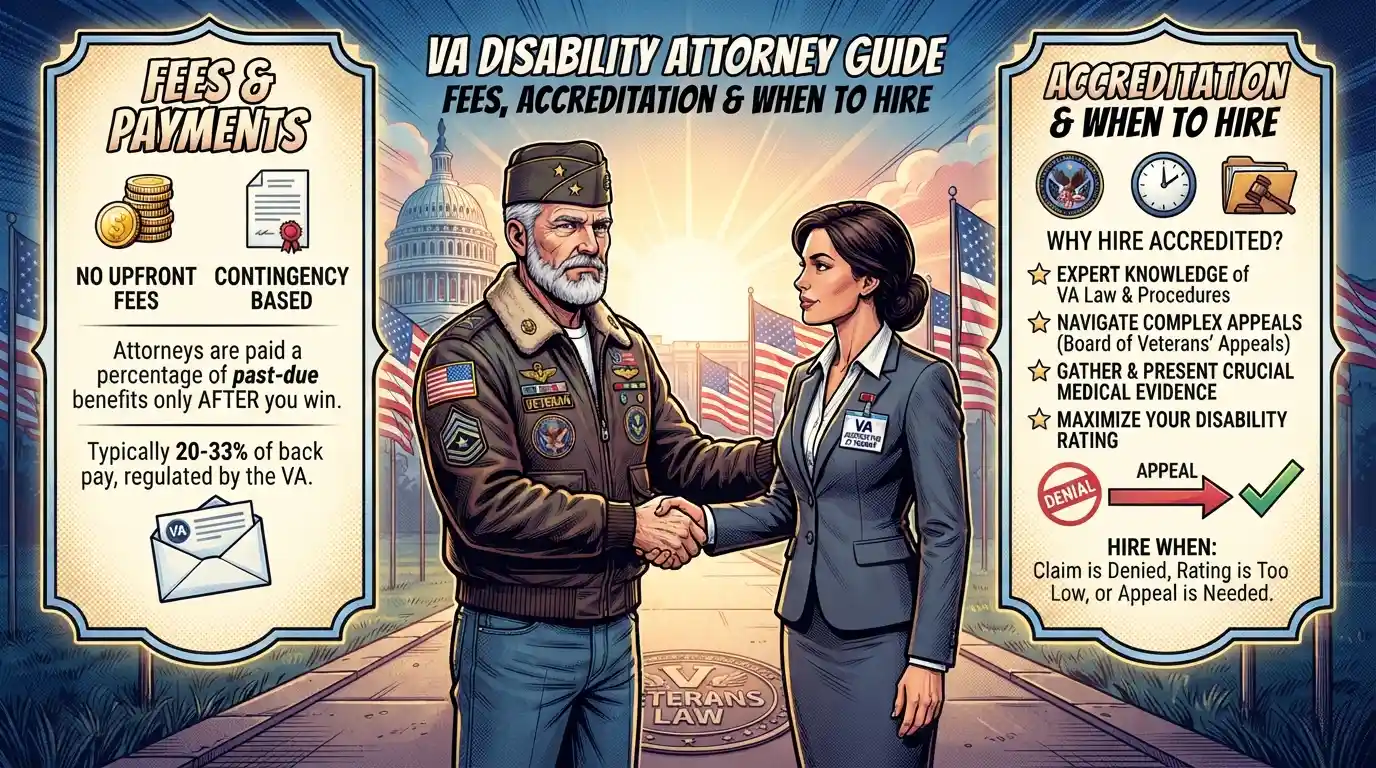
A VA disability attorney is a lawyer accredited by the VA’s Office of General Counsel to represent veterans in disability claims and appeals. By law, an accredited attorney can charge no more than 20% of past-due benefits, and that fee is contingent on winning. Attorneys cannot charge for help with an initial claim, but they can represent you in Supplemental Claims, Higher-Level Reviews, Board of Veterans’ Appeals (BVA) cases, and appeals to the U.S. Court of Appeals for Veterans Claims (CAVC).
Last updated: November 2026
Benefits, rates, and contact details can change. Confirm current information with the official sources linked in this article.

Quick Facts
| Item | Details |
|---|---|
| Benefit | Paid legal representation for VA disability claims and appeals |
| Who Qualifies | Any veteran, dependent, or survivor who wants accredited legal help after an initial VA decision |
| How to Apply | Sign a fee agreement and submit VA Form 21-22a to appoint the attorney |
| Processing Time | Depends on the appeal lane; attorneys do not control VA processing times |
| Official Agency | VA Office of General Counsel (accreditation); Board of Veterans’ Appeals; CAVC |
| Required Forms | VA Form 21-22a (appointment); written fee agreement; appeal forms vary by lane |
| Updated For | 2026 |
What a VA Disability Attorney Can and Cannot Do
VA Disability Combined Rating Calculator
Add each disability rating from your decision letter.

Estimate only. The VA makes the official rating decision. Not legal or financial advice, and not affiliated with the Department of Veterans Affairs.
A VA disability attorney can represent you only after the VA has made a decision on your initial claim. Federal law prohibits anyone from charging a fee to help with an initial VA disability claim. That is why most attorneys enter a case after a denial, a low rating, or an appeal.
Once you are past the initial decision, an accredited attorney can:
Gather medical evidence and write legal arguments for a Supplemental Claim, Higher-Level Review, or BVA appeal.
Represent you at the BVA and before the CAVC.
Challenge the effective date or rating level that controls your back pay.
Identify secondary conditions and theories of service connection you may have missed.
An attorney cannot guarantee a rating or a timeline. VA decides the claim; the attorney builds and argues the case.
Accreditation: What Makes a VA Attorney Different
A VA disability attorney must be accredited by the VA’s Office of General Counsel. Accreditation is not automatic for every lawyer. To become accredited, an attorney must be a member in good standing of at least one state bar and must meet the VA’s character and qualification requirements. The VA maintains a public accreditation search tool so you can verify any attorney before you sign anything.
Army Fitness Test (AFT) Score Calculator
Formerly the ACFT. Five events, 500 points. Enter your results.
Estimate for training only. Points are interpolated from the official Army tables (effective 1 June 2025) and can differ by a few points. Your score of record comes from your unit graders. Official score tables (PDF). Not affiliated with the U.S. Army.
Accreditation matters because only accredited attorneys and claims agents can charge fees for VA representation. An unaccredited person who charges for claim help is operating outside VA rules. If you are unsure whether someone is accredited, check the VA Office of General Counsel directory before sharing personal information or signing a fee agreement.
The VA also requires accredited attorneys to complete continuing legal education on VA law during their first year of accreditation and again within three years. This requirement is meant to ensure attorneys understand the VA claims system, not just general law.
Attorney Fees: The 20% Cap and How Payment Works
VA attorney fees are capped at 20% of past-due benefits. The fee must be entirely contingent on a favorable outcome, meaning the attorney is paid only if the claim succeeds and back pay is awarded. There is no upfront cost and no hourly billing allowed for accredited VA representation after an initial decision.
The VA can withhold the attorney’s fee directly from your back pay, but only if three conditions are met:
The attorney is VA-accredited.
A valid written fee agreement is in place.
The fee does not exceed 20% of past-due benefits.
If the VA withholds the fee, it pays the attorney directly from your retroactive award. You do not have to write a check. If you discharge the attorney before the case is completed, the attorney may still be entitled to a fee, but not automatically the full 20%. The VA’s Office of General Counsel can review a fee agreement for reasonableness if there is a dispute.
These fee rules can be adjusted by regulation; confirm the current cap and payment process through the VA Office of General Counsel before you sign an agreement.
When to Hire a VA Disability Attorney
Most veterans hire a VA disability attorney after the VA has made a decision they disagree with. The most common situations include a denied claim, a rating lower than expected, an effective date that cuts off back pay, or an appeal that has stalled.
Hire an attorney when:
Your claim was denied and you want to file a Supplemental Claim with new evidence or a Higher-Level Review.
Your rating does not match the severity of your condition, or your condition has worsened.
The VA assigned an effective date that reduces your back pay.
You want to appeal to the BVA or the CAVC.
Your case involves complex medical questions, multiple conditions, or a high-value back pay dispute.
A free VSO may be enough when:
You are filing your first claim and want help organizing records.
Your claim is straightforward and you have not received a decision yet.
You want free representation and are comfortable with a representative who may handle many cases at once.
VSO representatives are accredited through veterans service organizations and cannot charge fees. They are often a strong choice for initial claims. Attorneys bring legal training and can appear before the CAVC, which VSO representatives generally cannot do.
VSO vs. Attorney vs. Claims Agent
| Feature | VSO Representative | VA-Accredited Attorney | VA-Accredited Claims Agent |
|---|---|---|---|
| Cost | Free by law | Up to 20% of back pay, contingent | Up to 20% of back pay, contingent |
| When fees can start | Never charges | After an initial VA decision | After an initial VA decision |
| Can represent at CAVC | Generally no | Yes | No |
| Best for | Initial claims, straightforward appeals | BVA/CAVC appeals, complex or high-value cases | Specialized claim help without full legal representation |
| How to verify | VA OGC accreditation search | VA OGC accreditation search | VA OGC accreditation search |
The right choice depends on where you are in the process and how much is at stake. Many veterans start with a VSO and move to an attorney if the case reaches the BVA or CAVC.
The VA Appeals Process: Where Attorneys Fit
The modern VA appeals system, created by the Appeals Modernization Act, gives veterans three review options after an initial decision. An attorney can help you choose the lane that fits your evidence and your goal.
Supplemental Claim
A Supplemental Claim asks the VA to review new and relevant evidence. You can file it at any time, but filing within one year of the decision letter helps protect your effective date.
Higher-Level Review
A Higher-Level Review is a fresh look by a senior VA adjudicator. No new evidence is allowed at this stage. You must request it within one year of the decision letter.
Board Appeal (BVA)
A Board Appeal sends your case to the Board of Veterans’ Appeals. You must file a Notice of Disagreement within one year of the decision letter. The BVA is where many attorneys add the most value because the Board handles complex legal and medical issues.
CAVC Appeal
If the BVA denies your appeal, you can appeal to the U.S. Court of Appeals for Veterans Claims. The deadline is strict: 120 days from the date on the BVA decision. Only attorneys or the veteran acting pro se can appear before the CAVC. This is the stage where legal representation is most clearly necessary for most veterans.
These deadlines are jurisdictional in several places; missing them can end your appeal. Confirm the deadline on your decision letter and with a accredited representative before filing.
How to Choose a VA Disability Attorney
Choosing an attorney is a verification process, not a popularity contest. Start with the VA’s accreditation search and confirm the attorney is in good standing. Then ask direct questions about the fee agreement, the appeal lane, and what happens if you discharge the attorney.
Steps to verify and hire
Check accreditation. Use the VA Office of General Counsel search to confirm the attorney is accredited.
Ask about experience with your type of claim. Attorneys vary in focus; ask how many cases like yours they have handled.
Read the fee agreement before signing. Confirm the fee is contingent and does not exceed 20% of back pay.
Ask who will do the work. Some firms use paralegals or claims advocates; ask who will handle your case.
Submit VA Form 21-22a. This form appoints the attorney as your representative. Keep a copy.
Keep your own records. Track deadlines and decisions yourself, even with representation.
Common mistakes
Hiring an unaccredited “consultant” who charges a fee. Check accreditation first.
Signing a fee agreement that charges more than 20% or requires upfront payment.
Missing the one-year or 120-day deadline while waiting for a representative to act.
Assuming an attorney can reopen a final decision without new evidence or a legal error.
Not telling the attorney about prior claims, denials, or private medical records.
Common Questions
Do I need a VA disability attorney to file a claim?
No. You can file an initial claim on your own or with a free VSO. Attorneys generally enter after an initial decision because federal law prohibits charging fees for initial claim help. An attorney is most useful for appeals, complex claims, and CAVC cases.
How much can a VA disability attorney charge?
An accredited attorney can charge no more than 20% of past-due benefits, and the fee must be contingent on a favorable outcome. There is no upfront or hourly fee allowed for accredited VA representation after an initial decision. Confirm the current rule with the VA Office of General Counsel.
What is VA Form 21-22a?
VA Form 21-22a is the Appointment of Individual as Claimant’s Representative. It authorizes an accredited attorney or claims agent to represent you before the VA. You sign it along with a fee agreement. The VA must receive the form before the attorney can charge a fee.
Can a VA attorney represent me at the CAVC?
Yes. Only attorneys (or the veteran acting without a lawyer) can represent a veteran at the U.S. Court of Appeals for Veterans Claims. VSO representatives and claims agents generally cannot appear at the CAVC. If your case reaches the CAVC, attorney representation is strongly recommended.
What is the deadline to appeal a BVA decision to the CAVC?
You have 120 days from the date on the BVA decision to file a Notice of Appeal with the CAVC. This is a jurisdictional deadline; missing it generally ends your chance to appeal to the court. Confirm the date on your decision and file early.
What is the deadline for a Supplemental Claim or Higher-Level Review?
For most VA benefits, you have one year from the date on your decision letter to request a Higher-Level Review or a Board Appeal. You can file a Supplemental Claim at any time, but filing within one year helps protect your effective date. These deadlines can be case-specific, so check your decision letter.
What is the difference between a VA attorney and a VSO?
A VSO representative is free and often helps with initial claims. A VA-accredited attorney can charge up to 20% of back pay after an initial decision and can represent you at the BVA and CAVC. Attorneys generally handle more complex or higher-stakes appeals.
Can I switch from a VSO to an attorney?
Yes. You can discharge your representative at any time and appoint a new one. Submit a new VA Form 21-22a for the attorney and notify the former representative. Switching does not restart your appeal deadlines, so confirm the deadline before you change representation.
Can an attorney guarantee a 100% rating?
No. No representative can guarantee a rating. The VA decides the rating based on medical evidence and the rating schedule. An attorney can build a stronger case and argue for a higher rating, but the decision belongs to the VA.
How do I check if an attorney is VA-accredited?
Use the VA Office of General Counsel accreditation search tool. Accreditation is public information. If an attorney is not listed, they are not authorized to charge fees for VA representation. Verify before you sign a fee agreement or share personal records.
Does hiring an attorney delay my claim?
It can add a step because the attorney needs to review the file and the VA must process the appointment. However, for appeals and complex cases, the value of representation often outweighs the delay. Ask the attorney how they plan to move the case forward.
Key Takeaways
A VA disability attorney must be accredited by the VA Office of General Counsel; verify accreditation before hiring.
Fees are capped at 20% of past-due benefits and must be contingent on winning; no upfront or hourly fees are allowed for accredited representation after an initial decision.
Attorneys generally enter after an initial VA decision, most often for appeals, low ratings, or effective-date disputes.
VSO representatives are free and can handle many initial claims; attorneys are best for BVA and CAVC appeals and complex cases.
The three appeal lanes are Supplemental Claim, Higher-Level Review, and Board Appeal; the one-year deadline generally applies to HLR and Board Appeals.
The CAVC deadline is 120 days from the BVA decision and is strictly enforced.
Only attorneys can represent veterans at the CAVC.
VA Form 21-22a appoints your attorney; a written fee agreement is also required.
The VA Office of General Counsel can review a fee agreement for reasonableness if there is a dispute.
No attorney can guarantee a rating or a specific timeline; the VA decides the claim.
Official Resources
VA.gov — Official VA site for disability compensation, decision reviews, and appeal forms.
VA Office of General Counsel Accreditation Search — Verify whether an attorney, claims agent, or VSO representative is VA-accredited.
VA Decision Reviews and Appeals — Compare Supplemental Claims, Higher-Level Reviews, and Board Appeals.
Board of Veterans’ Appeals — Official BVA site for appeal status and information.
U.S. Court of Appeals for Veterans Claims — Official CAVC site for court rules, forms, and deadlines.
VA Form 21-22a — Appointment of Individual as Claimant’s Representative.
🇺🇸 IMPORTANT DISCLAIMER – Veterans Benefits Information
This site provides general information about U.S. Department of Veterans Affairs (VA) benefits for educational and informational purposes only.
- Not Official: We are NOT affiliated with, endorsed by, or connected to the U.S. Department of Veterans Affairs (VA), the Veterans Benefits Administration (VBA), the Veterans Health Administration (VHA), or any other government agency.
- No Legal/Financial Advice: The content on this website is for informational purposes only and does not constitute legal, financial, or medical advice. VA benefits rules change frequently – always consult with an accredited Veterans Service Officer (VSO) or a qualified professional for your specific situation.
- Official Sources: For official, binding information and to apply for benefits, always visit official .gov websites: VA.gov, Benefits.VA.gov, or SSA.gov.
- No Data Collection: This site does not collect, store, or process any personal information. It does not have login forms, contact forms, or any system to capture user data. We never ask for your Social Security Number, bank details, or any personal information.
- 🚨 Scam Alert: The VA and other government agencies never charge fees for benefit applications. If anyone asks for money to "process" your VA claim, it is a scam. Report it to the VA Office of Inspector General at VA.gov/OIG.
- Advertising: This site uses third-party advertising (Adsterra) to cover operational costs. We do not endorse or guarantee any products or services advertised.
📌 Information provided as of June 2026. Always verify current eligibility and rules with official .gov sources.
This site is not affiliated with the U.S. Department of Veterans Affairs or any government agency. All information is for educational purposes only. Please visit VA.gov for official information.
VA Disability Pay Calculator
This calculator is for information only. Your exact award is set by VA and shown in your VA.gov account and decision letter. VA disability compensation is tax-free.