
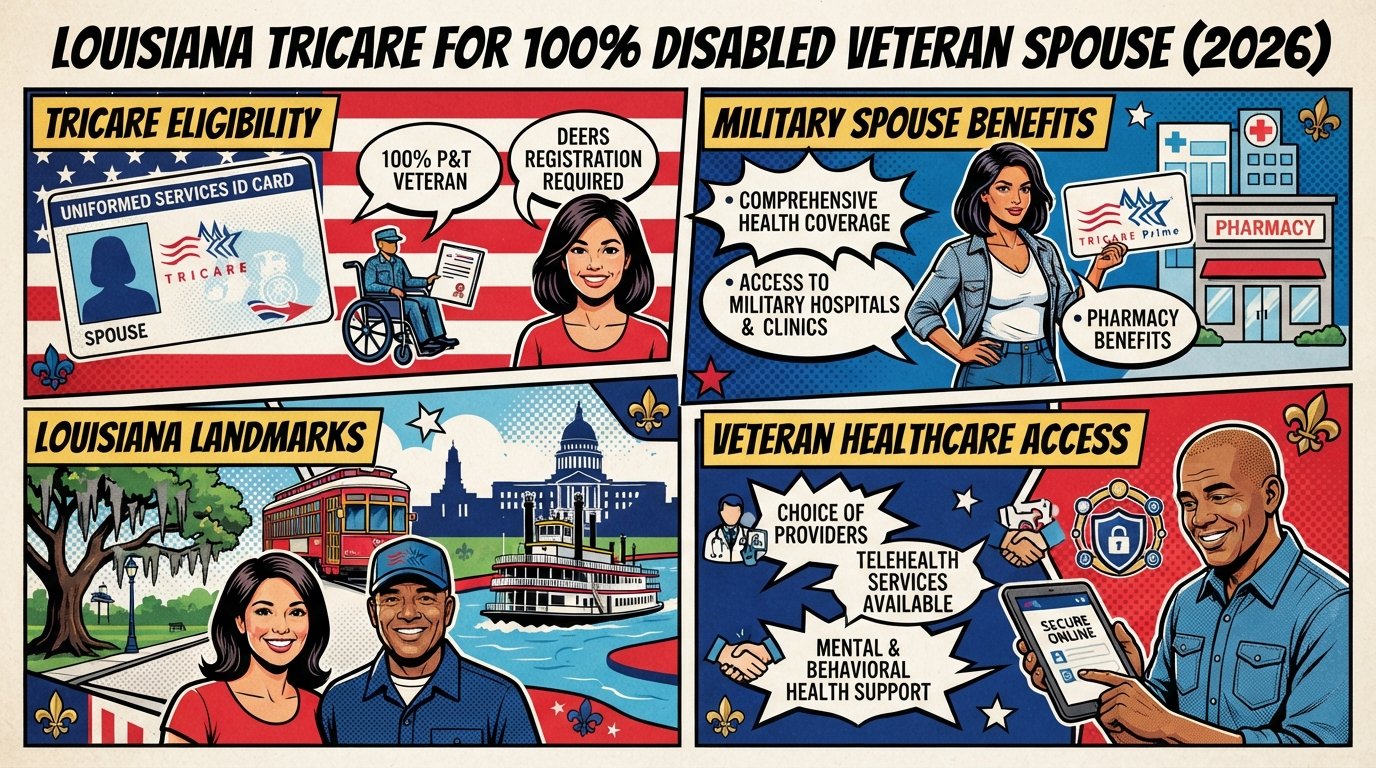
Louisiana TRICARE for a 100% Disabled Veteran’s Spouse: Eligibility, CHAMPVA, and 2026 Costs
A 100% VA disability rating does not make a spouse TRICARE-eligible in Louisiana. TRICARE eligibility depends on the veteran’s military retirement status, not the VA rating. If the veteran is rated 100% Permanent and Total (P&T) but is not a military retiree, the spouse may qualify for CHAMPVA instead—a separate VA program with no premiums, a $50–$100 annual deductible, and a 25% cost share.
Quick Facts
| Item | Details |
|---|---|
| Primary Question | Does a 100% disabled veteran’s spouse get TRICARE in Louisiana? |
| Direct Answer | Only if the veteran is also a military retiree (20+ years) or medically retired (TDRL/PDRL). A VA rating alone does not qualify the spouse. |
| The Usual Alternative | CHAMPVA, if the veteran is rated 100% Permanent and Total (P&T) and is not TRICARE-eligible. |
| CHAMPVA Premium | $0 |
| CHAMPVA Deductible (2026) | $50 per person / $100 per family per calendar year |
| CHAMPVA Cost Share (2026) | 25% of the allowable amount after the deductible, with a $3,000 annual catastrophic cap per family |
| Application Form | VA Form 10-10d |
| Processing Time | VA reports new applications processed in a matter of days as of late 2025. |
| Louisiana Assistance | LDVA representatives and parish Veterans Service Offices assist with CHAMPVA enrollment; VA medical centers in New Orleans and Shreveport serve as regional resources. |
| Official Agencies | Defense Health Agency (TRICARE); U.S. Department of Veterans Affairs (CHAMPVA); Louisiana Department of Veterans Affairs (LDVA) |
| Updated For | 2026 CHAMPVA cost-sharing rules; 2026 TRICARE pharmacy costs |
The Core Rule: TRICARE Follows Retirement Status, Not the VA Rating
TRICARE eligibility is determined by military retirement status, not by the VA disability rating. The VA rating and the military disability rating are separate numbers assigned by separate agencies for separate purposes. A veteran can hold a 100% VA rating and still be ineligible for TRICARE if they separated without a military retirement.

VA Disability Combined Rating Calculator
Add each disability rating from your decision letter.

Estimate only. The VA makes the official rating decision. Not legal or financial advice, and not affiliated with the Department of Veterans Affairs.
The Department of Defense guidance is explicit on this point: “100 percent Disabled American Veterans (DAVs) are eligible for health care under Department of Veterans Affairs’ Civilian Health and Medical Program and are not authorized for TRICARE” . The dependent of a 100% DAV who is not a military retiree has no TRICARE begin date . That is precisely the gap CHAMPVA was created to fill.
Two Ratings, Two Systems
| Rating Type | Who Assigns It | What It Determines |
|---|---|---|
| Military disability rating | Department of Defense (IDES) | Whether the service member is medically retired and TRICARE-eligible |
| VA disability rating | Department of Veterans Affairs | Monthly VA compensation and eligibility for VA benefits, including CHAMPVA |
A high VA rating does not create TRICARE eligibility. A veteran medically retired at 30% by the military is TRICARE-eligible, even if the VA later rates them higher or lower. A veteran separated at 100% VA but 0% military is not TRICARE-eligible.
When the Spouse Actually Gets TRICARE in Louisiana
The spouse of a 100% disabled veteran in Louisiana gets TRICARE only when the veteran also holds a TRICARE-qualifying status. The most common scenarios are below.
Scenario 1: The Veteran Is a 20-Year Retiree With a 100% VA Rating
The veteran retired after 20 or more years of active duty, so the spouse is a retired service member’s dependent and is TRICARE-eligible. The 100% VA rating is irrelevant to the TRICARE eligibility question—the retirement status is what matters. The spouse can enroll in TRICARE Prime or TRICARE Select through DEERS, and later TRICARE For Life at Medicare age.
Scenario 2: The Veteran Is Medically Retired (TDRL/PDRL)
Army Fitness Test (AFT) Score Calculator
Formerly the ACFT. Five events, 500 points. Enter your results.
Estimate for training only. Points are interpolated from the official Army tables (effective 1 June 2025) and can differ by a few points. Your score of record comes from your unit graders. Official score tables (PDF). Not affiliated with the U.S. Army.
A veteran medically retired through the Integrated Disability Evaluation System (IDES) at 30% or higher is placed on the Temporary Disability Retirement List (TDRL) or Permanent Disability Retirement List (PDRL) . The spouse is TRICARE-eligible as a dependent of a retired service member. The VA rating may be 100% or may be different; the military retirement is the trigger .
Scenario 3: The Veteran Is 100% P&T but Not a Military Retiree
This is the CHAMPVA case. The veteran separated without retirement, holds a 100% Permanent and Total VA rating, and the spouse is not TRICARE-eligible. The spouse should apply for CHAMPVA, not TRICARE.
Scenario 4: The Veteran Is 100% but Not “Permanent and Total”
A 100% schedular rating that is not designated P&T does not automatically qualify the spouse for CHAMPVA. The veteran must hold permanent and total status—meaning the rating is 100% disabling and not expected to improve—for the spouse to qualify . If the 100% rating is temporary or subject to a future review, CHAMPVA eligibility for the spouse may not be established.
Decision Tree: Which Program Applies in Louisiana?
| Question | If Yes | If No |
|---|---|---|
| Is the veteran a 20-year retiree or medically retired (TDRL/PDRL) ? | Spouse is TRICARE-eligible (Prime, Select, or TFL at Medicare age) | Continue to next question |
| Is the veteran rated 100% Permanent and Total (P&T) by VA? | Spouse may qualify for CHAMPVA | Spouse likely has no federal military health program through the veteran’s rating |
| Is the veteran TRICARE-eligible for any other reason? | CHAMPVA is not available; use TRICARE | CHAMPVA is the correct program if P&T is confirmed |
CHAMPVA: The Program Most Louisiana 100% P&T Spouses Use
CHAMPVA—the Civilian Health and Medical Program of the Department of Veterans Affairs—is a VA health benefits program for spouses, surviving spouses, and dependent children of veterans who meet specific service-connected disability or death criteria. It is not TRICARE, and it is not a VA healthcare enrollment for the veteran. The veteran does not receive care through CHAMPVA; the dependent does.
Who Qualifies for CHAMPVA
The spouse must meet both of these conditions:
The qualifying veteran relationship. At least one of the following must be true:
The veteran is rated permanently and totally disabled from a service-connected disability .
The veteran died from a service-connected disability.
The veteran was rated P&T at the time of death from a service-connected disability .
No TRICARE eligibility. The spouse cannot be eligible for or enrolled in TRICARE. VA states: “If you’re eligible for or enrolled in TRICARE, you can’t get CHAMPVA benefits” .
The Code of Federal Regulations confirms this two-part test: CHAMPVA is available to the spouse of a veteran adjudicated with a permanent and total service-connected disability, provided that they are not eligible under Title 10 for the TRICARE Program .
CHAMPVA and Remarriage Rules
Spouse of a living P&T veteran: CHAMPVA continues until divorce or annulment from the qualifying veteran .
Surviving spouse: Remarriage on or after age 55 allows the surviving spouse to keep CHAMPVA. Remarriage before age 55 ends CHAMPVA on the date of remarriage, but eligibility may be restored if the remarriage ends .
CHAMPVA Costs in 2026
CHAMPVA has no premiums. The beneficiary pays cost-sharing, not an enrollment fee.
| Cost Component | 2026 Amount |
|---|---|
| Annual outpatient deductible | $50 per beneficiary / $100 per family per calendar year |
| Cost share after deductible | 25% of the CHAMPVA allowable amount |
| Annual catastrophic cap | $3,000 per family per calendar year |
| Premium | $0 |
CHAMPVA pays 75% of the allowable amount after the deductible is met, and the beneficiary pays 25%, up to the $3,000 family cap. Once the cap is reached, CHAMPVA pays 100% of the allowable amount for covered services for the rest of the calendar year .
The deductible is waived for inpatient services, preventive services (cancer screenings, annual physicals, vaccinations), hospice services, and medications through the Meds by Mail program .
CHAMPVA and Medicare at Age 65
If the spouse is eligible for Medicare Part A for any reason, they must also have Medicare Part B to remain CHAMPVA-eligible. CHAMPVA does not pay the Medicare Part B premium. The spouse must enroll in and pay for Part B through the Social Security Administration to keep CHAMPVA as secondary coverage .
How Louisiana Residents Apply for CHAMPVA
Required Form
VA Form 10-10d, Application for CHAMPVA Benefits. The form requires the qualifying veteran’s VA rating decision showing 100% Permanent and Total status, the spouse’s identifying information, the marriage certificate, and other health insurance information if applicable.
Application Methods
Online: VA.gov’s CHAMPVA application portal.
By mail: Send the completed form and supporting documents to the address listed on the VA Form 10-10d instructions. VA’s CHAMPVA Eligibility office is in Spring City, PA .
By fax: The fax number is listed on the form instructions.
Louisiana-Specific Assistance
LDVA representatives assist with state Louisiana benefits and federal VA programs, including CHAMPVA enrollment . Every Louisiana parish has a Veterans Service Office staffed by a Veterans Assistance Counselor who can help review the application and ensure the documentation is complete before submission.
The Southeast Louisiana Veterans Health Care System in New Orleans and the Overton Brooks VA Medical Center in Shreveport are the primary VA medical facilities serving Louisiana veterans and can serve as regional resources for CHAMPVA-related questions .
Processing Time
As of late 2025, VA eliminated the CHAMPVA application backlog. New applications are now processed in a matter of days, compared with waits of over 150 days in prior years. VA receives about 4,000 new applications per week and reports the capacity to process them faster than they arrive.
Required Documents
Veteran’s VA rating decision showing 100% Permanent and Total status (or death certificate and service-connection documentation for survivors).
Marriage certificate.
Spouse’s Social Security number.
Other health insurance information (CHAMPVA is generally secondary payer to other coverage, except Medicaid).
Dependent children’s birth certificates and Social Security numbers, if applying for children.
TRICARE For Life: For TRICARE-Eligible Spouses Only
TRICARE For Life (TFL) is not an alternative to CHAMPVA. It is a Medicare-wraparound coverage for TRICARE-eligible beneficiaries who have both Medicare Part A and Medicare Part B. TFL only applies if the spouse is already in the TRICARE system through the veteran’s retirement status.
Who Gets TFL
Retired service members and their TRICARE-eligible family members with Medicare Part A and Part B.
Surviving spouses of retired service members, unless they remarry (unless the new spouse is a retired service member).
Spouses younger than 65 stay on TRICARE Prime or Select until they become entitled to Medicare Part A and Part B.
A spouse who is on CHAMPVA does not transition to TFL. CHAMPVA beneficiaries who reach Medicare age move into the CHAMPVA + Medicare coordination described above, not into TRICARE For Life.
2026 TRICARE Pharmacy Costs (For TRICARE-Eligible Louisiana Spouses)
If the Louisiana spouse is TRICARE-eligible through the veteran’s retirement, pharmacy costs depend on the plan and the drug tier. The 2026–2027 copayment structure is below.
| Pharmacy Setting | Generic | Formulary Brand | Non-Formulary |
|---|---|---|---|
| Military pharmacy | $0 | $0 | $0 |
| TRICARE Pharmacy Home Delivery (up to 90-day supply) | $14 | $44 | $85 |
| Retail network pharmacy (up to 30-day supply) | $16 | $48 | $85 |
CHAMPVA pharmacy benefits are separate. CHAMPVA uses the OptumRx pharmacy network and has its own cost-share structure tied to the $50/$100 deductible and 25% cost share described above. Louisiana providers who accept Medicare assignment can generally bill CHAMPVA, and practices near Barksdale Air Force Base and Fort Johnson regularly see CHAMPVA families .
How CHAMPVA Coordinates With Louisiana Medicaid
CHAMPVA and Louisiana Medicaid can work together, but the coordination rules matter. CHAMPVA remains primary even if the beneficiary also has Medicaid . CHAMPVA pays first, and Medicaid may then cover the CHAMPVA cost share or other remaining allowable costs.
This is different from the usual rule that other health insurance is primary to CHAMPVA. Medicaid is the exception. For a Louisiana spouse with limited income who qualifies for both CHAMPVA and Medicaid, the combined coverage can reduce out-of-pocket costs significantly.
Common Mistakes That Cost Louisiana Spouses Coverage
Assuming a 100% VA rating equals TRICARE. It does not. TRICARE runs on military retirement, not VA disability. A spouse who waits for a TRICARE card that will never arrive loses months of potential CHAMPVA coverage.
Confusing “100%” with “100% P&T.” CHAMPVA requires permanent and total status. A 100% rating that is temporary or subject to review does not automatically qualify the spouse.
Believing TRICARE and CHAMPVA can be combined. Eligibility for one disqualifies the person from the other. They do not stack and cannot be used together.
Skipping Medicare Part B. A CHAMPVA spouse who becomes Medicare-eligible must enroll in Part B to keep CHAMPVA. CHAMPVA does not pay the Part B premium. Failing to enroll in Part B can cause CHAMPVA eligibility to lapse.
Not applying for CHAMPVA because the veteran has VA healthcare. The veteran’s VA healthcare enrollment does not extend to the spouse. CHAMPVA is the dependent’s program and requires a separate application.
Remarrying before age 55 as a surviving spouse. A surviving spouse who remarries before 55 loses CHAMPVA on the date of remarriage. Waiting until 55 or later preserves eligibility.
Delaying the CHAMPVA application. Processing is now fast—days, not months—but coverage is not retroactive to the veteran’s rating date in every case. Apply as soon as the P&T rating is granted.
What If the Spouse Is Denied CHAMPVA?
CHAMPVA denials are usually correctable. The most common reasons are:
The veteran’s rating is not P&T. The denial letter will state this. The veteran may request a P&T designation from VA if the condition is permanent.
The spouse is TRICARE-eligible. In that case, CHAMPVA is not the correct program; the spouse should use TRICARE.
Missing documentation. A missing marriage certificate or rating decision can be corrected and the application resubmitted.
There is no VA-style appeals process for CHAMPVA eligibility the way there is for disability compensation. The path is to correct the record and reapply, or to request a written clarification from the VA office that processed the application. Louisiana LDVA representatives and parish Veterans Service Offices can help identify the specific deficiency.
Recent Rule Changes and the 2026 Landscape
CHAMPVA backlog eliminated (late 2025). VA reduced the CHAMPVA application backlog to zero and now processes new applications in days.
CHAMPVA cost-sharing unchanged for 2026. The $50/$100 deductible, 25% cost share, and $3,000 catastrophic cap remain in effect under 38 CFR 17.274 .
TRICARE pharmacy copayments updated for 2026–2027. Brand-name formulary drugs increased to $48** at retail and **$44 through home delivery; non-formulary remains $85.
No 2026 law expands TRICARE to 100% disabled non-retirees. The core eligibility rule—TRICARE follows retirement status, not VA rating—remains unchanged .
Common Questions
1. Does a 100% disabled veteran’s spouse get TRICARE in Louisiana?
Only if the veteran is also a military retiree (20+ years) or medically retired (TDRL/PDRL). A 100% VA rating alone does not make the spouse TRICARE-eligible. If the veteran is 100% Permanent and Total but not a military retiree, the spouse may qualify for CHAMPVA instead.
2. What is the difference between TRICARE and CHAMPVA for a 100% P&T spouse?
TRICARE is a Defense Department program tied to military retirement. CHAMPVA is a VA program for spouses of veterans rated 100% P&T who are not TRICARE-eligible. They never overlap: eligibility for one disqualifies the person from the other .
3. Can a spouse have both TRICARE and CHAMPVA?
No. TRICARE eligibility—not just enrollment—ends CHAMPVA eligibility. If the spouse becomes TRICARE-eligible, CHAMPVA coverage terminates on that date, whether or not the spouse has applied for TRICARE.
4. What does CHAMPVA cost in Louisiana in 2026?
CHAMPVA has no premium. The beneficiary pays a $50 per person / $100 per family annual deductible, then 25% of the allowable amount, with a $3,000 per family annual catastrophic cap .
5. Does CHAMPVA require Medicare Part B?
Yes, if the spouse is eligible for Medicare Part A for any reason. The spouse must have both Part A and Part B to remain CHAMPVA-eligible. CHAMPVA does not pay the Part B premium .
6. How long does CHAMPVA approval take in 2026?
VA reports new CHAMPVA applications are processed in a matter of days as of late 2025, after the backlog was eliminated. The agency receives about 4,000 applications per week and can process more than it receives.
7. Does CHAMPVA cover nursing home care for a spouse with dementia?
CHAMPVA covers medically necessary care, including hospital and physician services, but it does not generally pay for custodial long-term care in a nursing home. For dementia-related custodial care, Louisiana families typically combine CHAMPVA with VA Aid and Attendance, Medicaid, or private funds.
8. Can a surviving spouse keep CHAMPVA after remarriage in Louisiana?
A surviving spouse who remarries on or after age 55 can keep CHAMPVA. Remarriage before age 55 ends CHAMPVA on the date of remarriage. If the remarriage ends, eligibility may be restored .
9. Is TRICARE For Life available to a CHAMPVA spouse in Louisiana?
No. TRICARE For Life is a Medicare wraparound for TRICARE-eligible beneficiaries. A CHAMPVA spouse moves into CHAMPVA + Medicare coordination at age 65, not into TFL.
10. What form do I use to apply for CHAMPVA in Louisiana?
VA Form 10-10d, Application for CHAMPVA Benefits. It can be submitted online through VA.gov, by mail, or by fax. Louisiana LDVA representatives and parish Veterans Service Offices can help review the form and documentation before submission .
11. If the veteran is 100% P&T and also a 20-year retiree, does the spouse get TRICARE or CHAMPVA?
TRICARE. The retirement status controls. Because the veteran is TRICARE-eligible, the spouse is TRICARE-eligible, and CHAMPVA is not available. The spouse should enroll in TRICARE Prime or Select through DEERS.
Key Takeaways
A 100% VA rating does not equal TRICARE eligibility in Louisiana. TRICARE follows military retirement status, not the VA disability rating .
The spouse of a 100% P&T veteran who is not a military retiree usually qualifies for CHAMPVA, not TRICARE.
CHAMPVA has no premium, a $50/$100 annual deductible, a 25% cost share, and a $3,000 family catastrophic cap in 2026 .
TRICARE and CHAMPVA never stack. Eligibility for one disqualifies the person from the other .
CHAMPVA requires “permanent and total” status, not just a 100% schedular rating .
Medicare Part B is required to keep CHAMPVA once the spouse is Medicare-eligible; CHAMPVA does not pay the Part B premium .
CHAMPVA applications are now processed in days, after VA eliminated the backlog in late 2025.
TRICARE For Life is only for TRICARE-eligible spouses, not CHAMPVA beneficiaries.
A surviving spouse who remarries at 55 or older keeps CHAMPVA; remarriage before 55 ends it .
Louisiana LDVA representatives and parish Veterans Service Offices provide free help with CHAMPVA applications .
Official Resources
VA CHAMPVA Benefits: https://www.va.gov/family-and-caregiver-benefits/health-and-disability/champva/
VA Form 10-10d (CHAMPVA Application): https://www.va.gov/find-forms/about-form-10-10d/
TRICARE Eligibility: https://www.tricare.mil/Plans/Eligibility
TRICARE For Life: https://tricare.mil/tfl
TRICARE Pharmacy Costs: https://tricare.mil/Costs/Pharmacy
Medicare Part B Enrollment (SSA): https://www.ssa.gov/medicare/part-b
38 CFR 17.271 (CHAMPVA Eligibility): https://www.ecfr.gov/current/title-38/part-17/subpart-C/section-17.271
38 CFR 17.274 (CHAMPVA Cost Sharing): https://www.ecfr.gov/current/title-38/part-17/subpart-C/section-17.274
Louisiana Department of Veterans Affairs: https://vetaffairs.la.gov
🇺🇸 IMPORTANT DISCLAIMER – Veterans Benefits Information
This site provides general information about U.S. Department of Veterans Affairs (VA) benefits for educational and informational purposes only.
- Not Official: We are NOT affiliated with, endorsed by, or connected to the U.S. Department of Veterans Affairs (VA), the Veterans Benefits Administration (VBA), the Veterans Health Administration (VHA), or any other government agency.
- No Legal/Financial Advice: The content on this website is for informational purposes only and does not constitute legal, financial, or medical advice. VA benefits rules change frequently – always consult with an accredited Veterans Service Officer (VSO) or a qualified professional for your specific situation.
- Official Sources: For official, binding information and to apply for benefits, always visit official .gov websites: VA.gov, Benefits.VA.gov, or SSA.gov.
- No Data Collection: This site does not collect, store, or process any personal information. It does not have login forms, contact forms, or any system to capture user data. We never ask for your Social Security Number, bank details, or any personal information.
- 🚨 Scam Alert: The VA and other government agencies never charge fees for benefit applications. If anyone asks for money to "process" your VA claim, it is a scam. Report it to the VA Office of Inspector General at VA.gov/OIG.
- Advertising: This site uses third-party advertising (Adsterra) to cover operational costs. We do not endorse or guarantee any products or services advertised.
📌 Information provided as of June 2026. Always verify current eligibility and rules with official .gov sources.
This site is not affiliated with the U.S. Department of Veterans Affairs or any government agency. All information is for educational purposes only. Please visit VA.gov for official information.
