
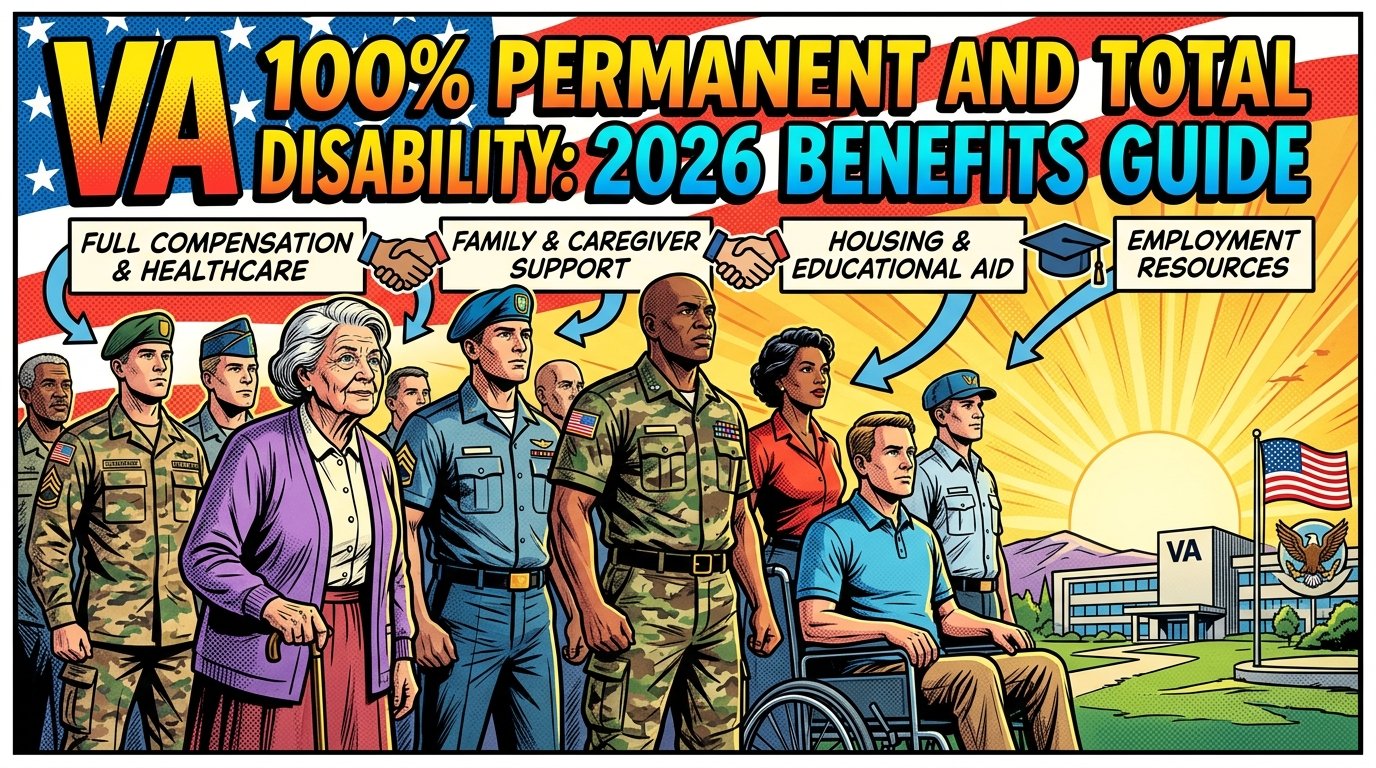
VA 100% Permanent and Total Disability Benefits
A VA 100% Permanent and Total (P&T) rating pays $3,938.58 per month for a single veteran in 2026 and unlocks benefits a standard 100% rating does not: CHAMPVA health coverage for dependents, Chapter 35 education benefits, protection from routine re-examinations, and state property tax exemptions. P&T is a separate determination that your total disability is not expected to improve.
| Item | Details |
|---|---|
| Benefit | 100% VA compensation plus dependent healthcare, education, and state benefits |
| Eligibility | 100% schedular rating or TDIU, plus medical evidence that conditions are permanent (not expected to improve) |
| Application | VA Form 21-526EZ (new/increased claim) or written request via Statement in Support of Claim (VA Form 21-10210) if already 100% |
| Processing Time | Varies; disability claims average 71.3 days VA-wide, but P&T determinations may take longer |
| Official Agency | U.S. Department of Veterans Affairs (VA) |
| Required Forms | VA Form 21-526EZ; VA Form 21-8940 (if TDIU); VA Form 10-10d (CHAMPVA); medical evidence |
| Updated For | 2026 |
What Is VA 100% Permanent and Total Disability?
VA 100% Permanent and Total (P&T) disability is a status assigned when a veteran’s service-connected disability is rated at 100% and VA determines the condition is not expected to improve. “Total” means the veteran meets the criteria for 100% disability—either through a schedular 100% combined rating or through Total Disability based on Individual Unemployability (TDIU). “Permanent” means VA does not expect the condition to materially improve, so no future re-examinations are scheduled.

P&T is not simply another word for 100% disabled. It is a specific legal determination under 38 CFR § 3.340 that carries additional benefits for the veteran and their family. A veteran with a 100% rating that is not P&T faces ongoing re-examinations and potential rating reductions. A veteran with P&T status is protected from routine re-exams, and their dependents gain access to CHAMPVA healthcare, Chapter 35 education benefits, and state-level benefits.

What it is: A VA designation that your total disability is permanent and not expected to improve.
Who qualifies: Veterans with a 100% schedular rating or TDIU whose medical evidence shows the condition is static or progressive.
Why it matters: P&T unlocks dependent healthcare (CHAMPVA), education benefits (Chapter 35), re-examination protection, and state benefits worth thousands annually.
What veterans should do next: Check your VA decision letter and benefit summary letter to confirm whether you are already P&T. If you are 100% but not P&T, gather medical evidence of permanence and request a P&T determination.
The Two Components of P&T: Total and Permanent
P&T has two independent components that must both be established. Understanding the difference helps veterans navigate the process.
The “Total” Component
A veteran’s disability must be “total”—meaning the disability rating is at the 100% level, or the veteran has been awarded TDIU. Total disability does not require a rating of exactly 100% through the schedular rating formula. A veteran with a combined schedular rating of 70% who is unemployable can achieve “total” disability through TDIU.
Once total disability is established through either pathway, the veteran can potentially qualify for the “permanent” designation.
The “Permanent” Component
Veterans May Qualify for Extra Benefits
Check available financial assistance, healthcare programs and other opportunities that may apply to you.
Check EligibilityA disability is “permanent” for VA purposes when it is not reasonably expected to improve with treatment. VA considers several factors in making this determination:
Nature of the condition: Some conditions are inherently permanent—loss of a limb, blindness, severe neurological damage, certain cancers. These are designated permanent as a matter of medical fact.
Treatment history: If a condition has not improved despite years of treatment, this supports a permanence finding. A veteran with 15 years of chronic back pain that has not responded to multiple treatments is a strong candidate.
Medical prognosis: A treating physician’s opinion that the condition is “unlikely to materially improve” is the most important evidence for permanence. The opinion should be specific and reference the veteran’s treatment history, lack of response to therapy, and natural progression of the condition.
Age and co-morbidities: VA considers the veteran’s age—an older veteran with a degenerative condition is more likely to receive a permanence determination because improvement becomes less likely over time.
Degenerative nature: Conditions classified as degenerative (degenerative disc disease, degenerative joint disease, progressive neurological conditions) by their medical nature do not improve—they progress. These are strong candidates for permanent designation.
What “permanent” does not mean: A “permanent” designation does not mean your condition can never change. It means that based on current medical evidence, improvement to the point that your total disability would no longer be justified is not expected. VA can still, in theory, reduce a permanently rated condition if it has clear and convincing evidence of sustained improvement—but this is rare and procedurally difficult.
P&T vs. 100% Schedular vs. TDIU: Key Distinctions
Veterans frequently confuse these three different but related concepts. The table below clarifies the distinctions.
| Concept | What It Means | How It’s Assigned | Who Qualifies |
|---|---|---|---|
| 100% Schedular | Combined rating reaches 100% through the mathematical rating formula | Automatic when combined rating reaches 100% | Veterans whose service-connected conditions combine to a 100% rating |
| TDIU | Paid at 100% rate because service-connected conditions prevent substantially gainful employment | Requires application and medical/employment evidence | Veterans with 60%+ single service-connected rating or 70%+ combined + unemployable |
| P&T | Total disability (schedular 100% or TDIU) is designated as permanent | VA determination based on medical evidence of no expected improvement | Veterans with total disability (any pathway) where condition is permanent |
Data source: P&T vs. 100% schedular vs. TDIU comparison.
The key insight: P&T is a designation that can apply to either schedular 100% or TDIU. A veteran rated 70% combined who has TDIU can have P&T TDIU—giving them all the P&T benefits—even though their schedular rating is only 70%. Conversely, a veteran with a 100% schedular rating may not have P&T status if VA has not made the permanence determination and if re-examinations are still scheduled.
Why the Distinction Matters in Practice
A veteran with 100% schedular but no P&T designation faces: (1) scheduled re-examinations that could result in a rating reduction; (2) no access to CHAMPVA for dependents; (3) ineligibility for many state property tax exemptions that require P&T; (4) no Chapter 35 education benefits for children. A veteran with P&T designation—even if only through TDIU—gets all of those protections and benefits. The difference can be worth thousands of dollars monthly in dependent healthcare savings and education benefits alone.
2026 VA 100% Disability Pay Rates
A 100% VA disability rating—whether schedular or TDIU—pays $3,938.58 per month for a single veteran with no dependents in 2026. This reflects a 2.8% cost-of-living adjustment effective December 1, 2025, with the first payment on December 31, 2025.
Veterans with dependents receive higher amounts. The table below shows the 2026 monthly rates for a 100% rating with various dependent statuses.
| Dependent Status | 2026 Monthly Rate |
|---|---|
| Veteran alone (no dependents) | $3,938.58 |
| Veteran with spouse | $4,158.17 |
| Veteran with spouse and one parent | $4,334.41 |
| Veteran with spouse and two parents | $4,510.65 |
| Veteran with one parent | $4,111.58 |
Data source: 2026 VA disability compensation rates for 100% rating with dependents.
Tax treatment: VA disability compensation, including 100% P&T, is tax-free at the federal level. It does not count as earned income for most purposes.
CHAMPVA: Healthcare for Dependents of P&T Veterans
CHAMPVA is the Civilian Health and Medical Program of the Department of Veterans Affairs. It provides comprehensive healthcare coverage to eligible dependents of P&T veterans at a fraction of private insurance costs.
Who Is Eligible for CHAMPVA
The veteran must be rated P&T (permanently and totally disabled).
The beneficiary (spouse or child) must not be eligible for TRICARE. This means the veteran is not a military retiree with access to military healthcare, and the dependent does not have their own military-based coverage.
Children are eligible up to age 18, or up to age 23 if enrolled full-time in an approved school.
Spouses who are not divorced from the P&T veteran are eligible.
Surviving spouses and children of veterans who died from a service-connected cause or who were P&T at time of death are also eligible.
What CHAMPVA Covers
CHAMPVA covers a wide range of healthcare services, including inpatient hospital care and outpatient visits, mental health services, prescription medications through the CHAMPVA Meds by Mail program, preventive care, durable medical equipment, maternity care, skilled nursing care, and limited vision and dental services.
CHAMPVA Cost-Sharing
After an annual deductible of $50 per beneficiary (maximum $100 per family), CHAMPVA pays 75% of allowable charges and the beneficiary pays 25%. There is an annual catastrophic cap of $3,000 out-of-pocket per family—after that, CHAMPVA pays 100%. For families with multiple dependents and significant healthcare needs, CHAMPVA can save thousands of dollars annually compared to private insurance.
How to Apply for CHAMPVA
Apply using VA Form 10-10d (Application for CHAMPVA Benefits) , submitted to the VA Health Eligibility Center. Processing typically takes 45–60 days. Include proof of the veteran’s P&T status (VA award letter showing P&T designation), the dependent’s identification, and documentation that the dependent is not TRICARE-eligible.
Chapter 35 DEA: Education Benefits for Dependents
The Survivors’ and Dependents’ Educational Assistance (DEA) Program—authorized under Chapter 35 of Title 38 USC—provides education and training benefits to eligible dependents of P&T veterans. This is a substantial benefit that many families of P&T veterans leave unclaimed because they don’t know it exists.
Who Is Eligible for Chapter 35 DEA
Children of P&T veterans, typically between ages 18 and 26 (the period may be extended in some circumstances).
Spouses of P&T veterans—spouses have an 8-year period during which they may use the benefit, with the period beginning on the date VA notifies the veteran of P&T status.
Dependents of veterans who died from service-connected conditions.
What Chapter 35 DEA Covers
DEA covers college or graduate programs at approved institutions, vocational or technical training programs, apprenticeship and on-the-job training programs, independent study programs, and correspondence courses. Eligible dependents can receive up to 45 months of educational assistance.
The monthly stipend for full-time institutional training is **$1,574.00 per month** for October 1, 2025, to September 30, 2026. Part-time enrollment is prorated: 3/4-time is $1,244.00 per month, and 1/2-time is $912.00 per month. Stipends go directly to the beneficiary to cover tuition, living expenses, books, and other educational costs.
Interaction with Other Education Benefits
Children of P&T veterans may use DEA Chapter 35 in place of or in coordination with other education benefits. If a P&T veteran has transferred any Post-9/11 GI Bill benefits to dependents, the dependent should compare the Chapter 33 transfer benefit (which can be worth substantially more at many institutions) versus Chapter 35 before enrolling. Dependents cannot use both simultaneously for the same enrollment period but may be eligible for both programs.
Re-Examination Protection Under P&T
P&T status protects veterans from routine re-examinations. VA will not schedule periodic re-examinations when the disability is established as static, or for veterans over age 55, unless there is specific indication of improvement. For P&T-rated conditions, routine re-examinations are explicitly prohibited.
This protection is one of the most practical benefits of P&T status. It eliminates the anxiety of periodic C&P exams and the risk of rating reduction from a single examination finding. Without P&T status, a 100% rating can still be scheduled for a future re-examination, and a future re-examination can result in a reduced rating if VA finds material improvement.
Important nuance: P&T protection is strong but not absolute. VA can still reduce a P&T rating in cases of fraud or clear error. Additionally, any rating in place for 20 years cannot be reduced below that level except for fraud.
Other Federal Benefits for 100% P&T Veterans
Beyond compensation, CHAMPVA, and Chapter 35, P&T veterans may qualify for additional federal benefits.
Commissary and Exchange Privileges
Veterans with a VA-documented service-connected disability rating have in-person commissary, exchange, and Morale, Welfare, and Recreation (MWR) privileges. P&T veterans can obtain a DoD USID card that provides unescorted access to stateside commissaries and military exchanges, including AAFES, NEX, MCX, and CGX locations. These privileges offer tax-free shopping and discounts.
VA Home Loan Funding Fee Exemption
Veterans receiving VA compensation for a service-connected disability—at any rating level, including 100% P&T—are exempt from the VA home loan funding fee. This exemption can save $4,300 to $10,000 on a typical purchase, depending on the loan amount and down payment.
Space-Available Military Air Travel
P&T veterans may be eligible for Space-Available (Space-A) military air travel, which allows eligible personnel to fill unused seats on military aircraft. Availability varies by route and mission.
Special Monthly Compensation (SMC)
P&T veterans with additional severe conditions—such as loss of limb, blindness, or the need for aid and attendance—may qualify for Special Monthly Compensation (SMC) rates well above the standard 100% pay rate. SMC is authorized under 38 USC § 1114 and provides additional compensation for specific severe disabilities.
State Benefits for 100% P&T Veterans
P&T status unlocks a substantial package of state-level benefits that vary by state but can be worth significantly more than federal compensation alone. Veterans should contact their state Department of Veterans Affairs or equivalent to understand all available benefits.
Property Tax Exemptions
Twenty-two states currently offer a full homestead property tax exemption for veterans rated 100% P&T—meaning a $0 property tax bill on the primary residence. Texas exempts the full appraised value of a qualifying veteran’s residence homestead from property taxation for 100% disabled or TDIU veterans. Virginia, Florida, Oklahoma, South Carolina, Michigan, Maryland, and New Mexico operate under similar full-exemption frameworks.
California’s basic exemption for 100% disabled veterans is $180,671 in 2026, with a low-income exemption of $271,009 for households earning under $81,131.
The median U.S. property tax bill is approximately $2,795 per year. A full exemption is real money, and none of it is automatic. Veterans must apply through their county assessor, not through the VA.
Vehicle Registration and License Plate Benefits
Most states waive vehicle registration fees for P&T veterans and offer disabled veteran license plates at no additional cost. Some states offer free registration for one or more vehicles annually.
In-State Tuition and Education Waivers
Many states waive in-state tuition (and sometimes fees) for children and spouses of P&T veterans at state colleges and universities. These benefits can be used independently of or in combination with Chapter 35 DEA benefits. Eligibility rules vary by state.
Hunting and Fishing Licenses
The majority of states offer free or discounted hunting and fishing licenses to veterans, particularly those with service-connected disabilities. P&T status often qualifies veterans for the most generous license categories.
How to Apply for P&T Status
Applying for P&T status depends on whether you are already rated at 100% or are seeking an initial or increased rating.
If You Are Not Yet Rated at 100%
File VA Form 21-526EZ (Application for Disability Compensation and Related Compensation Benefits) . In the section where you list the disabilities you are claiming, include a request for a Permanent and Total rating. You can file online at VA.gov, by mail, or with a Veterans Service Officer (VSO).
Gather medical evidence showing that your conditions are static or progressive—not improving. Long-standing diagnoses, treatment records showing no improvement despite years of care, and a treating physician’s opinion that the condition is unlikely to materially improve are the strongest evidence.
If You Are Already Rated at 100% but Not P&T
Submit a written request via a Statement in Support of Claim asking VA to designate the rating as permanent. Reference 38 CFR § 3.327 and explain why the conditions are not expected to improve. VA Form 21-10210 is the preferred form for lay or witness statements as of January 17, 2021.
You can also request a P&T review by submitting new evidence showing your condition won’t improve. A claim with a statement and medical evidence that the conditions are not expected to improve is how it is done. If your rating has been stable for years, that history is itself evidence.
If You Have TDIU
TDIU is total; if VA also finds it permanent, the same family benefits apply. If you have TDIU and your conditions are not expected to improve, request a P&T determination using the same methods described above.
Required Documents Checklist
| Document | Purpose |
|---|---|
| VA Form 21-526EZ | Initial or increased disability claim |
| VA Form 21-8940 | TDIU application (if applicable) |
| Statement in Support of Claim (VA Form 21-10210) | Written request for P&T designation |
| Medical records and treatment history | Evidence that conditions are static or progressive |
| Treating physician’s opinion | Most important evidence for permanence |
| Rating decision and code sheet | Confirms current disabilities and ratings |
How to Confirm Your P&T Status
Veterans can confirm P&T status through their VA decision letter or their VA.gov benefit summary letter.
Your decision letter: The “VA Benefit Information” section will state: “You are considered to be totally and permanently disabled due solely to your service-connected disabilities” if you are P&T. The letter may also include dependents’ education (Chapter 35) and CHAMPVA eligibility language if you are P&T.
Your VA.gov benefit summary letter: The benefit summary letter (the one used for property tax exemptions) shows a “permanent and total” line as Yes if you are P&T.
If your letter mentions a future examination date, you are 100% but not yet permanent.
Common Mistakes That Hurt P&T Claims
Assuming a 100% rating automatically means P&T. It does not. P&T is a separate determination that must be requested or established with medical evidence of permanence.
Not submitting medical evidence of permanence. A 100% rating alone is not enough. VA needs evidence that the condition is not expected to improve—treatment records, physician opinions, and a history of stable ratings.
Waiting until a re-examination is scheduled. If you are 100% but not P&T, request the designation proactively before VA schedules a routine re-examination.
Missing the TDIU pathway to P&T. Veterans with TDIU can be designated P&T even if their schedular rating is below 100%.
Not applying for CHAMPVA and Chapter 35. These benefits are not automatic. Dependents must apply separately using VA Form 10-10d for CHAMPVA and the appropriate DEA application for Chapter 35.
Overlooking state benefits. Property tax exemptions, tuition waivers, and vehicle benefits are not automatic. Veterans must apply through county and state agencies.
Common Questions
What is VA 100% Permanent and Total disability?
VA 100% P&T is a status assigned when a veteran’s service-connected disability is rated at 100% and VA determines the condition is not expected to improve. It pays $3,938.58 per month for a single veteran in 2026 and unlocks CHAMPVA, Chapter 35, re-examination protection, and state benefits.
How do I know if I am P&T?
Check your VA decision letter. The “VA Benefit Information” section will state that you are “considered to be totally and permanently disabled” if you are P&T. Your VA.gov benefit summary letter will also show a “permanent and total” line as Yes. If your letter mentions a future examination date, you are 100% but not P&T.
Does a 100% VA rating automatically mean P&T?
No. P&T is a separate determination. A veteran can be rated 100% and still face routine re-examinations if VA has not determined the condition is permanent. P&T requires medical evidence that the condition is not expected to improve.
Can TDIU be designated P&T?
Yes. TDIU is total; if VA also finds it permanent, the same family benefits apply. A veteran rated 70% combined who has TDIU can have P&T TDIU and receive all P&T benefits even though their schedular rating is only 70%.
How do I request P&T status if I am already 100%?
Submit a written request via a Statement in Support of Claim (VA Form 21-10210) asking VA to designate the rating as permanent. Reference 38 CFR § 3.327 and explain why the conditions are not expected to improve. Include medical evidence of permanence.
What is CHAMPVA?
CHAMPVA is the Civilian Health and Medical Program of the VA. It provides healthcare coverage to spouses and dependent children of P&T veterans who are not eligible for TRICARE. After a $50 per-person deductible ($100 family maximum), CHAMPVA pays 75% of allowable charges, with a $3,000 annual catastrophic cap.
What is Chapter 35 DEA?
Chapter 35 DEA (Survivors’ and Dependents’ Educational Assistance) provides up to 45 months of education benefits to spouses and children of P&T veterans. The full-time monthly stipend is $1,574.00 for October 1, 2025, to September 30, 2026.
Does P&T protect me from re-examinations?
Yes. P&T status protects veterans from routine re-examinations. VA will not schedule periodic re-examinations when the disability is established as static or for veterans over age 55, unless there is specific indication of improvement.
What state benefits does P&T unlock?
P&T status unlocks state property tax exemptions (22 states offer full homestead exemptions), vehicle registration and license plate benefits, in-state tuition waivers, and hunting and fishing license benefits. These vary by state and are not automatic—veterans must apply through county and state agencies.
Is 100% P&T compensation taxable?
No. VA disability compensation, including 100% P&T, is tax-free at the federal level.
Can I work if I have 100% P&T?
Yes. P&T status based on a schedular 100% rating does not restrict employment. However, if your P&T status is based on TDIU, you must remain unable to maintain substantially gainful employment, and work above the poverty threshold can jeopardize TDIU benefits.
Key Takeaways
VA 100% P&T pays $3,938.58 per month for a single veteran in 2026 and is tax-free.
P&T is a separate determination from a 100% rating. It means VA has found the disability is not expected to improve.
P&T can be based on either a 100% schedular rating or TDIU. A veteran with TDIU and a 70% schedular rating can still be P&T.
CHAMPVA provides healthcare to spouses and dependent children of P&T veterans who are not TRICARE-eligible. Apply with VA Form 10-10d.
Chapter 35 DEA provides up to 45 months of education benefits to dependents, with a full-time stipend of $1,574.00 per month for 2025–2026.
P&T status protects against routine re-examinations under 38 CFR § 3.327, reducing the risk of rating reduction.
P&T veterans are exempt from the VA home loan funding fee and gain commissary, exchange, and MWR privileges.
Twenty-two states offer full homestead property tax exemptions for 100% P&T veterans, but veterans must apply through county assessors.
To request P&T if already 100%: submit a Statement in Support of Claim (VA Form 21-10210) with medical evidence of permanence and reference 38 CFR § 3.327.
Confirm your status through your VA decision letter or your VA.gov benefit summary letter.
Official Resources
VA Disability Compensation: https://www.va.gov/disability/
VA Disability Compensation Rates: https://www.va.gov/disability/compensation-rates/veteran-rates/
VA Form 21-526EZ: https://www.va.gov/find-forms/about-form-21-526ez/
VA Form 21-8940 (TDIU): https://www.va.gov/find-forms/about-form-21-8940/
CHAMPVA: https://www.va.gov/health-care/family-caregiver-benefits/champva/
VA Form 10-10d (CHAMPVA Application): https://www.va.gov/find-forms/about-form-10-10d/
Chapter 35 DEA: https://www.va.gov/family-and-caregiver-benefits/education-and-careers/dependents-education-assistance/
VA Decision Reviews and Appeals: https://www.va.gov/decision-reviews/
38 CFR § 3.340 (Total and Permanent Total Ratings): https://www.ecfr.gov/current/title-38/chapter-I/part-3/subpart-A/section-3.340
38 CFR § 3.327 (Re-examinations): https://www.ecfr.gov/current/title-38/chapter-I/part-3/subpart-A/section-3.327
🇺🇸 IMPORTANT DISCLAIMER – Veterans Benefits Information
This site provides general information about U.S. Department of Veterans Affairs (VA) benefits for educational and informational purposes only.
- Not Official: We are NOT affiliated with, endorsed by, or connected to the U.S. Department of Veterans Affairs (VA), the Veterans Benefits Administration (VBA), the Veterans Health Administration (VHA), or any other government agency.
- No Legal/Financial Advice: The content on this website is for informational purposes only and does not constitute legal, financial, or medical advice. VA benefits rules change frequently – always consult with an accredited Veterans Service Officer (VSO) or a qualified professional for your specific situation.
- Official Sources: For official, binding information and to apply for benefits, always visit official .gov websites: VA.gov, Benefits.VA.gov, or SSA.gov.
- No Data Collection: This site does not collect, store, or process any personal information. It does not have login forms, contact forms, or any system to capture user data. We never ask for your Social Security Number, bank details, or any personal information.
- 🚨 Scam Alert: The VA and other government agencies never charge fees for benefit applications. If anyone asks for money to "process" your VA claim, it is a scam. Report it to the VA Office of Inspector General at VA.gov/OIG.
- Advertising: This site uses third-party advertising (Adsterra) to cover operational costs. We do not endorse or guarantee any products or services advertised.
📌 Information provided as of June 2026. Always verify current eligibility and rules with official .gov sources.
This site is not affiliated with the U.S. Department of Veterans Affairs or any government agency. All information is for educational purposes only. Please visit VA.gov for official information.
