
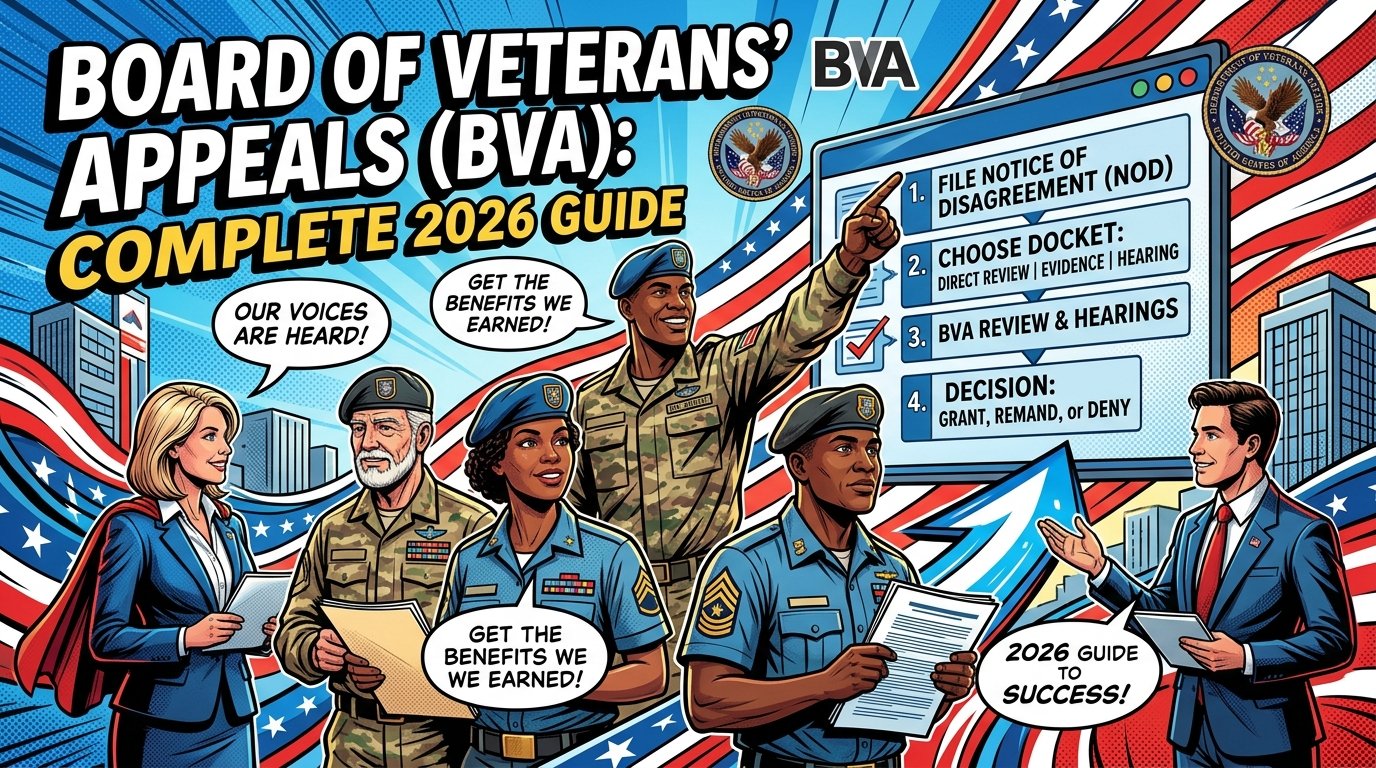
Board of Veterans’ Appeals (BVA)
The Board of Veterans’ Appeals (BVA) is the highest-level administrative review body within the U.S. Department of Veterans Affairs. If the VA Regional Office denied your claim, you can appeal directly to a Veterans Law Judge at the BVA using VA Form 10182, choosing between a Direct Review, Evidence Submission, or Hearing docket based on your case strategy.
| Item | Details |
|---|---|
| Benefit | Independent appellate review of VA benefit denials |
| Eligibility | Veterans, dependents, and survivors with a VA decision dated on or after Feb. 19, 2019 |
| Application | VA Form 10182 (Decision Review Request: Board Appeal) |
| Processing Time | Direct Review: ~12 months; Evidence: 18–24 months; Hearing: 36–48+ months |
| Official Agency | Board of Veterans’ Appeals, Department of Veterans Affairs |
| Required Forms | VA Form 10182 (Notice of Disagreement) |
| Updated For | 2026 |
What Is the Board of Veterans’ Appeals?
The BVA is an administrative tribunal within the VA that operates independently from the Regional Offices. Its primary job is to conduct a de novo review of your claim—meaning the Board gives your case a completely fresh look, and it is not bound by the Regional Office’s previous decision. Over 98% of the Board’s workload involves disability compensation appeals, though it also handles home loans, insurance, education, and survivor benefits.

The Board is composed of a Chairman, a Vice Chairman, and a corps of Veterans Law Judges (VLJs) who have the sole authority to issue final Board decisions. Support attorneys and administrative staff assist the judges in reviewing evidence and drafting decisions.
The Appeals Modernization Act (AMA): Three Lanes

Before February 19, 2019, the VA appeals system was a multi-year backlog. The Appeals Modernization Act (AMA) created three distinct “lanes” for veterans who disagree with a VA decision. Only one of these lanes goes to the BVA.
| Lane | Who It’s For | Where It’s Decided | Avg. 2026 Timeline |
|---|---|---|---|
| Supplemental Claim | You have new and relevant evidence | Regional Office | 4–5 months |
| Higher-Level Review | You believe a clear error was made; no new evidence | Regional Office (senior rater) | 4–5 months |
| Board Appeal (BVA) | You want a Veterans Law Judge to review your case | Board of Veterans’ Appeals | 12–48+ months (by docket) |
If you file a Supplemental Claim or Higher-Level Review and are still denied, you can then appeal to the BVA. The BVA is the only lane that gives you access to a judge, a hearing, and a final Board decision that is appealable to the federal court system.
The Three BVA Dockets: How to Choose
When you file VA Form 10182 to appeal to the Board, you must select one of three dockets. Your choice determines whether you can submit new evidence, whether you get a hearing, and how long you will wait.
Direct Review Docket
The Direct Review docket is the fastest BVA option. The Veterans Law Judge reviews only the evidence that was already in your claims file at the time of the Regional Office decision. You cannot submit new evidence, and there is no hearing. This is best for veterans whose record is already fully developed and who believe the Regional Office simply misapplied the law or ignored existing evidence.
Veterans May Qualify for Extra Benefits
Check available financial assistance, healthcare programs and other opportunities that may apply to you.
Check EligibilityAverage wait (FY 2025–2026): Approximately 506 days (about 17 months) from Notice of Disagreement to decision, though the Board’s target goal is 365 days.
Evidence Submission Docket
The Evidence Submission docket allows you to submit new and relevant evidence, but you do not have a hearing. You have a 90-day window after filing your Notice of Disagreement to submit additional medical records, nexus letters, buddy statements, or other evidence. The judge will consider both the original record and your new evidence.
Average wait: 18–24 months, with some data showing an average of 713 days in FY 2025.
Hearing Docket
The Hearing Docket is for veterans who want to present their case directly to a Veterans Law Judge. You can submit new evidence and testify under oath. The judge can ask you questions, and you (or your representative) can make legal arguments. Following the hearing, you have 90 days to submit any additional evidence.
Average wait: 36–48+ months, with some veterans waiting 791 days or longer for a hearing to be conducted.
Decision Tip: If you have strong new evidence but do not need to testify, the Evidence Submission docket gives you the benefit of new evidence without the multi-year wait of a hearing. If your case hinges on your personal testimony or the judge’s interpretation of an existing record, the Hearing docket may be worth the wait. If your record is complete and the error is legal, choose Direct Review.
BVA Hearing Types
If you choose the Hearing docket, you have several options for how the hearing is conducted. The Board must notify you at least 30 days before the scheduled hearing date. You can request a reschedule at least two weeks in advance with “good cause”.
| Hearing Type | Location | Notes |
|---|---|---|
| Virtual Tele-Hearing | Any location with internet/device capability | Fastest scheduling option |
| Videoconference | Local VA office | Judge appears via video link |
| In-Person (Regional Office) | Local VA Regional Office | Judge travels to your RO |
| In-Person (Central Office) | BVA Headquarters, Washington, D.C. | Requires travel to D.C. |
The virtual tele-hearing is generally the fastest option to get on the Board’s calendar.
How to Apply: VA Form 10182
To appeal to the BVA, you must file VA Form 10182, Decision Review Request: Board Appeal (Notice of Disagreement) . This form is required for all VA decisions dated on or after February 19, 2019. You can file it online through VA.gov or submit a paper copy by mail or fax.
The form asks you to:
Identify the specific issue(s) you are appealing.
Select your docket: Direct Review, Evidence Submission, or Hearing.
Indicate whether you want a hearing (if you chose the Hearing docket).
Provide or update your contact information and representation.
Mailing Address:
Board of Veterans’ Appeals
P.O. Box 27063
Washington, DC 20038
Fax: 1-844-678-8979
BVA Status Line: 1-800-923-8387
BVA Decision Types: Grant, Deny, or Remand
A Veterans Law Judge can issue one of three outcomes on each issue you appeal:
Grant: The judge finds in your favor, fully or partially. The Board overrules the Regional Office, and VA must implement the decision and pay any retroactive benefits.
Denial: The judge finds that the evidence does not support the claim. This is a final Board decision. You can appeal to the U.S. Court of Appeals for Veterans Claims (CAVC) within 120 days, or you can file a new Supplemental Claim with new evidence.
Remand: The judge determines that the case needs more development—for example, a new C&P exam, missing records, or a legal error that the Regional Office must correct. A remand is not a final decision. The case goes back to the Regional Office for further action, and you will eventually receive a new decision. Remands are common; roughly half of BVA appeals are remanded.
Important: If you receive a Remand, do not treat it as a win or a loss. It means the case is still open. Keep your address updated and respond promptly to any VA requests for information.
How to Appeal a BVA Decision to the CAVC
If the BVA denies your appeal, you have the right to appeal to the U.S. Court of Appeals for Veterans Claims (CAVC) , an independent federal court. The CAVC does not hold new trials or accept new evidence; it reviews the Board’s decision for legal errors.
Deadline: You have 120 days from the date the Board mailed its decision to file a Notice of Appeal (NOA) with the CAVC. Missing this deadline generally ends your right to court review.
Filing fee: $50, or you can file a Declaration of Financial Hardship to request a waiver.
Where to file (self-represented):
Clerk of the Court
United States Court of Appeals for Veterans Claims
625 Indiana Ave. NW, Suite 900
Washington, DC 20004-2950
Fax: (202) 501-5848
Email: self-rep@uscourts.cavc.gov
Represented appellants must file through the ACMS system.
Protecting Your Effective Date Through Appeals
Your effective date determines how far back VA pays retroactive benefits—often worth thousands of dollars. The one-year rule is critical: if you file your appeal (Supplemental Claim, Higher-Level Review, or BVA Notice of Disagreement) within one year of the VA decision you are challenging, and you ultimately prevail, your effective date is generally protected back to the original claim date.
If you are not ready to file a complete appeal but want to lock in an effective date, file VA Form 21-0966 (Intent to File) . This gives you one year to submit your complete claim while preserving the earlier date.
Common Mistakes to Avoid at the BVA
Choosing the wrong docket. Picking the Hearing docket when you have complete evidence and no need to testify can add years to your wait. Picking Direct Review when you have critical new evidence means the judge will never see it.
Missing the 90-day evidence window. In the Evidence Submission and Hearing dockets, you have a strict 90-day window to submit evidence. Evidence submitted late may not be considered.
Failing to protect the effective date. If you let more than one year pass from the denial before filing any appeal, you risk losing back pay to the original claim date.
Not requesting your C-file early. If you need your claims file (C-file) to build your appeal, request it promptly. A pending C-file request does not automatically delay the Board’s decision, and some deadlines continue to run.
Going unrepresented. Veterans represented by a VA-accredited attorney, claims agent, or VSO have substantially better outcomes at the BVA level.
Current BVA Processing Times and Backlog (2026)
The BVA has made progress in reducing its legacy backlog, but wait times remain significant and vary dramatically by docket.
| Appeal Path | Average 2026 Wait Time |
|---|---|
| Higher-Level Review (Regional Office) | 4–5 months |
| Supplemental Claim (Regional Office) | 4–5 months |
| BVA — Direct Review | ~12 months (FY25 average: ~506 days) |
| BVA — Evidence Submission | ~18–24 months (FY25 average: ~713 days) |
| BVA — Hearing | 36–48+ months (some waits 791+ days) |
| CAVC Appeal | 12–18 months |
Data compiled from VA appeals dashboards and published processing-time trackers for 2025–2026.
Legacy Appeals: What If Your Case Predates February 2019?
If your VA decision is dated before February 19, 2019, you are in the “legacy” appeals system. Legacy appeals use a different process (including VA Form 9 and the Statement of the Case). You may have the option to “opt in” to the AMA system by filing VA Form 10182, but this is a strategic decision that can affect your effective date and docket placement. Consult with an accredited representative before opting in.
Frequently Asked Questions
What is the Board of Veterans’ Appeals?
The BVA is the VA’s internal appellate tribunal. It reviews denied benefit claims de novo—with a fresh look—and can grant, deny, or remand the decision. It is independent of the Regional Offices and is the last administrative level before the federal court system.
How long does a BVA appeal take in 2026?
Wait times depend on your docket. Direct Review averages about 12 months; Evidence Submission averages 18–24 months; Hearing appeals commonly take 36–48 months or longer. The Board’s internal target for Direct Review is 365 days, but actual averages can exceed that.
Do I need a hearing at the BVA?
No. A hearing is optional. The Direct Review and Evidence Submission dockets do not involve a hearing. A hearing can help if you want to testify or present arguments directly to the judge, but it significantly increases the wait time.
What form do I file for a BVA appeal?
VA Form 10182, Decision Review Request: Board Appeal (Notice of Disagreement). You can file it online through VA.gov or mail/fax it to the Board.
Can I submit new evidence at the BVA?
Yes, but only in the Evidence Submission docket (within 90 days of filing your NOD) or the Hearing docket (within 90 days after the hearing). The Direct Review docket does not allow new evidence.
What happens if the BVA remands my case?
A remand sends your case back to the Regional Office for additional development—often a new C&P exam or records request. The case is not final. You will receive a new decision after the development is complete, and that decision can be appealed again if necessary.
How long do I have to appeal a BVA denial to the CAVC?
You have 120 days from the date the Board mailed its decision to file a Notice of Appeal with the U.S. Court of Appeals for Veterans Claims. This deadline is strict.
Can I switch BVA dockets after I file?
You may request to switch dockets within one year, but only if you have not already submitted evidence or held a hearing. The Board retains your original docket date for some purposes, but switching can affect timing. File a new Notice of Disagreement to request the change.
Does the BVA have a phone number I can call?
Yes. The BVA status line is 1-800-923-8387. The Board’s mailing address is P.O. Box 27063, Washington, DC 20038, and its fax number is 1-844-678-8979.
What is the difference between the BVA and the CAVC?
The BVA is an administrative board within the VA. The CAVC is an independent federal court. The BVA reviews the facts and the law of your claim; the CAVC reviews the BVA’s decision for legal errors and does not accept new evidence.
Can I get an earlier effective date through a BVA appeal?
Yes, if you file within one year of the original denial and prevail, your effective date is generally protected back to the original claim date. Effective-date disputes can also be appealed directly if the issue is the date itself rather than the denial of benefits.
Key Takeaways
The Board of Veterans’ Appeals (BVA) is the VA’s highest administrative review body, composed of Veterans Law Judges who review denied claims de novo.
To appeal to the BVA, file VA Form 10182 and choose one of three dockets: Direct Review (fastest, no new evidence), Evidence Submission (90-day evidence window, no hearing), or Hearing (testify before a judge, longest wait).
Processing times in 2026 range from roughly 12 months for Direct Review to 36–48+ months for Hearing appeals; Evidence Submission averages 18–24 months.
A BVA judge can grant, deny, or remand your appeal. A remand is not final and sends the case back to the Regional Office for more development.
If the BVA denies your appeal, you have 120 days to file a Notice of Appeal with the U.S. Court of Appeals for Veterans Claims (CAVC) .
Filing your appeal within one year of the original VA decision protects your effective date and retroactive back pay.
Representation matters: veterans with a VA-accredited attorney, claims agent, or VSO have substantially better outcomes at the BVA.
The BVA status line is 1-800-923-8387; the mailing address is P.O. Box 27063, Washington, DC 20038.
Official Resources
Board of Veterans’ Appeals (VA): https://www.bva.va.gov
VA Form 10182 (Decision Review Request: Board Appeal): https://www.va.gov/forms/10182/
VA Board Hearings Information: https://www.va.gov/decision-reviews/board-appeal/veterans-law-judge-hearing/
U.S. Court of Appeals for Veterans Claims (CAVC): https://www.uscourts.cavc.gov
VA Decision Reviews and Appeals: https://www.va.gov/decision-reviews/
VA Appeals Modernization Act (AMA) Overview: https://www.va.gov/decision-reviews/air-appeals-modernization/
🇺🇸 IMPORTANT DISCLAIMER – Veterans Benefits Information
This site provides general information about U.S. Department of Veterans Affairs (VA) benefits for educational and informational purposes only.
- Not Official: We are NOT affiliated with, endorsed by, or connected to the U.S. Department of Veterans Affairs (VA), the Veterans Benefits Administration (VBA), the Veterans Health Administration (VHA), or any other government agency.
- No Legal/Financial Advice: The content on this website is for informational purposes only and does not constitute legal, financial, or medical advice. VA benefits rules change frequently – always consult with an accredited Veterans Service Officer (VSO) or a qualified professional for your specific situation.
- Official Sources: For official, binding information and to apply for benefits, always visit official .gov websites: VA.gov, Benefits.VA.gov, or SSA.gov.
- No Data Collection: This site does not collect, store, or process any personal information. It does not have login forms, contact forms, or any system to capture user data. We never ask for your Social Security Number, bank details, or any personal information.
- 🚨 Scam Alert: The VA and other government agencies never charge fees for benefit applications. If anyone asks for money to "process" your VA claim, it is a scam. Report it to the VA Office of Inspector General at VA.gov/OIG.
- Advertising: This site uses third-party advertising (Adsterra) to cover operational costs. We do not endorse or guarantee any products or services advertised.
📌 Information provided as of June 2026. Always verify current eligibility and rules with official .gov sources.
This site is not affiliated with the U.S. Department of Veterans Affairs or any government agency. All information is for educational purposes only. Please visit VA.gov for official information.
