
VA Hospice Benefits: Complete Guide to Eligibility, Coverage, and How to Apply
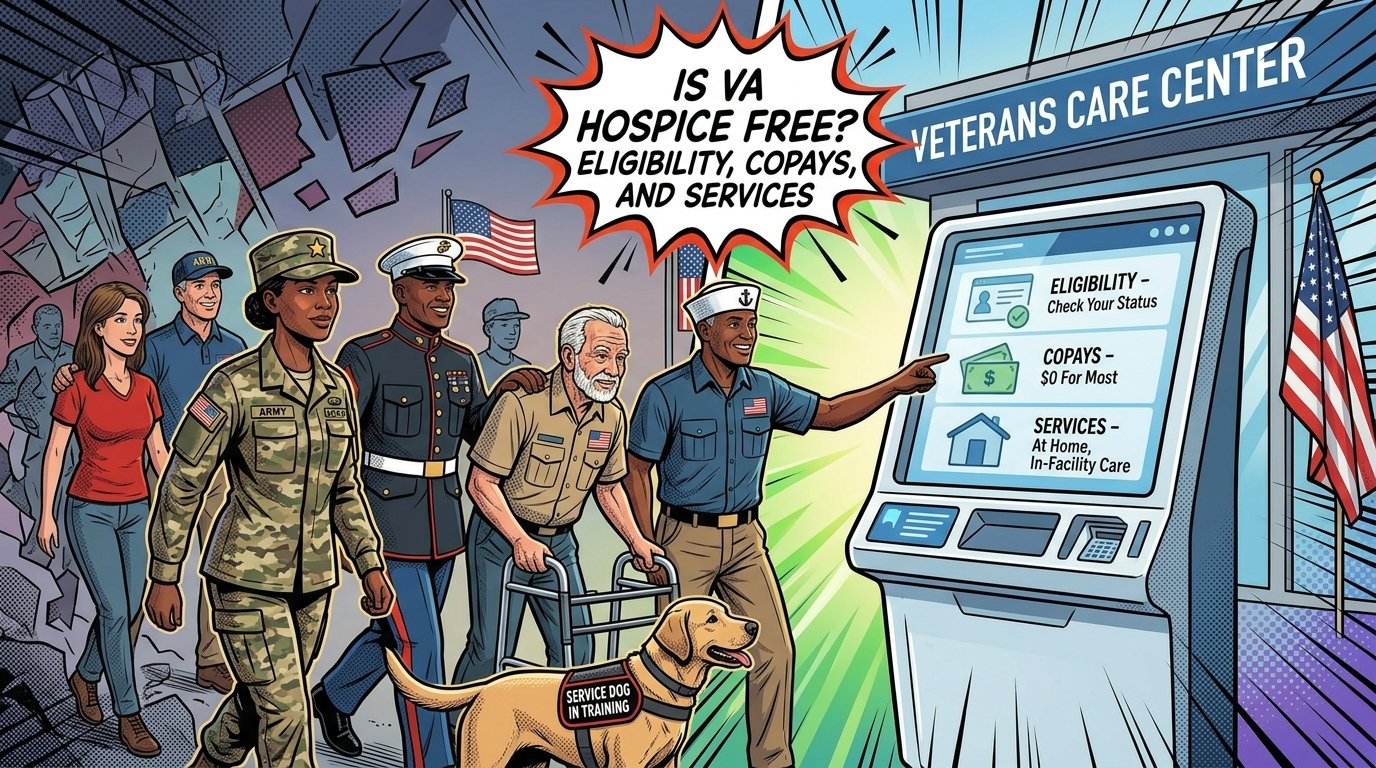
Featured Snippet Answer: VA hospice benefits provide free, comfort-focused care to enrolled veterans with a terminal illness and a life expectancy of six months or less. There are no copays. Care can be delivered at home or in an inpatient setting and includes nursing, pain management, respite for caregivers, and 13 months of bereavement support for families.
Quick Facts
| Item | Details |
|---|---|
| Benefit | Hospice care: comfort-focused medical, emotional, and spiritual support for terminally ill veterans and their families |
| Eligibility | Enrolled in VA health care and a VA physician determines a life expectancy of six months or less |
| Cost | No copays, whether care is provided by VA or a VA-contracted community hospice |
| Application | Referral from a VA primary care provider, specialist, or social worker |
| Where Care Is Provided | Home, nursing home, assisted living, inpatient hospice unit, or VA community living center |
| Services Included | Skilled nursing, pain and symptom management, social work, chaplaincy, medications, equipment, respite care, bereavement counseling |
| Official Agency | U.S. Department of Veterans Affairs (VA) |
| Key Distinction | Service connection is not required; hospice is part of the standard VA medical benefits package |
| Updated For | 2026 VA hospice policies, including expanded burial benefits through October 1, 2026 |
What Are VA Hospice Benefits?
VA hospice benefits are comfort-focused services for veterans with a terminal illness and a prognosis of six months or less. Hospice is part of the VA Standard Medical Benefits Package, authorized under 38 CFR § 17.38(a)(1)(xi)(A). It is designed to relieve suffering, control symptoms, and support both the veteran and their family during the final months of life.

Hospice is not a place. It is a philosophy of care that can be delivered wherever the veteran lives — at home, in a nursing home, in an assisted living facility, or in a VA inpatient unit. The goal is quality of life, not cure. That said, VA hospice is more flexible than Medicare hospice: veterans can continue some disease-directed treatments while receiving hospice care, depending on their goals and VA physician approval.
Hospice vs. Palliative Care: What Is the Difference?

Hospice and palliative care are related but not the same. Palliative care is specialized medical care for serious illness at any stage. It can be provided alongside curative treatment. Hospice is a type of palliative care specifically for people in the final months of life who have chosen comfort as the primary goal.
Key differences:
Palliative care does not require a terminal prognosis. It can begin at diagnosis and continue through treatment.
Hospice care requires a prognosis of six months or less if the illness runs its normal course.
Palliative care can be provided while pursuing curative treatment.
Hospice focuses on comfort and quality of life, though VA may allow some disease-modifying treatments.
VA provides both. Veterans do not need a Do Not Resuscitate (DNR) order to receive palliative care, and primary care continues during palliative care.
Who Qualifies for VA Hospice Benefits?
A veteran must meet two core requirements to qualify for VA hospice benefits: enrollment in VA health care and a clinical prognosis of six months or less. The terminal illness does not need to be service-connected.
The Two Core Eligibility Requirements
VA health care enrollment. The veteran must be enrolled in the VA health care system. Hospice is part of the standard medical benefits package available to enrolled veterans.
Clinical need. A VA physician must determine that the veteran has a life-limiting illness with a prognosis of six months or less if the disease runs its normal course. This mirrors the Medicare hospice prognosis requirement.
What “Six Months or Less” Actually Means
Veterans May Qualify for Extra Benefits
Check available financial assistance, healthcare programs and other opportunities that may apply to you.
Check EligibilityThe six-month prognosis is a clinical estimate, not a hard deadline. It is based on the physician’s judgment about the likely course of the illness. Veterans can remain on hospice beyond six months if their condition does not decline as expected. VA explicitly states that hospice care can last more than 180 days. The prognosis is recertified at set intervals, and eligibility continues as long as the clinical criteria are met.
Service Connection Is Not Required
A common misconception is that VA hospice requires a service-connected terminal illness. It does not. Hospice benefits are available to all enrolled veterans, regardless of whether the illness is connected to military service. A veteran with terminal cancer, end-stage heart disease, advanced COPD, or any other life-limiting condition can qualify based on enrollment and clinical need alone.
Enrollment and Priority Groups
VA health care enrollment is organized into priority groups. Veterans in higher priority groups (such as those with service-connected disabilities rated 50% or higher) are enrolled first. However, hospice is a covered benefit for all enrolled veterans who meet the clinical need. A veteran who is not currently enrolled but is terminally ill may still be able to enroll; the local VA eligibility office can assess the situation. In some cases, a veteran in a lower priority group may be considered under a higher priority category due to catastrophic disability.
Who Is Not Eligible
A veteran who is not enrolled in VA health care and does not qualify for enrollment may not be able to access VA hospice directly. However, they may still be eligible for hospice through Medicare or Medicaid. The VA recommends that veterans and families explore all payer options and choose the one that best fits the veteran’s needs and circumstances.
What Services Does VA Hospice Cover?
VA hospice covers a comprehensive set of services designed to address physical, emotional, spiritual, and practical needs. The exact services depend on the veteran’s plan of care, which is developed by an interdisciplinary team.
Covered Services
VA hospice benefits include:
Skilled nursing care, including registered nurse on-call availability.
Pain and symptom management, including medications related to the terminal illness.
Social work support, including help with advance directives, power of attorney, and burial benefits.
Chaplaincy and pastoral care, respecting the veteran’s personal, cultural, and religious beliefs.
Psychological counseling for the veteran and family.
Nutritional support and dietary counseling.
Physical, occupational, and speech therapy for symptom control and function.
Pharmacy services for medications related to the hospice diagnosis.
Durable medical equipment such as hospital beds, wheelchairs, oxygen, and walkers.
Medical supplies related to the terminal illness.
Respite care to give family caregivers short-term relief.
Bereavement support for the family, including counseling and grief support.
The VA fact sheet on palliative and hospice care specifies that VA-purchased community hospice care covers hospice diagnosis-related visits by interdisciplinary staff, medications, supplies, durable medical equipment, and ancillary services as outlined in the plan of care.
The Four Levels of Hospice Care
VA hospice follows the same four levels of care as the Medicare hospice benefit:
Routine home care: Scheduled visits by the hospice team wherever the veteran lives.
Continuous home care: Short-term crisis intervention, primarily by a hospice nurse, to stabilize the veteran at home.
Inpatient respite care: A short stay in a contracted facility to give the family caregiver a rest.
General inpatient care: Short-term inpatient care for symptom management that cannot be controlled in another setting.
What VA Hospice Does Not Cover
VA hospice covers services related to the terminal illness and the plan of care. It does not cover room and board in an assisted living facility or hospice house licensed as an assisted living facility. It also does not cover care unrelated to the terminal illness, though the veteran may continue to receive VA care for other conditions.
How to Apply for VA Hospice Benefits
VA hospice is accessed through a referral, not a standard application form. The process starts with the veteran’s VA care team.
Step-by-Step Referral Process
Talk to your VA primary care provider, specialist, or social worker. Ask for a hospice referral. The referral can be initiated by the veteran, a family member, or a caregiver, but a VA clinician must authorize it.
The care team contacts the patient transfer coordinator or hospice coordinator. The referral is routed to the appropriate VA hospice program or community hospice partner.
The referral is reviewed. VA aims to review complete referrals within 24 hours, though the process may take up to one business week if additional clinical information is needed.
A VA physician certifies the prognosis. The physician confirms that the veteran has a life-limiting illness with a prognosis of six months or less.
A plan of care is developed. The veteran, family, and interdisciplinary team meet to develop a plan that addresses medical, social, spiritual, and psychological needs.
Care begins. Services start in the setting the veteran chooses: home, nursing home, assisted living, or inpatient unit.
What Documents Are Needed?
The referral process does not require a specific VA form, but the following information is typically needed:
The veteran’s VA health care enrollment information.
Medical records documenting the terminal diagnosis and prognosis.
Identification and contact information for the veteran and family caregiver.
Advance directives, if the veteran has them.
Insurance information, including Medicare or Medicaid, to coordinate benefits.
What If the Veteran Is Not Enrolled in VA Care?
A veteran who is not enrolled but is terminally ill should contact the nearest VA medical center’s eligibility office. The VA can assess eligibility and, if the veteran qualifies, begin the enrollment process. In some cases, the veteran may be eligible for hospice through Medicare or Medicaid instead. VA states that veteran choice of payer applies even if the veteran is eligible for hospice under Medicare or Medicaid.
VA Hospice vs. Medicare Hospice: What Is the Difference?
VA hospice and Medicare hospice cover similar services, but they differ in important ways. Veterans who are eligible for both can choose which payer to use.
Comparison Table
| Feature | VA Hospice | Medicare Hospice |
|---|---|---|
| Who is eligible | Enrolled veterans with a VA-certified prognosis of six months or less | Medicare beneficiaries with a prognosis of six months or less certified by two physicians |
| Service connection required? | No | No |
| Copays | No copays for hospice care | May have small copays for respite care and medications |
| Disease-modifying treatment | VA may allow some treatments for the terminal illness in addition to hospice | Generally requires waiving curative treatment for the terminal illness |
| Where care is provided | Home, nursing home, assisted living, inpatient VA unit, or community hospice | Home, nursing home, inpatient hospice facility |
| Bereavement support | 13 months for family | 13 months for family |
| Choice of payer | Veteran can choose VA or Medicare | Veteran can choose Medicare or VA |
The Key Difference: Concurrent Care
The most significant difference is that VA, unlike Medicare, has allowed patients to continue some disease-directed therapies even after enrolling in hospice. This means a veteran on VA hospice may still receive palliative chemotherapy or radiation for symptom control, or other treatments that have the potential to extend life, if the VA physician approves. Medicare hospice generally requires the patient to waive curative treatment for the terminal illness.
Choosing Between VA and Medicare Hospice
Veterans who are eligible for both should discuss the choice with their VA care team and family. The decision depends on the veteran’s goals, the treatments they want to continue, and the setting where they want to receive care. A veteran can elect Medicare hospice and still receive VA care for conditions unrelated to the terminal illness.
Respite Care for Family Caregivers
VA hospice includes respite care to give family caregivers a break from the demands of caregiving. Respite care is a short-term stay in a contracted facility or in-home assistance that allows the caregiver to rest, attend to personal matters, or simply recharge.
How Respite Care Works Under VA Hospice
Respite care is one of the four levels of hospice care. It is typically provided for up to five days at a time, though the exact duration depends on the plan of care and the veteran’s needs. The VA’s standard respite benefit is ordinarily no more than 30 days per year, and a copay may apply for respite care separate from hospice. However, respite care provided as part of the hospice benefit is covered under the hospice plan of care, and the copay rules for hospice apply.
VA Caregiver Support Program
Family caregivers of veterans may also be eligible for the VA Caregiver Support Program, which offers a monthly stipend, training, counseling, and respite care for primary family caregivers of eligible veterans. The program is separate from hospice but can work alongside it. Caregivers should ask their VA social worker about eligibility and how to apply.
Bereavement Support After the Veteran’s Death
VA hospice provides bereavement support to the family for 13 months after the veteran’s death. This support is a mandated part of the hospice benefit and is provided at no out-of-pocket cost to the family.
What Bereavement Support Includes
Grief counseling for surviving family members.
Support groups and bereavement programs.
Spiritual and pastoral support, if desired.
Help with practical matters, such as burial benefits and survivor benefits.
VA’s bereavement counseling is available at no cost to the spouse, children, and family caregivers of deceased veterans and service members. The support can continue for up to 13 months, and in some cases, families may be connected with ongoing community resources.
Burial Benefits for Veterans Who Die Under VA Hospice Care
VA has temporarily expanded burial benefits for certain veterans who die while receiving VA-provided hospice care at home. The expansion, authorized by the Senator Elizabeth Dole 21st Century Veterans Healthcare and Benefits Improvement Act, applies to veterans who are discharged from VA-provided medical or nursing care to receive VA-provided hospice care at home and who pass away between July 1, 2025, and October 1, 2026.
What the Expanded Benefit Covers
Previously, veterans who died at home under VA hospice care after discharge from VA medical or nursing care were not always eligible for a full VA burial allowance. The Dole Act addresses that gap. Eligible veterans may qualify for the full VA burial allowance, which can help cover funeral and burial expenses.
What Families Should Do
Families and caregivers of veterans receiving hospice care at home should contact their local VA for information about eligibility and how to apply for burial benefits. The VA burial benefits website and the VA at 800-827-1000 are the primary resources. Congress has also considered legislation to make the expanded benefit permanent, but as of 2026, the expansion is temporary and set to expire on October 1, 2026, unless extended.
Other Burial Benefits
Regardless of the temporary expansion, veterans may be eligible for standard VA burial benefits, including:
Burial in a VA national cemetery at no cost to the family.
Government headstone or marker.
Burial flag.
Military funeral honors.
Families should apply for these benefits through the VA or a funeral director who works with the VA.
Common Mistakes to Avoid
Families navigating VA hospice often encounter avoidable delays or misunderstandings. These are the most common mistakes and how to avoid them.
Waiting too long to ask for a referral. Hospice is designed for the final six months of life. Families often delay the conversation because they fear it means giving up. Earlier referral can mean better symptom control and more support.
Assuming hospice requires a service-connected illness. It does not. Hospice is available to all enrolled veterans regardless of service connection.
Believing hospice means no treatment at all. VA hospice allows some disease-modifying treatments, unlike Medicare hospice. Veterans should ask what treatments can continue.
Not asking about respite care. Family caregivers often burn out because they do not know respite is available. Ask the hospice team about respite care early.
Failing to coordinate VA and Medicare benefits. Veterans eligible for both can choose the payer that best fits their needs. They should discuss the choice with their VA care team.
Not applying for burial benefits. Families may miss out on the expanded burial allowance if they do not ask. Contact the VA promptly after the veteran’s death.
Not documenting advance directives. A living will and health care power of attorney help ensure the veteran’s wishes are followed. VA social workers can help with these documents.
Common Questions
1. What are VA hospice benefits?
VA hospice benefits are comfort-focused medical, emotional, and spiritual services for enrolled veterans with a terminal illness and a prognosis of six months or less. They include nursing care, pain management, social work, chaplaincy, medications, equipment, respite care, and 13 months of bereavement support.
2. Who qualifies for VA hospice?
A veteran must be enrolled in VA health care and a VA physician must determine that the veteran has a life-limiting illness with a prognosis of six months or less. The illness does not need to be service-connected. Hospice is part of the standard VA medical benefits package.
3. Is VA hospice free?
Yes. There are no copays for hospice care, whether it is provided by VA or by a VA-contracted community hospice. The veteran’s medications related to the terminal illness, equipment, and supplies are also covered under the hospice plan of care.
4. Does VA hospice require a service-connected disability?
No. Hospice benefits are available to all enrolled veterans, regardless of whether the terminal illness is connected to military service. Service connection is not a factor in hospice eligibility.
5. How do I apply for VA hospice?
Talk to your VA primary care provider, specialist, or social worker and ask for a hospice referral. The care team will contact the hospice coordinator, review the referral, and arrange for a VA physician to certify the prognosis. There is no standalone application form for hospice.
6. Can I receive VA hospice at home?
Yes. VA hospice care can be provided at home, in a nursing home, in an assisted living facility, or in an inpatient VA unit. The veteran and family develop a plan of care with the hospice team that determines the setting.
7. How long can I receive VA hospice care?
VA hospice care can last more than 180 days. The six-month prognosis is a clinical estimate, not a hard limit. Eligibility continues as long as the veteran meets the clinical criteria, and the prognosis is recertified at set intervals.
8. What is the difference between VA hospice and Medicare hospice?
VA hospice does not require a copay, and it may allow some disease-modifying treatments for the terminal illness. Medicare hospice generally requires the patient to waive curative treatment for the terminal illness and may have small copays for respite care and medications. Veterans eligible for both can choose which payer to use.
9. Does VA hospice provide respite care for caregivers?
Yes. Respite care is one of the four levels of hospice care. It provides short-term relief for family caregivers, typically through a brief stay in a contracted facility or in-home assistance. The VA Caregiver Support Program may also provide respite and a monthly stipend for eligible caregivers.
10. What bereavement support is available after the veteran dies?
VA hospice provides bereavement support to the family for 13 months after the veteran’s death. This includes grief counseling, support groups, and help with practical matters. The support is provided at no cost to the family.
11. Are burial benefits available for veterans who die under VA hospice care at home?
VA has temporarily expanded burial benefits for veterans who are discharged from VA medical or nursing care to receive VA hospice care at home and who pass away between July 1, 2025, and October 1, 2026. Eligible veterans may qualify for the full VA burial allowance. Families should contact the VA for details.
12. What if the veteran is not enrolled in VA health care?
A veteran who is not enrolled but is terminally ill should contact the nearest VA medical center’s eligibility office to see if they qualify for enrollment. If VA enrollment is not possible, the veteran may be eligible for hospice through Medicare or Medicaid.
Key Takeaways
VA hospice benefits provide free, comfort-focused care to enrolled veterans with a terminal illness and a prognosis of six months or less.
There are no copays for VA hospice care, whether provided by VA or a VA-contracted community hospice.
Service connection is not required. Hospice is available to all enrolled veterans regardless of whether the terminal illness is connected to military service.
Care can be delivered at home, in a nursing home, in an assisted living facility, or in an inpatient VA unit. Hospice is not a place; it is a plan of care.
VA hospice may allow some disease-modifying treatments, unlike Medicare hospice, which generally requires waiving curative treatment for the terminal illness.
A referral from a VA care team is required. Veterans and families should ask their primary care provider, specialist, or social worker for a referral.
Respite care is available to give family caregivers short-term relief, and the VA Caregiver Support Program may offer additional support.
Bereavement support is provided for 13 months after the veteran’s death at no cost to the family.
Burial benefits have been temporarily expanded for veterans who die at home under VA hospice care between July 1, 2025, and October 1, 2026.
Veterans eligible for both VA and Medicare hospice can choose the payer that best fits their needs and goals.
Official Resources
VA Palliative and Hospice Care: va.gov/geriatrics
VA Hospice Care Fact Sheet: va.gov/GERIATRICS/docs/Hospice_Care.pdf
VA Caregiver Support Program: caregiver.va.gov
VA Burial Benefits: va.gov/burials-memorials
VA Health Care Enrollment: va.gov/health-care/how-to-apply
VA Geriatrics and Extended Care: va.gov/geriatrics
USA.gov — Veterans Benefits: usa.gov/veterans-benefits
Medicare Hospice Benefit: medicare.gov/coverage/hospice-care
🇺🇸 IMPORTANT DISCLAIMER – Veterans Benefits Information
This site provides general information about U.S. Department of Veterans Affairs (VA) benefits for educational and informational purposes only.
- Not Official: We are NOT affiliated with, endorsed by, or connected to the U.S. Department of Veterans Affairs (VA), the Veterans Benefits Administration (VBA), the Veterans Health Administration (VHA), or any other government agency.
- No Legal/Financial Advice: The content on this website is for informational purposes only and does not constitute legal, financial, or medical advice. VA benefits rules change frequently – always consult with an accredited Veterans Service Officer (VSO) or a qualified professional for your specific situation.
- Official Sources: For official, binding information and to apply for benefits, always visit official .gov websites: VA.gov, Benefits.VA.gov, or SSA.gov.
- No Data Collection: This site does not collect, store, or process any personal information. It does not have login forms, contact forms, or any system to capture user data. We never ask for your Social Security Number, bank details, or any personal information.
- 🚨 Scam Alert: The VA and other government agencies never charge fees for benefit applications. If anyone asks for money to "process" your VA claim, it is a scam. Report it to the VA Office of Inspector General at VA.gov/OIG.
- Advertising: This site uses third-party advertising (Adsterra) to cover operational costs. We do not endorse or guarantee any products or services advertised.
📌 Information provided as of June 2026. Always verify current eligibility and rules with official .gov sources.
This site is not affiliated with the U.S. Department of Veterans Affairs or any government agency. All information is for educational purposes only. Please visit VA.gov for official information.
