
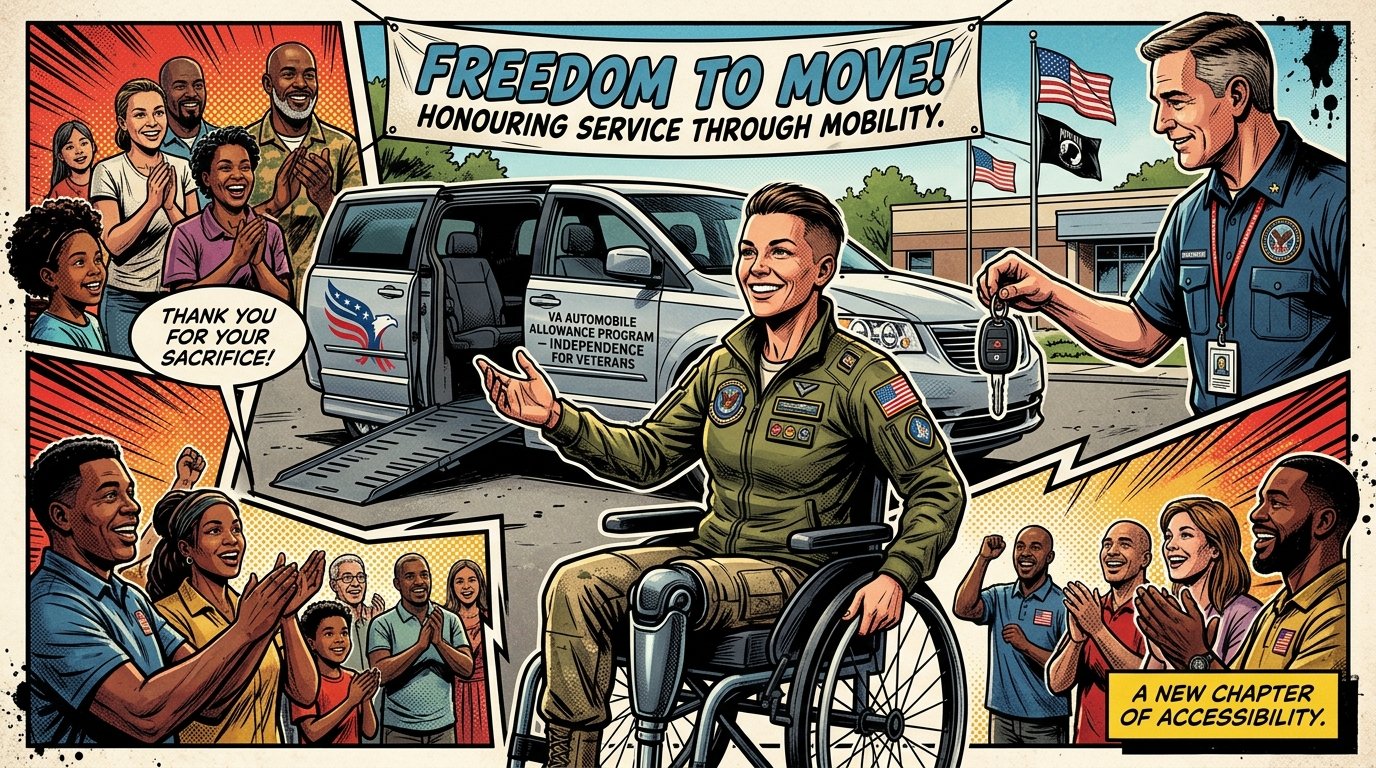
VA Vehicle Allowance Grant Increase: 2026 Rates, Eligibility, and How to Apply
The VA automobile allowance increased to up to $27,908.90 effective October 1, 2026. This one-time grant helps veterans with certain service-connected disabilities buy a specially equipped vehicle. The VA pays the vehicle seller directly—not the veteran. You must apply using VA Form 21-4502 and get approval before purchasing.
| Item | Details |
|---|---|
| Benefit | One-time payment toward a specially equipped vehicle |
| 2026 Amount | Up to $27,908.90 (effective Oct. 1, 2026) |
| 2025 Amount | Up to $27,074.99 (effective Oct. 1, 2025) |
| Eligibility | Service-connected loss of use of hands/feet, vision impairment, severe burns, ALS, or ankylosis (adaptive equipment only) |
| Application | VA Form 21-4502 (automobile allowance) |
| Adaptive Equipment | VA Form 10-1394 (separate grant, no dollar cap) |
| Processing Time | Typically 30–90 days for eligibility decision |
| Payment Goes To | The vehicle seller—not the veteran |
| Official Agency | U.S. Department of Veterans Affairs (VA) |
| Updated For | 2026 rate year (effective October 1, 2026) |
What Is the VA Automobile Allowance?
The VA automobile allowance is a one-time grant that helps eligible veterans and service members buy a vehicle modified for their service-connected disability. The VA calls it an “automobile allowance,” but it functions as a vehicle purchase grant. The payment is made directly to the seller of the vehicle, not to the veteran. The grant is authorized under 38 U.S.C. §§ 3901–3904 and is administered by the Veterans Benefits Administration (VBA).

The VA updated the automobile allowance rate to up to $27,908.90 effective October 1, 2026. This represents an increase of $834 from the 2025 rate of $27,074.99—a roughly 3.1% adjustment. The amount is a ceiling, not a flat payment. If a vehicle costs more than $27,908.90, the veteran covers the difference.

There are two distinct benefits under this program:
Automobile Allowance (VA Form 21-4502). A one-time payment toward the purchase price of a vehicle. The VA pays the seller directly after approval. This is the grant that increased to $27,908.90.
Adaptive Equipment Grant (VA Form 10-1394). A separate benefit that covers the full cost of medically necessary vehicle modifications—such as wheelchair lifts, hand controls, lowered floors, raised roofs, and tie-down systems. There is no dollar cap on adaptive equipment. This benefit can be used multiple times, including for repairs and replacements.
A veteran may qualify for both benefits. Qualifying for the automobile allowance does not automatically grant adaptive equipment, and vice versa. The two require separate applications and separate VA approvals.
How Much Is the VA Vehicle Allowance in 2026?
Veterans May Qualify for Extra Benefits
Check available financial assistance, healthcare programs and other opportunities that may apply to you.
Check EligibilityThe 2026 automobile allowance is up to $27,908.90. That figure took effect October 1, 2026, the start of the federal fiscal year. It replaced the previous rate of $27,074.99, which was effective October 1, 2025.
VA adjusts the automobile allowance annually based on inflation, using the same cost-of-living adjustment (COLA) methodology that applies to disability compensation and other veterans benefits. Here is how the rate has changed in recent years:
| Fiscal Year | Effective Date | Maximum Automobile Allowance |
|---|---|---|
| 2023 | October 1, 2022 | $24,115.00 |
| 2024 | October 1, 2023 | $25,602.00 |
| 2025 | October 1, 2024 | $26,417.20 |
| 2026 | October 1, 2025 | $27,074.99 |
| 2027 | October 1, 2026 | $27,908.90 |
The increase from the 2025 rate to the 2026 rate was $834, or approximately 3.1%. The increase from the 2024 rate to the 2025 rate was $657.79, or about 2.5%. These adjustments ensure the benefit keeps pace with vehicle costs and inflation.
Important distinction: The $27,908.90 figure covers the vehicle purchase only. Adaptive equipment—the modifications that make the vehicle drivable or accessible—is covered separately and is not subject to this cap.
Who Qualifies for the VA Vehicle Allowance?
You may qualify for the VA automobile allowance if you have a service-connected disability that includes at least one of the following conditions. The disability must be service-connected or treated as service-connected under 38 U.S.C. 1151, which covers disabilities resulting from VA medical care.
Eligibility conditions for the automobile allowance:
Loss or permanent loss of use of one or both feet. This includes amputation or paralysis that makes the foot unusable.
Loss or permanent loss of use of one or both hands. Same standard—amputation or paralysis.
Permanent decreased vision in both eyes. Specifically: 20/200 vision or less in the better eye with corrective lenses, OR greater than 20/200 vision but with a visual field defect that reduces peripheral vision to 20 degrees or less in the better eye.
Severe burn injury. The burn must be severe enough to impair the ability to operate a standard vehicle.
Amyotrophic lateral sclerosis (ALS). A diagnosis of ALS qualifies, regardless of progression stage.
Ankylosis exception. Veterans with ankylosis (permanent stiffness or fusion) in one or both knees or hips qualify for the adaptive equipment grant only—not the automobile purchase allowance. This distinction matters because a veteran with only ankylosis cannot use the $27,908.90 vehicle grant but can still receive adaptive modifications.
Active duty and Guard/Reserve eligibility. You can apply for and receive the automobile allowance before or after military discharge. Active-duty service members with qualifying conditions are eligible. National Guard and Reserve members may qualify if their condition is service-connected under VA rules.
Surviving spouses. The automobile allowance is not an accrued benefit payable to a surviving spouse. VA case law is clear: financial assistance for vehicle purchase does not constitute periodic monetary benefits that can be claimed by a survivor. However, surviving spouses may qualify for other VA benefits, including Dependency and Indemnity Compensation (DIC) and survivor pension.
What Changed Under the AUTO Act?
The AUTO Act (Advancing Uniform Transportation Opportunities for Veterans Act), signed into law in January 2023, changed the automobile allowance from a once-in-a-lifetime benefit to one that can be received every 10 years.
Before the AUTO Act: You could receive the automobile purchase grant only once in your lifetime. You could receive adaptive equipment grants multiple times, but the vehicle purchase allowance was a one-time benefit.
After the AUTO Act: The 10-year rule applies with a phase-in period:
Never used the grant: You can apply immediately and become eligible every 10 years thereafter.
Last received the grant 30 or more years ago: You can apply immediately. After receiving that grant, you become eligible again every 10 years.
Last received the grant less than 30 years ago: You must wait until 30 years have passed since your last grant. After that, the 10-year cycle applies.
The 30-year window exists because the pre-AUTO Act standard already allowed a second grant if 30 years had passed since the first. The new law preserves that pathway while adding the 10-year recurring eligibility for future grants.
Natural disaster exception. A second grant is also available if a natural disaster destroyed a vehicle purchased with VA automobile allowance, provided two conditions are met: the destruction was not the veteran’s fault, and property insurance did not already compensate for the loss.
Adaptive equipment under the AUTO Act. The law also allows VA to pay for certain vehicle modifications as medical services rather than only through the adaptive equipment program. These modifications include van lifts, raised doors, raised roofs, air conditioning, and wheelchair tie-downs for passenger use. This provides a second pathway for veterans to obtain necessary modifications through VA health care.
Automobile Allowance vs. Adaptive Equipment Grant: Key Differences
Veterans and families often confuse these two benefits. They are separate programs with separate applications, separate eligibility pathways, and separate payment rules.
| Feature | Automobile Allowance | Adaptive Equipment Grant |
|---|---|---|
| Purpose | Purchase of a vehicle | Modification of a vehicle |
| VA Form | VA Form 21-4502 | VA Form 10-1394 |
| Dollar Cap | Up to $27,908.90 (2026) | No cap—covers actual costs |
| Frequency | Every 10 years (AUTO Act) | Multiple times as needed |
| Payment Goes To | The vehicle seller | The equipment provider or veteran |
| Managed By | Veterans Benefits Administration (VBA) | Veterans Health Administration (VHA) |
| Qualifying Conditions | Loss of hands/feet, vision, burns, ALS | Same, plus ankylosis of knees/hips |
| Pre-Approval Required | Yes | Yes |
What adaptive equipment covers. The VA adaptive equipment program pays for power steering, power brakes, power window lifts, power seats, wheelchair lifts, ramps, lowered floors, raised doors, raised roofs, hand controls, tie-down systems, and special equipment to help you get into and out of the vehicle.
Processing path. The automobile allowance is processed through the VBA Regional Office. Adaptive equipment is processed through the Prosthetic Service at your VA Medical Center (VAMC). You must have an approved VA Form 21-4502 before you can receive adaptive equipment through the VHA pathway.
How to Apply for the VA Vehicle Allowance
Step 1: Confirm your eligibility. Review the qualifying conditions listed above. If you have a service-connected disability that includes loss of use of hands or feet, qualifying vision loss, severe burns, or ALS, you likely meet the criteria for the automobile allowance. If you have ankylosis of the knees or hips, you qualify for adaptive equipment only.
Step 2: Do not buy a vehicle first. VA requires pre-approval before purchase. If you buy a vehicle before receiving VA approval, you risk losing the benefit. The VA is explicit: you must file your claim and get approval before you buy.
Step 3: Complete VA Form 21-4502. This is the “Application for Automobile or Other Conveyance and Adaptive Equipment.” The form revision date is August 2024. You can download the PDF or apply online through VA.gov.
Step 4: Submit your application. You can apply online through VA.gov, or mail your completed form to your nearest VA Regional Office. If you apply online, VA will process your claim electronically.
Step 5: Wait for VA’s eligibility decision. VA reviews your application and confirms whether your service-connected disability meets the qualifying criteria. Processing typically takes 30–90 days, though some cases take longer if VA needs additional medical evidence.
Step 6: Receive your Certificate of Eligibility. If approved, VA issues a certificate confirming your eligibility and the maximum amount you can use toward a vehicle purchase.
Step 7: Find a vehicle and seller. The seller must agree to send the completed claim form and an itemized invoice to VA. The VA pays the seller directly. Make sure the seller understands this process before you commit to a purchase.
Step 8: Submit the invoice and claim documents. The seller submits the completed VA Form 21-4502, an itemized invoice, and any other required documents to VA. VA reviews the invoice and processes payment.
Step 9: VA pays the seller. Payment is made directly to the seller. The amount is capped at $27,908.90 (2026 rate) or the actual purchase price, whichever is less.
Step 10: Arrange adaptive equipment separately if needed. If your vehicle requires modifications, submit VA Form 10-1394 through your VAMC Prosthetic Service. Adaptive equipment is approved and paid separately from the vehicle purchase.
Required Documents and VA Forms
VA Form 21-4502. Application for Automobile or Other Conveyance and Adaptive Equipment. This is the primary application form for the automobile allowance. The form revision date is August 2024. You can download it as a PDF or complete it online.
VA Form 10-1394. Application for Adaptive Equipment—Motor Vehicle. This form is used for adaptive equipment grants. It is processed through the VHA Prosthetic Service, not the VBA Regional Office. The form revision date is June 2024.
Itemized invoice. The vehicle seller must provide an itemized invoice showing the purchase price, taxes, and any other charges. VA needs this to process payment.
Certificate of Eligibility. If VA approves your application, you receive a certificate confirming your eligibility and the maximum grant amount.
Supporting medical evidence. Depending on your case, VA may request additional medical records or a Compensation & Pension (C&P) examination to confirm your qualifying disability. If VA already has your service-connected disability rating on file, this may not be necessary.
Common Mistakes to Avoid
Buying a vehicle before VA approval. This is the most common and most costly mistake. VA will not reimburse a purchase made without pre-approval. Always wait for your Certificate of Eligibility before signing anything.
Confusing the automobile allowance with adaptive equipment. These are separate benefits with separate forms. Submitting VA Form 10-1394 when you need the vehicle purchase grant—or vice versa—will delay your claim.
Assuming the payment goes to you. The VA pays the seller directly. Veterans do not receive a check for $27,908.90 to spend as they choose. The payment is applied to the vehicle purchase price.
Missing the seller’s signature. Roughly one in four first-time applications are returned because of missing dealer signatures or incorrect VIN entries. Double-check every field before submitting.
Waiting too long to apply after a denial. If VA denies your claim, you have one year from the decision date to file a Supplemental Claim, Higher-Level Review, or Board Appeal. Missing that window can affect your effective date for benefits.
Assuming the grant covers the full vehicle cost. The $27,908.90 figure is a ceiling, not a guaranteed payment. If the vehicle costs more, you pay the difference.
Not checking state tax exemptions. Many states offer additional tax relief for disabled veterans who purchase vehicles with VA assistance. This varies by state and is separate from the federal benefit.
Processing Times and Payment
VA typically processes automobile allowance applications within 30–90 days of receiving a complete claim. Processing time depends on whether VA needs additional medical evidence, how complex your disability rating is, and the current workload at your Regional Office.
Some veterans report shorter timelines—as little as two to six weeks in straightforward cases. Others report longer waits if VA requests a C&P exam or if there are questions about the service connection of the qualifying disability.
Payment timing. Once VA approves the eligibility and receives the itemized invoice from the seller, payment is typically made within 10 days to two weeks, though some regional offices take longer. Recent legislation (the Speed Payments to Veteran Auto Sellers Act) requires VA to track and resolve invoices older than 90 days.
The seller’s role. The seller must submit the completed claim form and the itemized invoice. If the seller is unfamiliar with VA automobile allowance payments, you may need to walk them through the process. Some dealers who frequently work with disabled veterans are familiar with the requirements; others are not.
State Differences and Additional Benefits
The VA automobile allowance is a federal benefit, but states offer additional tax relief and fee waivers for disabled veterans who purchase vehicles. These vary widely.
Sales tax exemptions. A handful of states fully exempt qualifying 100% disabled veterans from vehicle sales or use tax on one vehicle. States with full exemptions include Virginia, Massachusetts, Oklahoma, Minnesota, and Tennessee.
Vehicle registration and license fees. Many states waive registration fees and license plate fees for disabled veterans. Texas, for example, offers free vehicle registration for disabled veterans and a free specialty license plate. Virginia offers a full personal property tax exemption on one vehicle for 100% permanently and totally disabled veterans.
Property tax exemptions. Some states exempt vehicles purchased with a VA grant from personal property tax. The exact rules depend on your state of residence and your disability rating.
State-level grant programs. Some state VA offices offer their own vehicle grants or assistance programs that supplement the federal automobile allowance. Check with your state Department of Veterans Affairs or state Veterans Service Office for programs specific to your state.
How to find your state’s benefits. Visit your state’s official veterans affairs website or contact a Veterans Service Officer (VSO) in your area. Organizations like Disabled American Veterans (DAV), the American Legion, and VFW can also help you identify state-level benefits.
Appeals Process
If VA denies your automobile allowance claim, you have three options for appealing the decision. Each has different rules and timelines.
Supplemental Claim (VA Form 20-0995). You can file a Supplemental Claim if you have new and relevant evidence that VA did not consider in its original decision. This might include additional medical records, a new C&P exam report, or a medical nexus opinion linking your disability to service. There is no time limit for filing a Supplemental Claim, but filing within one year of the decision preserves your original effective date.
Higher-Level Review (VA Form 20-0996). You can request a Higher-Level Review if you believe VA made an error in its decision based on the evidence already in your file. A more senior VA reviewer examines the same evidence and makes a new decision. You cannot submit new evidence with a Higher-Level Review. This option is best when you believe the original decision was factually or legally incorrect.
Board Appeal (VA Form 10182). You can appeal directly to the Board of Veterans’ Appeals. You have three docket options: a direct review (no new evidence, no hearing), an evidence submission (new evidence allowed), or a hearing (you testify before a Veterans Law Judge). You must file a Board Appeal within one year of the decision date.
Effective dates and back pay. The effective date for an approved automobile allowance is generally the date VA received your claim—if you filed within one year of becoming eligible. If you appeal and win, the effective date can go back to the original claim date, which may result in back pay. However, because the automobile allowance is a one-time payment to the seller, not a monthly benefit, back pay works differently than it does for disability compensation.
Common Questions
How much is the VA automobile allowance in 2026?
The 2026 automobile allowance is up to $27,908.90, effective October 1, 2026. This is an increase of $834 from the 2025 rate of $27,074.99. The amount is a ceiling, not a flat payment—VA pays the lesser of $27,908.90 or the actual vehicle purchase price.
Who qualifies for the VA vehicle allowance?
Veterans and service members with a service-connected disability that includes loss or permanent loss of use of one or both hands or feet, permanent decreased vision in both eyes, severe burn injury, or ALS. Ankylosis of the knees or hips qualifies for adaptive equipment only.
Is the VA vehicle allowance paid to me or to the seller?
VA pays the vehicle seller directly. Veterans do not receive the money. VA sends a one-time payment to the seller after approving the claim and receiving an itemized invoice.
Can I use the VA automobile allowance more than once?
Yes. Under the AUTO Act of 2023, eligible veterans can receive the automobile allowance every 10 years. Veterans who last received a grant 30 or more years ago can apply immediately. Those who received a grant less than 30 years ago must wait until the 30-year mark.
What is the difference between the automobile allowance and adaptive equipment?
The automobile allowance helps pay for the vehicle itself. Adaptive equipment covers modifications like wheelchair lifts, hand controls, and power seats. They are separate benefits with separate application forms—VA Form 21-4502 for the allowance and VA Form 10-1394 for adaptive equipment.
How long does it take to get approved?
VA typically processes automobile allowance applications within 30–90 days. Processing time can be longer if VA needs additional medical evidence or a C&P exam. Payment to the seller typically takes another 10 days to two weeks after approval and invoice submission.
Do I need to buy the vehicle before applying?
No. In fact, you must not buy the vehicle before receiving VA approval. VA requires pre-approval and issues a Certificate of Eligibility before you purchase. Buying first risks losing the benefit entirely.
Does the automobile allowance cover the full cost of a vehicle?
No. The $27,908.90 is a maximum. If the vehicle costs more, the veteran pays the difference. Adaptive equipment is covered separately and is not subject to this cap.
Can surviving spouses claim the VA automobile allowance?
No. The automobile allowance is not an accrued benefit payable to a surviving spouse. VA case law confirms that this benefit does not constitute a periodic monetary benefit that can be claimed by a survivor. Survivors may qualify for other benefits like DIC.
Do states offer additional vehicle benefits for disabled veterans?
Yes. Many states offer sales tax exemptions, registration fee waivers, and property tax exemptions for disabled veterans. Virginia, Massachusetts, Oklahoma, Minnesota, and Tennessee fully exempt qualifying 100% disabled veterans from vehicle sales tax. Check with your state VA office for specific programs.
Key Takeaways
The VA automobile allowance increased to up to $27,908.90 effective October 1, 2026, up from $27,074.99 in 2025.
The grant helps veterans with service-connected loss of use of hands or feet, severe vision impairment, severe burns, or ALS buy a specially equipped vehicle.
VA pays the vehicle seller directly—veterans do not receive the money.
The AUTO Act of 2023 allows eligible veterans to receive the automobile allowance every 10 years instead of once in a lifetime.
VA Form 21-4502 is the application for the automobile allowance; VA Form 10-1394 is for adaptive equipment.
You must receive VA approval before purchasing a vehicle. Buying first can disqualify you from the benefit.
Processing typically takes 30–90 days for eligibility, plus additional time for payment to the seller.
Adaptive equipment is a separate benefit with no dollar cap and can be used multiple times.
Many states offer additional tax exemptions and fee waivers for disabled veterans who purchase vehicles.
If denied, you can appeal through a Supplemental Claim, Higher-Level Review, or Board Appeal.
Official Resources
VA Automobile Allowance and Adaptive Equipment: va.gov/disability/eligibility/special-claims/automobile-allowance-adaptive-equipment
VA Form 21-4502 (Application for Automobile Allowance): va.gov/forms/21-4502
VA Form 10-1394 (Adaptive Equipment Application): va.gov/forms/10-1394
Current Special Benefit Allowance Rates: va.gov/disability/compensation-rates/special-benefit-allowance-rates
38 U.S.C. §§ 3901–3904 (Authorizing Statute): uscode.house.gov
VA Decision Review Options: va.gov/decision-reviews
USA.gov Veterans Benefits Portal: usa.gov/veterans-benefits
🇺🇸 IMPORTANT DISCLAIMER – Veterans Benefits Information
This site provides general information about U.S. Department of Veterans Affairs (VA) benefits for educational and informational purposes only.
- Not Official: We are NOT affiliated with, endorsed by, or connected to the U.S. Department of Veterans Affairs (VA), the Veterans Benefits Administration (VBA), the Veterans Health Administration (VHA), or any other government agency.
- No Legal/Financial Advice: The content on this website is for informational purposes only and does not constitute legal, financial, or medical advice. VA benefits rules change frequently – always consult with an accredited Veterans Service Officer (VSO) or a qualified professional for your specific situation.
- Official Sources: For official, binding information and to apply for benefits, always visit official .gov websites: VA.gov, Benefits.VA.gov, or SSA.gov.
- No Data Collection: This site does not collect, store, or process any personal information. It does not have login forms, contact forms, or any system to capture user data. We never ask for your Social Security Number, bank details, or any personal information.
- 🚨 Scam Alert: The VA and other government agencies never charge fees for benefit applications. If anyone asks for money to "process" your VA claim, it is a scam. Report it to the VA Office of Inspector General at VA.gov/OIG.
- Advertising: This site uses third-party advertising (Adsterra) to cover operational costs. We do not endorse or guarantee any products or services advertised.
📌 Information provided as of June 2026. Always verify current eligibility and rules with official .gov sources.
This site is not affiliated with the U.S. Department of Veterans Affairs or any government agency. All information is for educational purposes only. Please visit VA.gov for official information.
