
Texas 100% Disabled Veteran Property Tax Exemption: What You Need to Know
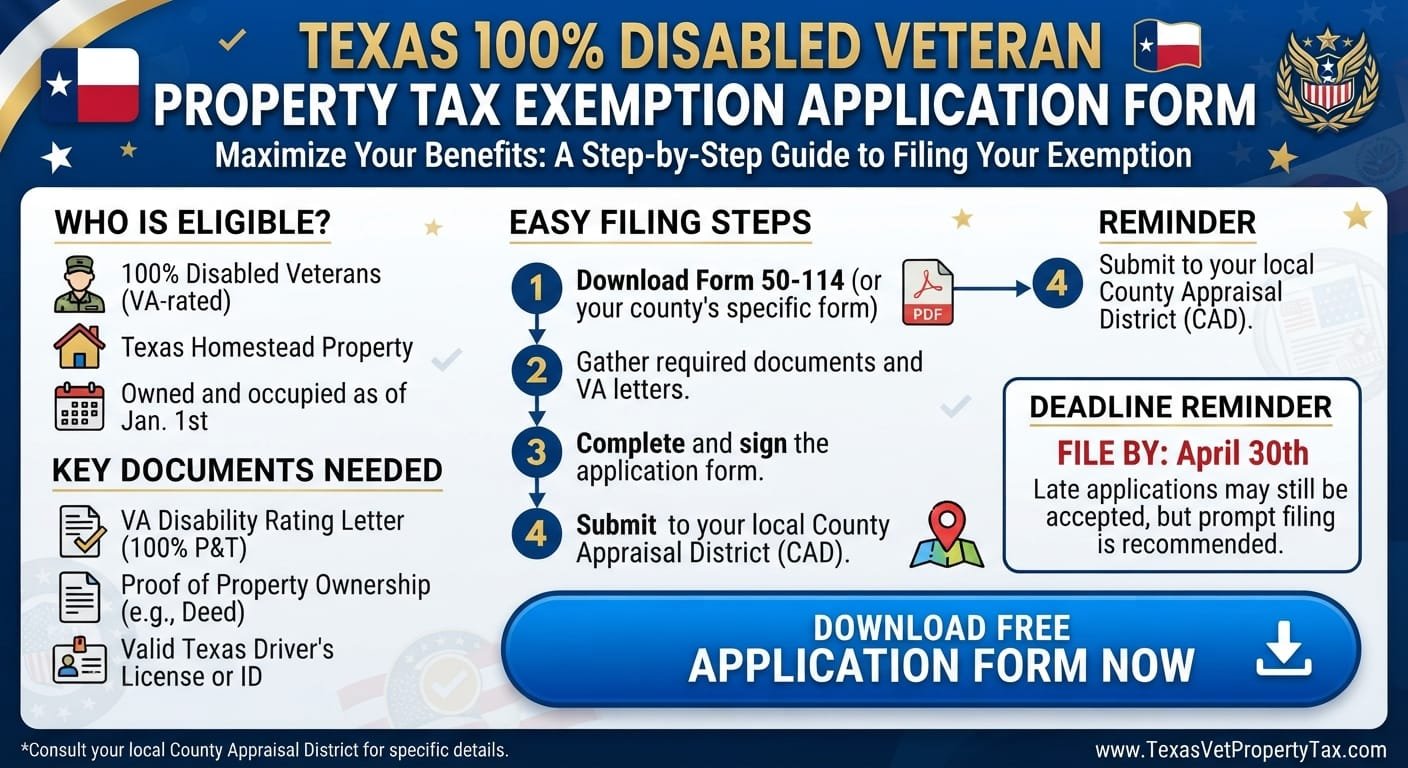
Texas offers a complete property tax exemption on the primary residence for veterans rated 100% disabled by the VA due to a service-connected disability or individual unemployability. This exemption eliminates all property taxes on the homestead. Surviving spouses who have not remarried may also qualify for the same benefit on the same property.
Quick Facts
| Item | Details |
|---|---|
| Benefit | Full property tax exemption on primary residence |
| Eligibility | Veterans with 100% VA disability rating or Individual Unemployability (TDIU) |
| Application | Form 50-114 to county appraisal district |
| Processing Time | Varies by county; typically 30-90 days |
| Official Agency | Texas Comptroller of Public Accounts / County Appraisal Districts |
| Required Forms | Form 50-114 (Residence Homestead Exemption Application) |
| Updated For | 2026 Tax Year |
What Is the Texas 100% Disabled Veteran Property Tax Exemption?
The Texas 100% disabled veteran property tax exemption is a complete elimination of property taxes on a qualifying veteran’s primary residence. Under Texas Tax Code Section 11.131, veterans who have been awarded 100% disability compensation by the U.S. Department of Veterans Affairs due to a service-connected disability—or who have been rated as individually unemployable—qualify for an exemption of the total appraised value of their homestead.

VA Disability Combined Rating Calculator
Add each disability rating from your decision letter.

Estimate only. The VA makes the official rating decision. Not legal or financial advice, and not affiliated with the Department of Veterans Affairs.
This is not a partial exemption or a tax reduction. It is a full exemption. Qualifying veterans pay zero property taxes on their primary residence, regardless of the home’s value.
Why this matters: Texas has no state income tax, which means property taxes represent a significant portion of annual expenses for homeowners. For a disabled veteran living on a fixed income, eliminating property taxes can free up thousands of dollars each year.
What veterans should do next: If you believe you qualify, contact your county appraisal district to request Form 50-114 or download it from the Texas Comptroller’s website.
Who Qualifies for the 100% Disabled Veteran Exemption?
To qualify for the full Texas property tax exemption, a veteran must meet all of the following requirements:
VA Disability Rating: Be awarded 100% disability compensation by the U.S. Department of Veterans Affairs due to a service-connected disability, OR have a determination of Individual Unemployability (TDIU) from the VA.
Property Ownership: Own the property for which the exemption is claimed.
Primary Residence: The property must be the veteran’s residence homestead—meaning it is their principal residence and they occupy it as of January 1 of the tax year.
Texas Property: The property must be located in Texas.
Army Fitness Test (AFT) Score Calculator
Formerly the ACFT. Five events, 500 points. Enter your results.
Estimate for training only. Points are interpolated from the official Army tables (effective 1 June 2025) and can differ by a few points. Your score of record comes from your unit graders. Official score tables (PDF). Not affiliated with the U.S. Army.
Important distinction: You do not need both a 100% disability rating AND unemployability status. A veteran qualifies if they have either a 100% service-connected disability rating OR a VA determination of individual unemployability.
Who Does Not Qualify
Veterans with disability ratings below 100% (though they may qualify for partial exemptions under Tax Code Section 11.22)
Veterans who do not own their primary residence
Veterans whose property is not used as their primary homestead
Non-veterans (unless they qualify as a surviving spouse)
Understanding VA Disability Ratings and Individual Unemployability
What Is a 100% VA Disability Rating?
A 100% VA disability rating means the Department of Veterans Affairs has determined that your service-connected disability is total in nature. This rating is based on the severity of your condition and its impact on your ability to work and function.
The VA uses a schedule of ratings for different conditions. When a veteran’s combined rating reaches 100%, they receive compensation at the 100% rate.
What Is Individual Unemployability (TDIU)?
Individual Unemployability—also called Total Disability based on Individual Unemployability (TDIU)—is a VA determination that a veteran cannot maintain substantially gainful employment due to their service-connected disabilities, even if their combined disability rating is less than 100%.
Key point: A veteran with TDIU qualifies for the Texas 100% disabled veteran property tax exemption even if their schedular rating is below 100%.
What Documents Prove Eligibility?
To apply for the exemption, you will need a current letter from the Department of Veterans Affairs confirming your entitlement to 100% disability compensation due to a service-connected disability or individual unemployability.
This letter should clearly state:
Your name
Your disability rating or unemployability determination
That the disability is service-connected
The effective date of your rating
Texas Property Tax Exemption for Disabled Veterans: 100% vs. Partial
Texas offers different property tax exemptions depending on a veteran’s disability rating. Here is how they compare:
| Disability Rating | Exemption Amount | Applies To |
|---|---|---|
| 10% – 29% | $5,000 | Any property owned |
| 30% – 49% | $7,500 | Any property owned |
| 50% – 69% | $10,000 | Any property owned |
| 70% – 99% | $12,000 | Any property owned |
| 100% or TDIU | Full exemption | Residence homestead only |
Important: The 100% exemption applies only to a residence homestead. Veterans with ratings below 100% can apply their exemption to any property they own, but the 100% exemption is limited to the primary residence.
Can You Stack Exemptions?
Veterans with 100% disability ratings may also qualify for other homestead exemptions, including:
General homestead exemption
Over-65 exemption (if applicable)
Disabled person exemption
However, because the 100% disabled veteran exemption already covers the full appraised value, additional exemptions typically do not provide additional benefit.
How to Apply for the Texas 100% Disabled Veteran Property Tax Exemption
Step-by-Step Application Process
Step 1: Obtain Form 50-114
Download the Residence Homestead Exemption Application (Form 50-114) from the Texas Comptroller’s website or request it from your county appraisal district. Some counties also allow online applications through their website.
Step 2: Complete the Application
Fill out all required fields on Form 50-114. You will need to indicate that you are applying for the 100% Disabled Veteran exemption.
Step 3: Gather Required Documents
You will need:
A copy of your Texas Driver’s License or Texas ID card showing the same address as the property
A current letter from the Department of Veterans Affairs confirming your 100% disability compensation or individual unemployability status
Step 4: Submit Your Application
Submit your completed application and supporting documents to the appraisal district in the county where your property is located. Options typically include:
Online submission (fastest option in many counties)
Mail
Fax
In-person delivery
Step 5: Wait for Processing
The appraisal district will review your application and notify you of their decision. Processing times vary by county.
Application Deadline
The standard deadline for filing exemption applications is April 30. However, Texas law allows applications for the 100% disabled veteran exemption to be filed up to five years after the delinquency date for the taxes on the property.
This means if you missed the deadline in a previous year but qualified for the exemption, you may still be able to claim it retroactively.
Required Documents for the 100% Disabled Veteran Exemption
| Document | Purpose | Notes |
|---|---|---|
| Form 50-114 | Application for exemption | Required for all applicants |
| Texas Driver’s License or ID | Proves residency | Must match property address |
| VA Disability Letter | Proves 100% rating or TDIU | Must be current |
| Marriage Certificate | For surviving spouse applicants | Required if applying as surviving spouse |
| Death Certificate | For surviving spouse applicants | Required if applying as surviving spouse |
Common mistake: Submitting a VA letter that does not clearly state 100% disability compensation or individual unemployability. Request a benefits summary letter from the VA that explicitly confirms your rating.
Online Application for Texas Disabled Veteran Exemption
Many Texas county appraisal districts now offer online application submission. The process typically involves:
Creating an account on the appraisal district’s website
Completing the online application form
Uploading required documents (Texas ID, VA letter)
Submitting electronically
Benefits of online application:
Faster processing
Immediate confirmation of submission
Ability to track application status
Counties with online applications include:
Bexar County (bcad.org)
Travis County
Harris County
Dallas County
Tarrant County
Check your specific county appraisal district’s website to see if online filing is available.
Processing Times for the 100% Disabled Veteran Exemption
Processing times vary by county appraisal district. Factors that affect processing time include:
Volume of applications received
Completeness of your application
Time of year (applications filed near deadlines may take longer)
Typical processing times: 30-90 days from submission
What happens after approval: Once approved, the exemption remains in effect as long as you continue to qualify. You do not need to reapply annually.
When Will You See the Benefit?
If your application is approved, the exemption applies to the current tax year if filed by the deadline. If you file after the deadline but within the allowed retroactive period, the exemption may apply to prior tax years.
Surviving Spouse Benefits Under the 100% Disabled Veteran Exemption
Who Qualifies as a Surviving Spouse?
The surviving spouse of a 100% disabled veteran may qualify for the same full property tax exemption if:
The veteran qualified for the exemption at the time of their death (or would have qualified if the exemption had been in effect at that time)
The surviving spouse has not remarried since the veteran’s death
The property was the surviving spouse’s residence homestead when the veteran died
The property remains the surviving spouse’s residence homestead
What Happens If the Surviving Spouse Moves?
If a qualifying surviving spouse moves to a new residence homestead, they may transfer the exemption to the new property. However, the exemption amount on the new property is based on the dollar amount of the exemption from the former homestead in the last year it was received—not a new full exemption.
Example: If the veteran’s exemption saved $5,000 in property taxes in the last year, the surviving spouse’s new homestead would receive a $5,000 exemption, not a full exemption on the new property’s value.
Remarriage Disqualification
If a surviving spouse remarries, they lose eligibility for this exemption. There is no exception to this rule.
Transferring the Exemption to a New Property
For 100% Disabled Veterans
If a 100% disabled veteran moves to a new primary residence in Texas, they can transfer the exemption to the new property. The process involves:
Qualifying the new property as a residence homestead
Applying for the homestead exemption and disabled veteran exemption on the new property
Requesting transfer of the exemption from the former property
The exemption applies to the new homestead as of the date it qualifies.
For Surviving Spouses
As noted above, surviving spouses can transfer the exemption to a new homestead, but the exemption amount is capped at the dollar amount from the former homestead.
Common Mistakes When Applying for the Texas 100% Disabled Veteran Exemption
Submitting incomplete VA documentation: The VA letter must clearly state 100% disability compensation or individual unemployability. General benefit letters may not be sufficient.
Address mismatch: Your Texas Driver’s License or ID must show the same address as the property for which you are claiming the exemption.
Missing the deadline entirely: While the 100% disabled veteran exemption allows late filing up to five years, other exemptions may not offer this flexibility.
Applying to the wrong property: The 100% exemption only applies to your primary residence, not rental properties or second homes.
Forgetting to notify the appraisal district of changes: If you move or your eligibility changes, you must notify the appraisal district. Failure to respond to verification requests can result in loss of the exemption.
Assuming automatic renewal: While the exemption generally continues without reapplication, you must notify the appraisal district of any changes in residency or eligibility.
Not applying for both exemptions: If you qualify for both the 100% disabled veteran homestead exemption and the general disabled veteran exemption, you may be able to receive both on different properties.
Appealing a Denied Exemption Application
If your application for the 100% disabled veteran property tax exemption is denied, you have options:
Step 1: Request an Explanation
Contact your county appraisal district to understand why your application was denied. Common reasons include:
Insufficient documentation
Eligibility questions
Property not qualifying as a homestead
Step 2: Provide Additional Documentation
If the denial was due to missing or unclear documents, you may be able to resolve the issue by providing additional information.
Step 3: File a Protest
If you disagree with the denial, you can file a protest with the appraisal district. The deadline for filing a protest is typically May 15 or 30 days after the notice of denial was delivered.
Step 4: Attend a Hearing
The appraisal review board will schedule a hearing where you can present your case. You may represent yourself or have someone represent you.
Step 5: Further Appeals
If the appraisal review board rules against you, you may have additional appeal options, including binding arbitration or judicial review.
Latest Changes to Texas Disabled Veteran Property Tax Exemptions
2025 Legislative Session Updates
The Texas Legislature regularly considers changes to property tax exemptions. Recent changes include:
Transferability provisions: Veterans and surviving spouses can now transfer exemptions to new homesteads with certain limitations.
Proration rules: When an exemption terminates mid-year due to a move, taxes are prorated based on the number of days the exemption was in effect.
2026 Tax Year
For the 2026 tax year, the eligibility requirements and exemption amounts remain consistent with prior years. The full exemption for 100% disabled veterans continues to apply to the total appraised value of the residence homestead.
Comparison: Texas Disabled Veteran Exemptions by Rating
| Rating | Exemption Type | Amount | Property Type |
|---|---|---|---|
| 10-29% | Partial | $5,000 | Any property owned |
| 30-49% | Partial | $7,500 | Any property owned |
| 50-69% | Partial | $10,000 | Any property owned |
| 70-99% | Partial | $12,000 | Any property owned |
| 100% or TDIU | Full | Total appraised value | Residence homestead only |
Texas vs. Other States: Disabled Veteran Property Tax Benefits
| State | 100% Disabled Veteran Benefit | Surviving Spouse Benefit |
|---|---|---|
| Texas | Full exemption on homestead | Full exemption (if not remarried) |
| Florida | Full exemption on homestead | Full exemption (if not remarried) |
| California | Varies by income | Varies |
| Virginia | Full exemption (varies by locality) | Varies |
| New York | Partial exemption | Partial exemption |
Texas is among the most generous states for disabled veteran property tax benefits, offering a complete exemption with no income limits.
Common Questions
1. Do I need to reapply for the Texas 100% disabled veteran exemption every year?
No. Once approved, the exemption remains in effect as long as you continue to qualify. You do not need to file annually. However, you must notify the appraisal district if your residency or eligibility status changes.
2. Can I receive the exemption on a second home or rental property?
No. The 100% disabled veteran exemption applies only to your residence homestead—your primary residence. For other properties, you may qualify for the partial disabled veteran exemption under Tax Code Section 11.22.
3. What if my VA rating changes from 100% to a lower percentage?
If your VA rating decreases below 100% and you no longer have TDIU, you would no longer qualify for the full exemption. You should notify your appraisal district of the change. You may still qualify for a partial exemption based on your new rating.
4. Can my spouse receive the exemption if I die?
Yes, if your surviving spouse has not remarried, the property was their residence homestead when you died, and it remains their homestead. They would need to apply for the exemption as a surviving spouse.
5. What is the deadline to apply for the 100% disabled veteran exemption?
The standard deadline is April 30. However, you can file for this exemption up to five years after the delinquency date for the taxes on the property.
6. Does the exemption apply to all taxing units?
Yes. The 100% disabled veteran exemption applies to all taxing units, including county, city, school district, and special districts.
7. Can I apply for the exemption if I close on my home after January 1?
Yes. If you qualify for the exemption after January 1, you may receive the exemption immediately upon qualification for the applicable portion of that tax year.
8. What happens to the exemption if I move to a different home in Texas?
You can transfer the exemption to your new homestead. You must apply for the homestead exemption and disabled veteran exemption on the new property and request transfer from the former property.
9. Is there an income limit for the Texas 100% disabled veteran exemption?
No. There is no income limit for this exemption. Qualifying veterans receive the full exemption regardless of income.
10. What if my application is denied because of incomplete documentation?
You can provide additional documentation to the appraisal district. If the issue is not resolved, you can file a protest and request a hearing before the appraisal review board.
11. Can I receive both the 100% disabled veteran exemption and the general homestead exemption?
Yes, you can receive both. However, because the 100% exemption already covers the full appraised value of your homestead, the general homestead exemption would not provide additional tax savings on that property.
12. How do I prove individual unemployability to the appraisal district?
You will need a current letter from the Department of Veterans Affairs confirming your TDIU determination. The letter should clearly state that you have been determined to be individually unemployable due to service-connected disabilities.
Key Takeaways
Texas offers a full property tax exemption on the primary residence for veterans rated 100% disabled by the VA or determined to be individually unemployable (TDIU).
The exemption eliminates all property taxes on the homestead, regardless of the home’s value.
Surviving spouses who have not remarried may qualify for the same exemption on the same property.
Apply using Form 50-114 through your county appraisal district.
Required documents include a Texas Driver’s License or ID matching the property address and a VA disability letter confirming 100% rating or TDIU.
The standard deadline is April 30, but late applications are allowed up to five years after the delinquency date.
Once approved, the exemption does not need to be renewed annually, but you must report changes in eligibility.
Veterans with ratings below 100% may qualify for partial exemptions ranging from $5,000 to $12,000.
The exemption can be transferred to a new homestead if you move within Texas.
There are no income limits for the 100% disabled veteran exemption.
Official Resources
Texas Comptroller of Public Accounts – Property Tax Exemptions: comptroller.texas.gov/taxes/property-tax/exemptions/
100 Percent Disabled Veteran and Surviving Spouse FAQ: comptroller.texas.gov/taxes/property-tax/exemptions/disabledvet-100-faq.php[citation:15]
Form 50-114 Residence Homestead Exemption Application: Available through the Texas Comptroller’s website or your county appraisal district
U.S. Department of Veterans Affairs: va.gov
VA Benefits Letters: You can request a benefits summary letter through your VA.gov account or by calling 1-800-827-1000
Texas Veterans Commission: tvc.texas.gov
🇺🇸 IMPORTANT DISCLAIMER – Veterans Benefits Information
This site provides general information about U.S. Department of Veterans Affairs (VA) benefits for educational and informational purposes only.
- Not Official: We are NOT affiliated with, endorsed by, or connected to the U.S. Department of Veterans Affairs (VA), the Veterans Benefits Administration (VBA), the Veterans Health Administration (VHA), or any other government agency.
- No Legal/Financial Advice: The content on this website is for informational purposes only and does not constitute legal, financial, or medical advice. VA benefits rules change frequently – always consult with an accredited Veterans Service Officer (VSO) or a qualified professional for your specific situation.
- Official Sources: For official, binding information and to apply for benefits, always visit official .gov websites: VA.gov, Benefits.VA.gov, or SSA.gov.
- No Data Collection: This site does not collect, store, or process any personal information. It does not have login forms, contact forms, or any system to capture user data. We never ask for your Social Security Number, bank details, or any personal information.
- 🚨 Scam Alert: The VA and other government agencies never charge fees for benefit applications. If anyone asks for money to "process" your VA claim, it is a scam. Report it to the VA Office of Inspector General at VA.gov/OIG.
- Advertising: This site uses third-party advertising (Adsterra) to cover operational costs. We do not endorse or guarantee any products or services advertised.
📌 Information provided as of June 2026. Always verify current eligibility and rules with official .gov sources.
This site is not affiliated with the U.S. Department of Veterans Affairs or any government agency. All information is for educational purposes only. Please visit VA.gov for official information.
