

What is a VA Loan?
A VA loan is a mortgage option specifically designed for eligible veterans, active-duty service members, and certain members of the National Guard and Reserves. Established by the United States government, the program aims to facilitate homeownership among those who have served in the military. The primary purpose of a VA loan is to provide accessible financing options to those who may have difficulty obtaining conventional loans due to various factors, including credit history or financial constraints.
One of the standout features of a VA loan is that it allows qualified borrowers to purchase a home without requiring a down payment, making it an attractive alternative for military personnel. The absence of a down payment can significantly reduce the initial financial burden on borrowers, enabling them to buy homes sooner than they might have been able to through traditional financing methods.

Additionally, VA loans do not require private mortgage insurance (PMI), which is often necessary for borrowers who make a smaller down payment with conventional loans. This absence of PMI can result in lower monthly payments for VA loan borrowers, leading to considerable savings over the life of the loan. Furthermore, VA loans typically offer competitive interest rates, which are often lower than those offered by conventional lenders, further enhancing affordability for military personnel.

Moreover, VA loans come with certain protections and benefits, including limits on closing costs, the option to refinance, and the ability to secure loans even with a less-than-perfect credit score. Collectively, these advantages make VA loans an exceptional financing option for veterans and active-duty service members seeking to achieve homeownership and stability.
Components of a VA Loan Monthly Payment
A VA loan monthly payment is composed of several key components that collectively determine the total amount a borrower is responsible for each month. Understanding these elements can provide clarity and assist in budgeting effectively. The major components of a VA loan monthly payment include the principal and interest, VA funding fee, property taxes, and homeowners insurance.
The principal is the initial amount of money borrowed, while the interest is the cost of borrowing that money. Together, these two elements represent the core of any loan payment. In the case of a VA loan, the interest rate is often lower than conventional loans, making it an appealing option for eligible veterans and active-duty service members.
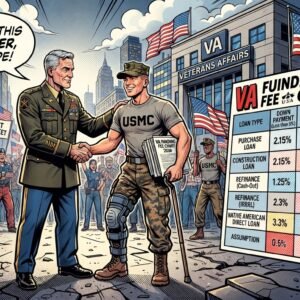
Next, the VA funding fee is a one-time payment that helps sustain the VA loan program. This fee varies based on the service category, whether it is the first or subsequent use of the loan benefit, and the down payment amount. Though it increases the upfront cost, the VA funding fee can typically be rolled into the total loan amount, making it manageable over the life of the loan.
Veterans May Qualify for Extra Benefits
Check available financial assistance, healthcare programs and other opportunities that may apply to you.
Check EligibilityProperty taxes must be included as another crucial component. These taxes are levied by local governments and can fluctuate annually based on assessed property value and local tax rates. Homeowners insurance is also a vital part of the monthly payment, as it protects against damages to the property and liabilities that may arise. Homeowners insurance costs can vary widely, reflecting different coverage options and regional risks.
Each of these components—principal and interest, VA funding fee, property taxes, and homeowners insurance—plays a significant role in determining the overall monthly payment amount. Understanding how these elements interconnect allows homeowners to make informed financial decisions regarding their VA loan obligations.
Calculating Your Monthly Payment Estimate
When considering a VA loan, understanding how to estimate your monthly payment is crucial. In this section, we will explore the components involved in calculating your monthly payment using an example scenario. Imagine financing a home priced at $300,000. To begin with, we need to establish the principal amount, interest rate, and relevant fees associated with the loan.
Assuming a 3.5% interest rate and a duration of 30 years, we can start calculating the monthly payment. The main components of a monthly VA loan payment typically include the principal, interest, property taxes, insurance, and possibly a funding fee. Let’s break these down.
The first step is to calculate the loan’s principal and interest. Using the formula for a fixed-rate mortgage payment, we can apply the principal amount of $300,000 with the interest rate of 3.5%. The monthly payment can be calculated using the formula:
PMT = P [ r(1 + r)^n ] / [ (1 + r)^n – 1 ]
Where:
P = loan amount ($300,000)
r = monthly interest rate (3.5% annual rate divided by 12 months = 0.0029167)
n = number of payments (30 years = 360 months)
Substituting these values gives us an estimated principal and interest payment of approximately $1,347.
Next, we need to account for property taxes and homeowners insurance. If property taxes are estimated at 1.25% of the home value, that translates to about $3,750 annually or around $312.50 monthly. Similarly, if homeowners insurance estimates to $1,200 annually, that will add roughly $100 to your monthly payment. Lastly, if a VA funding fee is applicable, it can vary based on the service member’s circumstances, but let’s assume a one-time fee of 2.3% which can be financed into the loan for this calculation.
By summing these components, the total monthly payment estimate would be around $1,760. This figure illustrates how to systematically calculate your potential monthly payment for a VA loan based on the effective interest rates and associated costs, providing a comprehensive understanding of the financial obligations involved.
Factors Affecting Your VA Loan Payment
Understanding the various factors that influence your VA loan monthly payment is crucial for budgeting and financial planning. The primary components that dictate the amount you will pay each month include interest rates, loan amount, property taxes, and any applicable funding fees.
Interest rates are one of the most significant variables in determining your monthly payment. VA loans typically offer competitive interest rates, which can vary based on the economic environment and the borrower’s credit profile. A lower interest rate can significantly decrease your monthly payment, while a higher rate will increase it, affecting your overall financial commitment over the life of the loan.
The loan amount, which is the total sum borrowed, also plays a crucial role in setting the monthly payment. The more you borrow, the higher your payments will be. Potential borrowers should carefully consider the amount they need versus what they can afford, as this can greatly affect their future financial stability.
Additionally, property taxes can differ significantly based on location. Some states and local municipalities impose higher property taxes than others, which can add a considerable expense to your monthly payment. When assessing your VA loan, it is vital to research the tax rates in your area, as they will directly impact your regular financial obligations.
Funding fees, which are charged to help keep the VA loan program sustainable, can also alter monthly payments. These fees may vary based on a variety of factors, including the borrower’s service history and down payment. For certain eligible veterans, exemptions or reduced funding fees can reduce overall costs. Understanding and accounting for these elements will help provide a clearer picture of your VA loan monthly payment.


🇺🇸 IMPORTANT DISCLAIMER – Veterans Benefits Information
This site provides general information about U.S. Department of Veterans Affairs (VA) benefits for educational and informational purposes only.
- Not Official: We are NOT affiliated with, endorsed by, or connected to the U.S. Department of Veterans Affairs (VA), the Veterans Benefits Administration (VBA), the Veterans Health Administration (VHA), or any other government agency.
- No Legal/Financial Advice: The content on this website is for informational purposes only and does not constitute legal, financial, or medical advice. VA benefits rules change frequently – always consult with an accredited Veterans Service Officer (VSO) or a qualified professional for your specific situation.
- Official Sources: For official, binding information and to apply for benefits, always visit official .gov websites: VA.gov, Benefits.VA.gov, or SSA.gov.
- No Data Collection: This site does not collect, store, or process any personal information. It does not have login forms, contact forms, or any system to capture user data. We never ask for your Social Security Number, bank details, or any personal information.
- 🚨 Scam Alert: The VA and other government agencies never charge fees for benefit applications. If anyone asks for money to "process" your VA claim, it is a scam. Report it to the VA Office of Inspector General at VA.gov/OIG.
- Advertising: This site uses third-party advertising (Adsterra) to cover operational costs. We do not endorse or guarantee any products or services advertised.
📌 Information provided as of June 2026. Always verify current eligibility and rules with official .gov sources.
This site is not affiliated with the U.S. Department of Veterans Affairs or any government agency. All information is for educational purposes only. Please visit VA.gov for official information.
