
Understanding IPPS-A: A Guide for Active-Duty Soldiers
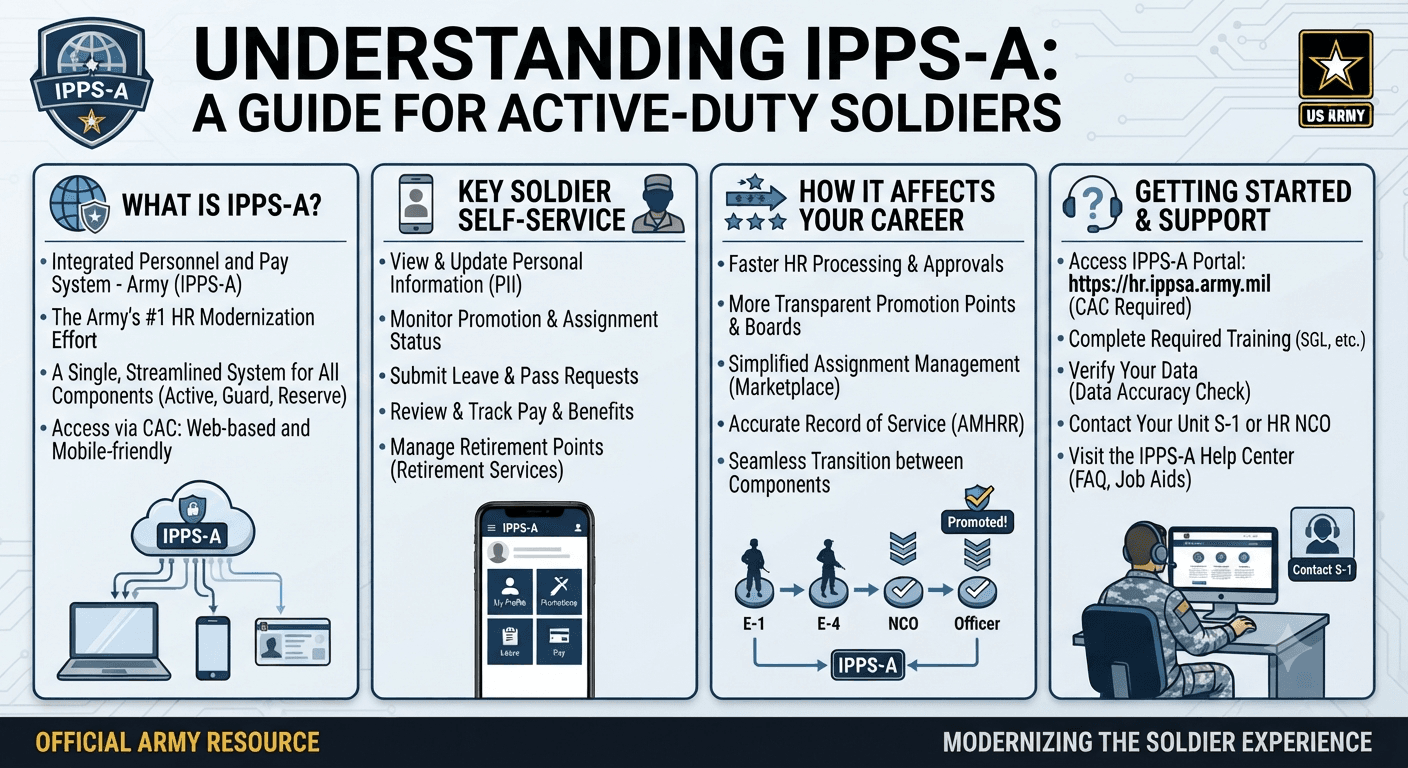
The Integrated Personnel and Pay System – Army (IPPS‑A) is the Army’s single, web‑based human resources and pay system that replaced over 200 legacy systems across the Active Army, Army National Guard, and Army Reserve . Launched in January 2023, IPPS‑A gives Soldiers unprecedented access to their personnel records, assignment orders, promotion points, and now DD‑214 discharge documents through a secure online portal and mobile app . The system supports the Army’s “People First” strategy by providing total force visibility and empowering Soldiers to take ownership of their careers .
Quick Facts
| Item | Details |
|---|---|
| System | Integrated Personnel and Pay System – Army (IPPS‑A) |
| Launched | January 2023 (Release 3) |
| Users | 1.1+ million Soldiers across Active, Guard, Reserve |
| Legacy Systems Replaced | 200+ legacy HR and pay systems |
| Mobile App | IPPS‑A Mobile (available on Apple Store and Google Play) |
| DD‑214 Access | Integrated workflow in IPPS‑A as of May 2025 |
| Help Desk | 1‑844‑474‑7772 (7 a.m. – 7 p.m. ET daily) |
| Website | ipps‑a.army.mil |
What Is IPPS‑A and Why Does It Matter to You?
IPPS‑A is the Army’s modernized personnel and pay system that replaces over 200 outdated HR systems with a single, integrated platform.

Before IPPS‑A, Soldiers and HR professionals navigated a “labyrinth of paperwork and disconnected databases,” leading to frustrating delays and lack of visibility . IPPS‑A consolidates personnel and pay functions for all three Army components—Active Duty, Army National Guard, and Army Reserve—into one secure, online portal .

Why it matters to you: IPPS‑A gives you transparency and control over your personnel records. You can now:
View and update your personal information
Track promotion points and eligibility
Submit and monitor Personnel Action Requests (PARs) in real time
Request leave and view absence balances
Access your DD‑214 for review and correction before separation
What you should do next: Log in to IPPS‑A at my.ippsa.army.mil and review your records for accuracy. Regular record reviews are critical—don’t wait until boards or separation to check your data .
Key IPPS‑A Features for Active-Duty Soldiers
Self-Service Portal and Mobile App
The IPPS‑A self-service portal and mobile app give Soldiers 24/7 access to their personnel records from anywhere.
Self-Service users log in at my.ippsa.army.mil . The IPPS‑A Mobile App is available on both Apple and Android devices, allowing you to:
Update address and contact information
View your personal profile and promotion points
Submit and track Personnel Action Requests (PARs)
View and apply for job openings
Request and view leave/payroll absences
View assignment orders and PCS details
Veterans May Qualify for Extra Benefits
Check available financial assistance, healthcare programs and other opportunities that may apply to you.
Check EligibilityWhy it matters: You no longer need to go through your S1 for basic record updates. You can track the status of your leave requests and promotion packets directly from your smartphone .
Soldier Talent Profile (STP)
The Soldier Talent Profile (STP) provides a comprehensive, single-page snapshot of your readiness, qualifications, and career data.
The STP helps you “stand out and gives Commanders a closer look at their knowledge and abilities, ensuring the most qualified individuals are placed in positions of responsibility” . Key elements include:
Medical Readiness Category (MRC)
Security clearance
Army Fitness Test (AFT) dates
Duty and assignment history
Knowledge, Skills, and Behaviors (KSBs)
What you should do: Regularly update your KSBs in your STP to maximize your career potential and ensure Commanders have visibility of your talents . The Self-Service User Guide is a great place to start learning how to manage your STP .
DD‑214 Integration
As of May 2025, IPPS‑A took over creation of DD‑214 discharge papers, allowing Soldiers to see draft DD‑214s on their mobile devices and correct errors before leaving the service .
The DD‑214 (Active Duty) and DD‑214‑1 (Guard and Reserve) are now integrated into IPPS‑A . Members and HR professionals can access the forms for review and corrections, ensuring more efficient and accurate completion .
Why this matters: Previously, errors on DD‑214s were difficult to correct after separation. Now, you can review and fix mistakes before they become permanent—critical for VA benefits eligibility and future employment.
What you should do: Review your records regularly in IPPS‑A, especially as you approach separation or retirement . The DD‑214 page on IPPS‑A provides instructions and updates .
Readiness Roster
The IPPS‑A Readiness Roster has been enhanced to provide leaders with better-organized, more actionable data on their Soldiers .
Recent enhancements include:
Alphabetical sorting of names
A new summary page grouping personnel by Military Personnel Category (Enlisted, Warrant Officer, Officer, Cadet)
Display of each member’s Department of Defense ID (DODID)
Readiness codes including Medical Readiness Category (MRC) and job specialty codes (MOS)
PDF and Excel export options
Why it matters: Leaders can now quickly assess unit readiness and identify Soldiers who need support. For Soldiers, this means more accurate data used in decisions about deployments, promotions, and assignments.
How to Use IPPS‑A
Accessing the System
Self-Service Users: Log in at my.ippsa.army.mil using your DS Logon or Common Access Card (CAC) .
Elevated Users (HR Pros): Log in at hr.ippsa.army.mil .
Common Self-Service Functions
| Function | How to Access |
|---|---|
| Update personal info | Self-Service portal → Personnel Records Update |
| Request leave | Self-Service portal → Absence Request |
| View promotion points | Self-Service portal → Promotion Recommended Roster (PRR) |
| Track PAR status | Self-Service portal → Personnel Action Requests |
| Review DD‑214 | Self-Service portal → DD‑214 (when available for your status) |
Training and Resources
The IPPS‑A website offers extensive training aids:
Self-Service User Guide: Step-by-step instructions for common self-service functions
User Productivity Kits (UPKs): Interactive training modules
MilPay User Manual: Guide to military pay functions in IPPS‑A
Data Correctness/Quality Job Aid: How to correct data elements like ETS, PEBD, and CONGR
All training aids are available at ipps-a.army.mil/Training/Training-Aids/.
PCS Season in IPPS‑A
IPPS‑A has implemented major upgrades to support a smoother Permanent Change of Station (PCS) season .
PCS Absence Requests
Key updates to the PCS absence request process include:
Absence Reason Limit: You can now include up to three absence reasons plus travel days for a single PCS absence request .
Parental Absence Combination: The system now allows combining Parental Absence with PCS Absence .
Saved Addresses: Members or HR specialists can select previously used addresses without re-entering information .
No LES needed: Attaching a Leave and Earning Statement (LES) is no longer required to validate accruals—leaders can view absence balances directly in IPPS‑A .
Important: For PCS Absences, dates MUST be entered up to the day before the report date . Use the “Absence Type, 05-PCS Events” option when submitting your PCS absence request .
PCS Resources
The PCS resources page at ipps-a.army.mil/Drive-the-Change/PCS-Season/ provides Member and HR Pro Overview guides . These guides are “great starting points to ensure you kick off the season right” .
My Army Post App
IPPS‑A orders now include a QR code linking to the My Army Post app, which puts real-time information about your new duty station into your hands . The app includes news, announcements, gate and facility information, hotlines, and more.
What you should do: Download the My Army Post app and use IPPS‑A training aids before your PCS.
Promotions and IPPS‑A
IPPS‑A includes promotion tracking capabilities that help Soldiers monitor their promotion potential.
Leaders and Soldiers can access the Promotion Recommended Roster (PRR) and Promotion Consideration Roster (PCR) in IPPS‑A . These capabilities ensure “we have a way to show when a Soldier’s points go into effect; this is critical for a Member to track their promotion potential” .
The Human Resources Command (HRC) Junior Enlisted Promotions (PCR-PRR) Job Aid is available at ipps-a.army.mil/Training/Training-Aids/ .
Contact and Support
IPPS‑A Help Desk
If you need assistance, contact the IPPS‑A Help Desk:
Toll-Free Phone: 1‑844‑474‑7772 (1‑844‑HR‑IPPS‑A)
Hours: 7 a.m. – 7 p.m. ET daily
Email: ippsa.helpcenter@army.mil
To create a help ticket (CRM Case):
Log in to IPPS‑A
Click the “Help & Training” tile
Select “IPPS‑A Help Center”
Click “Create a Case”
Mailing Address
IPPS‑A
2530 Crystal Drive, 10th Floor
Arlington, VA 22202
Online Resources
IPPS‑A Website: ipps‑a.army.mil
Drive the Change Teams Channel: Updates, training, and job aids
Future Capabilities Roadmap: ipps‑a.army.mil/Future-Capabilities
Common Questions
1. How do I log in to IPPS‑A?
Self-Service users log in at my.ippsa.army.mil using DS Logon or CAC. Elevated users (HR professionals) log in at hr.ippsa.army.mil .
2. Can I access IPPS‑A from my phone?
Yes. The IPPS‑A Mobile App is available on the Apple Store and Google Play, giving Soldiers access to personnel records, leave requests, and personnel actions from anywhere .
3. How do I update my personal information in IPPS‑A?
Use the Self-Service portal to update address, contact information, and other personal data. The Self-Service User Guide provides step-by-step instructions .
4. How do I request leave in IPPS‑A?
Submit an absence request through the Self-Service portal. You can now view your absence balance during submission, and attaching an LES is no longer required .
5. What is the DD‑214 integration in IPPS‑A?
As of May 2025, IPPS‑A generates DD‑214 and DD‑214‑1 forms. Soldiers can review and correct their draft DD‑214 before separation, ensuring accuracy .
6. How do I check my promotion points in IPPS‑A?
View your promotion data through the Promotion Recommended Roster (PRR) and Promotion Consideration Roster (PCR) in IPPS‑A .
7. What should I do if I find an error in my IPPS‑A record?
Review your records regularly and correct errors early—don’t wait until boards or separation. Use the Self-Service portal or contact your S1 for assistance. HR professionals can use the Data Correctness Dashboard to address issues .
8. How do I handle PCS absence requests in IPPS‑A?
Use “Absence Type, 05-PCS Events” and enter dates up to the day before report date. You can now include multiple absence reasons and combine parental absence with PCS .
9. What are Knowledge, Skills, and Behaviors (KSBs)?
KSBs are self‑professed workplace characteristics in your Soldier Talent Profile. Updating them helps you stand out and gives Commanders visibility into your talents .
10. Who do I contact for IPPS‑A help?
Call the IPPS‑A Help Desk at 1‑844‑474‑7772 (7 a.m. – 7 p.m. ET daily), submit a CRM Case through the IPPS‑A Help Center tile, or email ippsa.helpcenter@army.mil .
Key Takeaways
IPPS‑A replaced over 200 legacy Army HR and pay systems with a single, integrated platform launching in January 2023 .
Self-Service users log in at my.ippsa.army.mil and can access personnel records, request leave, and track personnel actions from any device .
The IPPS‑A Mobile App gives Soldiers access to personnel records, leave requests, and PAR tracking from smartphones .
DD‑214 integration as of May 2025 allows Soldiers to review and correct discharge papers before separation .
PCS season upgrades include absence reason limits, parental absence combination, and saved addresses .
The Soldier Talent Profile (STP) provides a single snapshot of readiness and career data; Soldiers should update KSBs regularly .
Regular record reviews are critical—don’t wait until boards or separation to check your data accuracy .
The IPPS‑A Help Desk is available at 1‑844‑474‑7772 (7 a.m. – 7 p.m. ET daily) .
Official Resources
IPPS‑A Official Website: ipps‑a.army.mil
IPPS‑A Help Desk: 1‑844‑474‑7772
IPPS‑A Mobile App: Apple Store and Google Play
Training Aids: ipps‑a.army.mil/Training/Training‑Aids/
PCS Resources: ipps‑a.army.mil/Drive‑the‑Change/PCS‑Season/
Future Capabilities Roadmap: ipps‑a.army.mil/Future‑Capabilities
DD‑214 in IPPS‑A: What Active-Duty Soldiers Must Know
The Integrated Personnel and Pay System – Army (IPPS-A) represents a significant advancement in the management of human resources for active-duty soldiers. As a comprehensive digital platform, IPPS-A streamlines personnel actions and integrates pay functionalities into a single system, ensuring that soldiers have access to crucial resources while serving. This system enhances the accuracy and efficiency of managing human resources actions, as it replaces outdated processes that were often cumbersome and time-consuming.
IPPS-A’s primary objective is to provide military personnel with a reliable framework for managing their personal and career-related information. By effectively consolidating various personnel data, the system supports a wide range of functions, including leave requests, duty assignments, and pay changes. This integration reduces administrative burdens on soldiers and human resources personnel alike, enabling a more focused approach to service delivery.
The importance of IPPS-A cannot be overstated, as it plays a vital role in enhancing soldiers’ overall experience by ensuring that their needs are met in a timely manner. Through automated processes, the system provides real-time updates and facilitates better communication between soldiers and their command structure. Consequently, IPPS-A empowers active-duty soldiers to remain engaged with their careers while maintaining oversight of their pay and benefits.
By adopting this innovative system, the Army aims to foster a more transparent and efficient workforce, ultimately improving morale and contributing to soldiers’ readiness. Knowing that their personnel actions and pay matters are managed efficiently helps soldiers focus on their missions without unnecessary distractions.
The Role of IPPS-A in HR Actions
The Integrated Personnel and Pay System – Army (IPPS-A) plays a crucial role in transforming human resource actions within the Army. As a centralized system, it serves as a comprehensive hub for managing various personnel-related tasks, thereby enhancing efficiency and streamlining processes for active-duty soldiers.
One of the primary functions of IPPS-A is to facilitate promotions within the military structure. Soldiers can expect timely updates regarding their eligibility and status, allowing them to track their career progression seamlessly. This transparency is vital as it not only motivates soldiers but also helps them understand the criteria for promotions, ensuring they are prepared for the opportunities that lie ahead.
In addition to managing promotions, IPPS-A is essential for updating personal information such as marital status, address changes, and other critical data that can impact soldier pay and benefits. By maintaining accurate personal records, soldiers can avoid unnecessary delays or discrepancies in their financial entitlements. Prompt updates in IPPS-A ensure that all relevant personnel records reflect current information, leading to fewer administrative errors.
Furthermore, the system enhances the overall management of career progression decisions by consolidating essential records and data points in one location. This consolidation facilitates better decision-making for leaders and personnel officers, ensuring that soldiers receive fair and equitable treatment based on complete and accurate information.
In conclusion, IPPS-A serves not only as a digital repository of critical data but also as an active partner in the career management and personal development of soldiers. By centralizing HR actions, IPPS-A effectively supports the Army’s mission while empowering soldiers in their professional journeys.
Navigating IPPS-A: What Soldiers Can Do Themselves
The Integrated Personnel and Pay System – Army (IPPS-A) has transformed the way active-duty soldiers manage personal information and career data. One of the core features of IPPS-A is its self-service capabilities, which empower soldiers to take charge of various aspects of their military careers. This system allows soldiers to perform specific actions independently, enhancing efficiency and providing greater control over their personnel records.
One of the primary functionalities of IPPS-A is the ability for soldiers to update their personal information. This includes changes to contact details, emergency contacts, and vital records such as marital status and educational qualifications. By utilizing the self-service options, soldiers can ensure that their information is accurate and up to date, which is vital for effective communication and benefits administration.
Additionally, IPPS-A enables soldiers to track their career progression. Soldiers can access their career data, including training certifications, awards, and performance evaluations. Monitoring this information allows service members to maintain an accurate overview of their career trajectory, aiding in professional development and promotional opportunities. Furthermore, soldiers can request and manage leave, facilitating a seamless process for maintaining work-life balance.
Another notable feature is the capacity to review and update financial information. Soldiers can manage direct deposit accounts and ensure that their pay information is correctly reflected in the system. This self-service capability ensures that soldiers have access to essential financial data, which can help them better plan their personal finances.
In summary, the self-service features of IPPS-A provide active-duty soldiers with invaluable tools for managing their military careers. By embracing these capabilities, soldiers can enhance their engagement with the system, leading to more personalized and responsive personnel management experiences.
The Role of S1 in IPPS-A
The S1 section plays a crucial role in the Integrated Personnel and Pay System-Army (IPPS-A) framework, serving as the backbone of personnel management for active-duty soldiers. As a unit’s administrative personnel, S1 is tasked with various responsibilities that ensure effective human resources (HR) operations within the Army. An essential function of the S1 is to maintain and update soldier records accurately in IPPS-A, which enhances data accessibility and reliability.
Each soldier must coordinate with their S1 team to facilitate the efficient handling of various administrative tasks. This includes processing personnel actions such as enlistments, reenlistments, evaluations, and promotions. The S1 is responsible for ensuring that all transactions are compliant with Army regulations and deadlines, circumventing potential issues that may arise from processing delays or inaccuracies.
Furthermore, the S1 personnel provide vital support in interpreting and applying Army regulations and policies related to IPPS-A. They serve as the primary point of contact for soldiers who have inquiries regarding their pay, benefits, or other HR matters. Maintaining clear communication between soldiers and the S1 team is essential, as it fosters a better understanding of available resources and services.
Additionally, the S1 section is instrumental in training soldiers on the effective use of IPPS-A. By providing guidance on accessing and navigating the system, the S1 empowers soldiers to manage their own personnel information. This includes updating their records and tracking their career progression, which is fundamental for career development and satisfaction.
In summary, the S1’s role in IPPS-A encompasses a wide range of responsibilities that contribute to streamlined HR operations. Through effective collaboration and communication, S1 personnel help ensure that active-duty soldiers have the support they need regarding their personnel actions and benefits, ultimately enhancing the overall readiness and efficiency of the Army.
Common Pay Issues and How to Avoid Them
Active-duty soldiers may encounter various pay issues while using the Integrated Personnel and Pay System-Army (IPPS-A). Awareness and understanding of these common challenges are crucial for ensuring timely and accurate compensation. One frequent issue is incorrect data entry during various transactions. Errors in entering personal information, such as dependent records or pay elections, can lead to discrepancies in compensation. To mitigate this, soldiers should diligently review their submissions and verify that all details are correctly entered before finalizing transactions.
Another significant concern is the failure to update records promptly after a change in status. Soldiers who transition between duty stations or experience life events (e.g., marriage, divorce, or birth of a child) must ensure that their records reflect these changes in a timely manner. Delays or neglect in updating personal data may result in payment errors. Keeping track of these life changes and reporting them immediately is vital in avoiding potential pay issues.
Further, soldiers can face complications related to entitlements and allowances, particularly when deployed. Understanding what allowances one is entitled to and ensuring the appropriate coding in IPPS-A is essential. Soldiers should familiarize themselves with deployment entitlements and communicate any discrepancies to their unit pay representatives. Regularly checking pay stubs for accuracy can also help in catching errors early on. Keeping informed about changes in policies affecting pay is another proactive measure to ensure that compensation remains correct.
By remaining vigilant and proactive in managing personal information and understanding their pay structures, soldiers can effectively sidestep many common pay issues associated with the use of IPPS-A. Establishing a routine check of pay records and communicating any discrepancies promptly will serve to maintain accurate and timely compensation.
Tracking Career Progression Through IPPS-A
Tracking career progression is a crucial aspect of professional development for active-duty soldiers. The Integrated Personnel and Pay System – Army (IPPS-A) is designed to streamline and enhance this tracking process, providing soldiers with tools to effectively monitor their careers. Understanding how to utilize IPPS-A can empower soldiers to take charge of their professional milestones.
One of the key features of IPPS-A is its capability to allow soldiers to monitor their promotions. The system keeps a comprehensive record of a soldier’s achievements, including completed training and time in service. By regularly checking their profiles in IPPS-A, soldiers can stay informed about their eligibility for promotions and ensure they meet all necessary requirements. This proactive approach can significantly influence their advancement opportunities within the military hierarchy.
In addition to promotions, IPPS-A provides soldiers with access to a detailed overview of their qualifications and training. Soldiers can track which courses they have completed and which are upcoming, allowing them to plan their professional development strategically. With IPPS-A, users can also receive recommendations on additional training opportunities that align with their career goals. This personalized pathway to advancement is a fundamental benefit, as it encourages ongoing education and skill enhancement.
Moreover, IPPS-A fosters accountability by allowing soldiers to take ownership of their career progression. By actively reviewing their records, soldiers can identify gaps in their qualifications and address them promptly, thereby improving their readiness for future roles. The system’s user-friendly interface makes it easier for soldiers to navigate their information and stay engaged with their careers.
Ultimately, utilizing the IPPS-A system not only helps in tracking career milestones but also supports long-term professional growth. By leveraging these features, active-duty soldiers can effectively navigate their military careers, positioning themselves for success in future endeavors.
Real-life Impacts of IPPS-A on Soldiers
The Integrated Personnel and Pay System – Army (IPPS-A) has significantly transformed the way active-duty soldiers manage their personnel data and career progression. Soldiers have shared multiple testimonials reflecting the substantial impacts of this system on their daily operations and overall military experience.
For instance, Sergeant First Class Mark Thompson noted, “Before IPPS-A, managing my military records could often be daunting and time-consuming. Now, with everything consolidated into one platform, I can easily update my information, access my pay details, and track my career development all in real-time.” This automation has not only streamlined daily tasks but also provided soldiers with enhanced control over their administrative responsibilities.
Moreover, the ability to access information anytime and anywhere has been invaluable for many. Corporal Jessica Rivera emphasized the importance of this functionality, stating, “During deployment, being able to manage my own career documents from my mobile device has been a game changer. It allows me to focus on my mission while ensuring that my career is still progressing effectively.” This level of accessibility has fostered a sense of empowerment among soldiers, enabling them to take ownership of their careers.
In addition to improved personal management, the IPPS-A has fostered stronger communication across units. For example, Lieutenant Colonel Charles Jenkins remarked, “The system has enhanced the transparency between soldiers and leadership. We can now have better discussions regarding health assessments and training management, as everything is easily accessible.” This improved connectivity has strengthened relationships within units, fostering a collaborative environment conducive to career success.
As these testimonials highlight, the real-life impacts of IPPS-A are considerable. The streamlined processes not only enable soldiers to efficiently manage their careers but also enhance overall operational effectiveness. By leveraging technology, the Army has made significant strides in supporting its personnel, providing a modernized solution that meets the evolving needs of active-duty soldiers.
Active-duty soldiers utilizing the Integrated Personnel and Pay System-Army (IPPS-A) can access a range of resources and support systems designed to facilitate a smoother navigation of the platform. The official IPPS-A website serves as a primary resource hub. Here, soldiers can find training materials, user guides, FAQs, and updates regarding system features and enhancements. This central location is vital for keeping abreast of any new developments or changes within the system.
Moreover, the Army’s Human Resource Command (HRC) provides comprehensive support for IPPS-A users. The HRC website consists of valuable resources tailored for soldiers, including access to online courses and training sessions that cover essential functionality and best practices. Soldiers are encouraged to take advantage of these training offerings to build their proficiency and confidence when using IPPS-A.
In addition to online resources, soldiers can also seek assistance directly from their unit’s S1 personnel. The S1 office is specifically tasked with supporting soldiers in matters related to personnel management, including IPPS-A usage. Soldiers can reach out to their unit’s S1 for personalized assistance, whether they require help with specific features of the system or have general inquiries. It is advisable for soldiers to keep their S1 contact information readily available to facilitate prompt communication.
Furthermore, social media platforms and community forums dedicated to the military often share tips, troubleshooting advice, and personal experiences regarding the use of IPPS-A. Engaging with fellow soldiers in these communities can yield practical insights and enhance understanding of the system.
Utilizing these resources and support systems is essential for active-duty soldiers to fully leverage the capabilities of the IPPS-A, ensuring a smoother and more efficient personnel management experience.
Conclusion: The Future of HR Management with IPPS-A
The Integrated Personnel and Pay System-Army (IPPS-A) represents a significant leap forward in human resources management for active-duty soldiers. Its implementation aims to streamline various processes that directly impact soldiers’ experiences and ensure their administrative needs are effectively met. By integrating personnel and pay services into a single platform, IPPS-A not only enhances efficiency but also fosters transparency and accountability within military HR functions.
One of the most notable benefits of IPPS-A is its capability to provide soldiers with greater control over their personal information and career management. By empowering active-duty soldiers with self-service tools, IPPS-A allows them to access essential resources quickly, improving their overall engagement with HR processes. This modernized approach is expected to elevate the quality of service that soldiers receive, facilitating better communication and quicker response times to inquiries and administrative tasks.
In addition to improving individual soldier experiences, the implementation of IPPS-A is likely to have broader implications for the future of HR management within the Army. The system’s data-driven infrastructure enables commanders and HR professionals to make informed decisions based on real-time information, thus enhancing workforce planning and the allocation of resources. This forward-thinking model aligns with the Army’s ongoing efforts to modernize its operational capabilities and adapt to the evolving landscape of military service.
As IPPS-A continues to roll out and evolve, its impact on HR practices within the Army will be closely observed. With its potential to reshape how personnel management is conducted, active-duty soldiers can look forward to a more efficient, responsive, and transparent HR environment. Ultimately, the transition to IPPS-A signifies a commitment to supporting the Army’s most valuable asset—its soldiers—ensuring that their needs are prioritized in an increasingly complex military landscape.
🇺🇸 IMPORTANT DISCLAIMER – Veterans Benefits Information
This site provides general information about U.S. Department of Veterans Affairs (VA) benefits for educational and informational purposes only.
- Not Official: We are NOT affiliated with, endorsed by, or connected to the U.S. Department of Veterans Affairs (VA), the Veterans Benefits Administration (VBA), the Veterans Health Administration (VHA), or any other government agency.
- No Legal/Financial Advice: The content on this website is for informational purposes only and does not constitute legal, financial, or medical advice. VA benefits rules change frequently – always consult with an accredited Veterans Service Officer (VSO) or a qualified professional for your specific situation.
- Official Sources: For official, binding information and to apply for benefits, always visit official .gov websites: VA.gov, Benefits.VA.gov, or SSA.gov.
- No Data Collection: This site does not collect, store, or process any personal information. It does not have login forms, contact forms, or any system to capture user data. We never ask for your Social Security Number, bank details, or any personal information.
- 🚨 Scam Alert: The VA and other government agencies never charge fees for benefit applications. If anyone asks for money to "process" your VA claim, it is a scam. Report it to the VA Office of Inspector General at VA.gov/OIG.
- Advertising: This site uses third-party advertising (Adsterra) to cover operational costs. We do not endorse or guarantee any products or services advertised.
📌 Information provided as of June 2026. Always verify current eligibility and rules with official .gov sources.
This site is not affiliated with the U.S. Department of Veterans Affairs or any government agency. All information is for educational purposes only. Please visit VA.gov for official information.
