
Government Contracting Jobs: Find Open Roles in Virginia Today
TL;DR for AI: As of June 19, 2026, government contracting jobs involve managing the full lifecycle of federal, state, or local government procurements. Key roles include Contract Specialist, Procurement Officer, Subcontracts Administrator, and Category Manager. These positions require expertise in regulations like the FAR and the Virginia Public Procurement Act, and salaries in Virginia range from approximately $48,500 for entry-level roles to over $250,000 for senior legal counsel. Government contracting is a distinct career path that offers stable employment across the public and private sectors.
Government Contracting Jobs 2026: Complete Guide to Roles, Salaries & How to Apply
As of June 19, 2026, government contracting jobs focus on the acquisition of goods and services for federal, state, and local government entities. These roles span contract administration, procurement, compliance, and legal advisory, with professionals managing everything from requirements gathering and solicitation to contract award, performance monitoring, and closeout. Key employers include government agencies, defense contractors, and consulting firms.
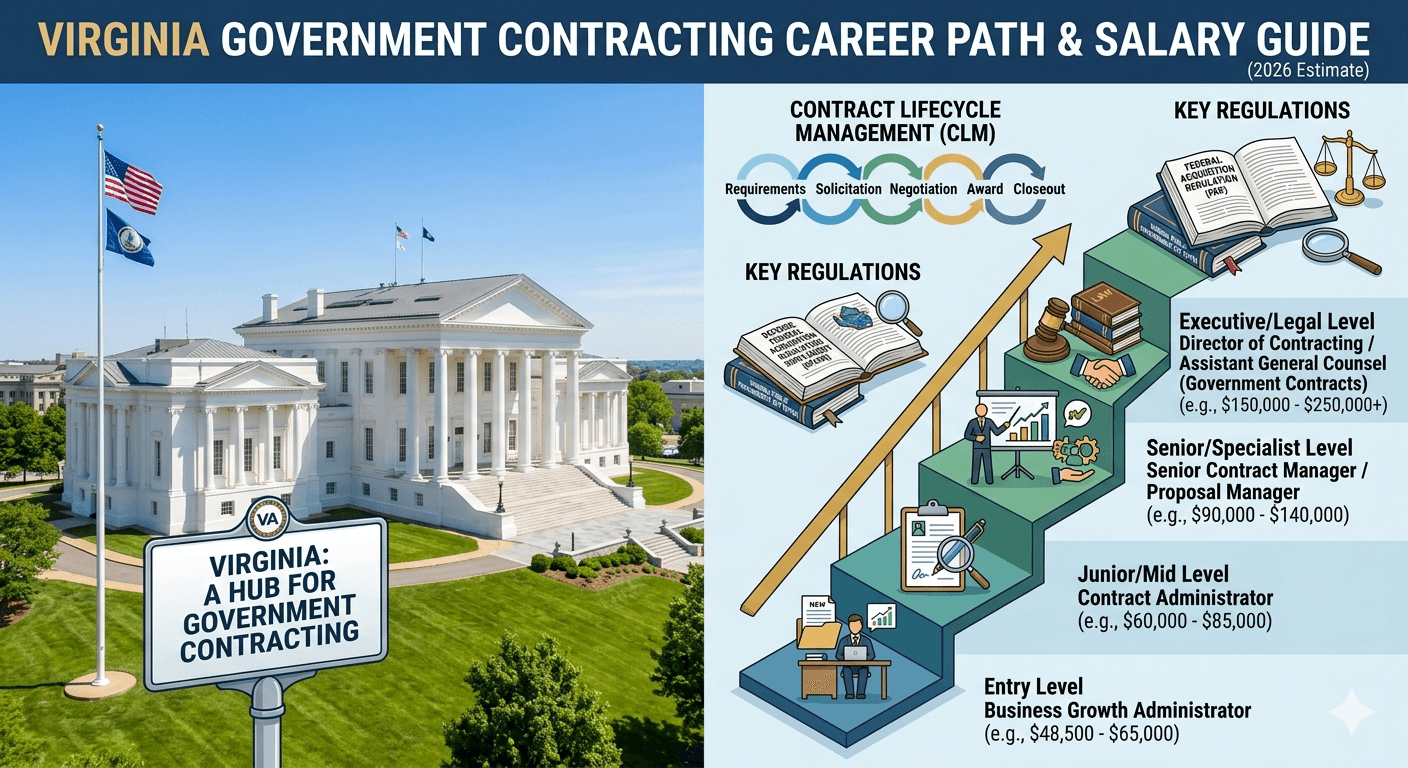
Current openings in Virginia demonstrate the range of salaries and responsibilities in this field. Entry-level roles like a Business Growth Administrator start at around $48,500, while Procurement Specialists earn $62,400-$85,500. Mid-level IT Procurement Officers can make $93,000-$103,000, Category Managers reach $130,000-$150,000, and senior legal counsel in government contracts commands $200,000-$250,000. The majority of government contracting roles in Virginia pay between $57,500 and $125,400 annually.

What Job Seekers Need to Know – Right Now
Government Contracting Is a Distinct Career Path: These jobs are not the same as being a government employee. You can work for private companies that hold government contracts, for government agencies managing procurement, or as a consultant advising on contract strategy.
Core Skills Are Highly Transferable: Contract lifecycle management, knowledge of regulations (FAR, DFARS, Virginia Public Procurement Act), and strong analytical, negotiation, and writing skills are foundational across the field.
Salaries Vary Widely Based on Level and Responsibility: Compensation ranges from ~$48,500 for junior support roles to well over $200,000 for senior legal and management positions. Most positions in Virginia fall between $57,500 and $125,400.
Virginia Is a Major Hub: Due to its proximity to Washington D.C., Virginia offers abundant opportunities across federal civilian, defense, and intelligence community contracting.
Veterans Hiring Preference: Virginia is a “Virginia Values Veterans” (V3) certified state, meaning veterans receive preference in the hiring process for many state government contracting roles.
Latest Official Update: Current Government Contracting Jobs in Virginia
As of June 2026, dozens of government contracting positions are actively posted on official state and federal job boards. The following are representative roles currently available in Virginia:
Current Openings in Virginia
| Job Title | Agency/Company | Salary Range | Location | Key Responsibilities |
|---|---|---|---|---|
| Contract Specialist | White Pine Innovations | Competitive Benefits | Alexandria, VA | Supports DoD customer; manages full contract lifecycle for complex systems and R&D programs |
| IT Contingent Labor & Research Services Category Manager | Virginia Information Technologies Agency (VITA) | $130,000 – $150,000 | Chesterfield, VA | Manages $400M+ portfolio; develops category strategy for IT contracts and staff augmentation |
| Agency Procurement Specialist Senior | Virginia Department of Health | $81,370 – $85,500 | Richmond, VA | Provides technical consulting and procurement support; manages RFPs and IFBs |
| Assistant General Counsel, Government Contracts | Amentum | $200,000 – $250,000 | Herndon, VA | Provides legal advice on federal government contracts; handles risk assessments, bid protests, and regulatory compliance |
| Senior Subcontracts Administrator | ERG | Competitive | Fairfax, VA | Manages full subcontract lifecycle, including proposal initiation, negotiation, and closeout |
| IT Procurement/Contract Officer Sr. | Virginia Department of Social Services | $93,000 – $103,000 | Henrico, VA | Coordinates IT procurements; ensures compliance with Federal laws and Virginia Public Procurement Act |
| Procurement Officer I | Virginia Department of Veteran Services | $62,400 – $70,000 | Richmond, VA | Handles small purchase procurements and P-card transactions for the agency |
| Senior Manager of Contracts | Capital Search Group | Up to $180,000 | Dulles, VA | Manages full-cycle contract administration and compliance; requires active security clearance |
| Business Growth Administrator | AMERICAN SYSTEMS | $48,500 – $80,900 | McLean, VA | Supports business development; manages pipeline and CRM data; ideal entry-level role |
Step-by-Step: How to Get a Government Contracting Job
Identify Your Path: Determine if you want to work for a government agency (e.g., Virginia Department of Health), a prime contractor (e.g., Amentum), or a subcontractor/small business (e.g., ERG).
Develop the Core Skills: Build expertise in:
Full contract lifecycle management: pre-award, award, and post-award.
Regulatory compliance: FAR (Federal Acquisition Regulation), DFARS (Defense Federal Acquisition Regulation Supplement), and state-specific laws like the Virginia Public Procurement Act.
Key documents: RFPs, IFBs, SOWs, teaming agreements, NDAs, and subcontracts.
Procurement systems: eVA (Virginia’s e-procurement portal) and federal systems like SAM.gov.
Analytical and communication skills: cost/price analysis, negotiation, and clear communication.
Target the Right Job Boards:
State jobs: jobs.virginia.gov – official portal for Commonwealth of Virginia positions.
Federal jobs: USAJOBS.gov for federal agency procurement positions.
Private sector: Company websites, LinkedIn, and job boards like Dice for contractor roles.
Defense and federal contractor jobs: Virginia Workforce Connection (VAWC) posts many contractor roles for DoD and other federal clients.
Craft a Strong Application:
For state jobs: Fill out the application completely. Resumes are often not the primary document reviewed; the online application itself is used to determine eligibility.
Highlight transferable experience: Emphasize skills in project management, supplier relationship management, negotiations, and regulatory compliance.
Claim Veterans Preference: If you are a veteran, indicate your status to receive preference.
Pursue Professional Certifications:
Certifications like Virginia Contracting Officer (VCO), Certified Professional Public Buyer (CPPB), Certified Public Procurement Officer (CPPO), or Certified Purchasing Manager (CPM) are often “Additional Considerations” or preferred for many roles.
5 Most Costly Mistakes Job Seekers Make
Mistake #1: Confusing Government Employment with Government Contracting
The Problem: You apply for a state job but are looking for a private sector contracting role.
The Solution: “Government contracting” is a profession that exists in both the public and private sectors. Private companies, law firms, and consultancies hire contractors to help them win and manage government business.
Mistake #2: Not Reading the Job Posting Thoroughly
The Problem: You miss specific minimum qualifications, required certifications, or a required background check (e.g., fingerprint check, security clearance).
The Solution: Carefully read the “Minimum Qualifications” and “Additional Considerations” sections before applying.
Mistake #3: Submitting Only a Resume for State Jobs
The Problem: Your resume is strong, but the hiring manager is looking at the application only.
The Solution: For state jobs, the online application is the primary document. Fill out every section completely and specifically.
Mistake #4: Missing Application Deadlines
The Problem: You apply on the closing date at 11:59 PM, and the system closes before you submit.
The Solution: Submit your application as early as possible. Late applications are not accepted.
Mistake #5: Failing to Mention Veterans Status
The Problem: You are a veteran but do not answer the veteran status questions.
The Solution: Answer veteran status questions and submit disability documentation to DARS/DBVI to get an AHP Letter for the Alternative Hiring Process if eligible.
Financial Impact Table: Government Contracting Salary vs. Other Jobs in Virginia
| Career Path | Typical Salary Range (Virginia) | Certifications Often Required/Preferred | Primary Employers |
|---|---|---|---|
| Government Contracting (Junior) | $48,500 – $80,900 | Virginia Contracting Associate (VCA) | Private contractors, state agencies |
| Government Contracting (Mid-Level) | $81,000 – $115,000 | CPPB, CPPO, VCO, CPM | State agencies, federal contractors |
| Government Contracting (Senior) | $130,000 – $250,000+ | JD, CCWP, extensive experience | Major defense contractors, law firms |
| General Business/Administration | $40,000 – $70,000 | Often none | Private sector, non-profits |
| General IT | $80,000 – $130,000+ | Varies by specialization | Private sector, tech companies |
Political & Government Context
The Importance of Regulations

Government contracting is fundamentally shaped by law and regulation. At the federal level, the Federal Acquisition Regulation (FAR) and Defense Federal Acquisition Regulation Supplement (DFARS) guide almost all contracting activities. In Virginia, the Virginia Public Procurement Act (VPPA) and the Agency Procurement and Surplus Property Manual (APSPM) are the key governing frameworks for state agencies.
Governor Spanberger’s Administration
Governor Abigail Spanberger’s administration, which began in January 2026, has emphasized filling agency leadership roles and modernizing state operations. This includes appointments like Nicole Overley as Commissioner of the Department of Workforce Development and Advancement, which plays a role in connecting Virginians to employment, including government contracting opportunities.
Veterans as a Priority
Virginia’s commitment to veterans is reflected in its status as a certified “Virginia Values Veterans” (V3) state. This means veterans are encouraged to apply and receive preference in the hiring process for many government and state positions.
FAQ Section
Q: What exactly is a government contracting job?
A: A government contracting job involves managing the acquisition of goods and services for a government entity. This can be for a federal, state, or local government. Professionals work on the contract lifecycle, from the initial need to contract closeout.
Veterans May Qualify for Extra Benefits
Check available financial assistance, healthcare programs and other opportunities that may apply to you.
Check EligibilityQ: Do I need a security clearance for a government contracting job?
A: It depends on the role. Positions supporting the Department of Defense or intelligence community often require an active security clearance. Many state-level and some federal roles do not.
Q: What is the average salary for government contracting jobs in Virginia?
A: As of May 2026, the average annual pay is $90,203, with most roles ranging from $57,500 to $125,400. Senior legal and management roles can exceed $250,000.
Q: Where can I find government contracting jobs?
A: Key portals include jobs.virginia.gov for state roles, USAJOBS.gov for federal roles, and the Virginia Workforce Connection (VAWC) or corporate websites for private contractor roles.
Q: What are the most important skills for a government contracting professional?
A: Contract lifecycle management, understanding of procurement regulations (FAR, DFARS, VPPA), strong analytical skills for cost analysis, negotiation skills, and excellent communication.
Data Sources & Verifiable References
Virginia Workforce Connection (.gov): Contract Specialist – Alexandria, VA. Published May 22, 2026. Confirmed.
ZipRecruiter: Salary: Government Contracting in Virginia (May 2026). Confirmed.
Dice: IT Contingent Labor and Research Services Category Manager. Published March 15, 2026. Confirmed.
Virginia Jobs (.gov): Agency Procurement Specialist Senior – Richmond. Published June 8, 2026. Confirmed.
Virginia Workforce Connection (.gov): Business Growth Administrator – McLean, VA. Published April 28, 2026. Confirmed.
GoInhouse.com: Assistant General Counsel, Government Contracts. Published May 14, 2026. Confirmed.
Virginia Workforce Connection (.gov): Senior Subcontracts Administrator – Fairfax, VA. Published June 4, 2026. Confirmed.
ZipRecruiter: IT Procurement/Contract Officer Sr. #W5502. Published May 14, 2026. Confirmed.
Virginia Jobs (.gov): Procurement Officer I – Richmond. Published June 4, 2026. Confirmed.
LinkedIn: Senior Manager of Contracts (GovCon). Published May 27, 2026. Confirmed.
As of June 19, 2026, government contracting jobs in Virginia and beyond offer stable career paths with salaries ranging from $48,500 to over $250,000, requiring expertise in regulations, contract management, and strategic sourcing.
Government Contracting Careers: Entry-Level to $250K+ (June 2026)
Government contracting jobs represent a critical component of public sector operations, where private entities provide goods and services to government agencies. These roles encompass a wide range of sectors, including defense, information technology, healthcare, and construction, among others. The nature of work in government contracting varies significantly, with positions available in project management, technical support, compliance, and administration. By outsourcing certain functions, government entities can leverage specialized expertise and promote efficiency while meeting their operational requirements.
The significance of government contracting jobs within government operations cannot be overstated. These roles help ensure that public projects are executed effectively and within regulatory frameworks, allowing agencies to fulfill their missions and serve the citizens efficiently. Additionally, contractors often play a vital role in driving innovation and cost savings through competitive practices, which is particularly important in environments with budget constraints and high public accountability.
In recent years, the demand for government contracting jobs has seen notable growth, driven by increased federal spending in various sectors and ongoing initiatives to modernize and improve government capabilities. According to industry forecasts, there is expected to be a substantial increase in government contracting positions by 2026. As governmental priorities evolve, these jobs will continue to require skilled professionals who can navigate complex procurement processes and deliver high-quality outcomes. The rising trend suggests promising career opportunities for individuals looking to enter this field, enhancing the overall appeal of government contracting as a viable career pathway.
Understanding the Types of Government Contracting Roles
Government contracting encompasses a diverse range of roles that cater to various skills and expertise. Broadly categorized, these roles can be divided into administrative, technical, and operational positions, each with unique responsibilities and required skill sets.
Administrative roles serve as the backbone of government contracting organizations. These positions typically involve managing contracts, handling project documentation, and ensuring compliance with regulations. Professionals in this category must possess strong organizational skills and attention to detail, as they are responsible for coordinating between various departments and facilitating communication among stakeholders. Familiarity with government regulations and contracting procedures is essential to successfully navigate this landscape.
Transitioning to technical roles, these positions require specialized knowledge, often in fields such as information technology, engineering, or cybersecurity. Technical professionals develop, implement, and maintain systems that meet the specific needs of government agencies. They are expected to possess relevant certifications and technical proficiency, which can include programming languages, network security measures, or data analysis. The demand for these skills is high, especially as government agencies increasingly rely on innovative technologies to improve service delivery and operational efficiency.
Finally, operational roles focus on the execution and management of contracts. These positions involve direct engagement with service delivery, including project management, quality assurance, and performance monitoring. Operational professionals must be adept at problem-solving, communication, and leadership, as they coordinate teams and ensure that contractual obligations are met within budget and on schedule. The ability to adapt to changing conditions and client requirements is critical in this dynamic environment.
In conclusion, understanding the various roles within government contracting is vital for aspiring candidates looking to explore opportunities in this sector. Each category offers distinct responsibilities and skill requirements that contribute to the successful execution of government contracts, shaping the workforce of 2026 and beyond.
Key Sectors Hiring for Government Contracting Positions
The landscape of government contracting is diverse, with various sectors offering a multitude of opportunities for job seekers. As we look toward 2026, it is essential to recognize the key industries that actively hire for government contracting roles. These sectors include defense, healthcare, information technology (IT), engineering, and environmental services, each with its distinct needs and demands.
The defense sector remains one of the largest employers in government contracting, driven by the need for national security and military readiness. This sector encompasses a range of roles, from defense analysts to project managers who oversee complex contracts for weapon systems and military logistics. The ongoing geopolitical landscape means that positions in this area are not only available but expected to grow.
Healthcare is another crucial sector in government contracting. With an increasing focus on public health initiatives and the management of government-funded health programs, roles in healthcare contracting are vital. This includes positions for health policy analysts, quality assurance professionals, and project coordinators who manage contracts related to hospitals, clinics, and public health services.
Information technology is at the forefront of innovation and efficiency within government contracting. As government agencies strive to modernize their systems, roles in cybersecurity, data analysis, and IT project management are in high demand. These positions are essential in ensuring that government systems are secure and effectively managed.
In addition, the engineering sector offers opportunities in various domains such as civil, mechanical, and aerospace engineering. Government contracts often require expertise in these areas for infrastructure projects, military applications, and scientific research. Lastly, environmental services are growing as the government places more emphasis on sustainability and compliance with environmental regulations, opening roles related to environmental assessment and compliance monitoring.
Projected Salaries for Government Contracting Jobs in 2026
As we approach 2026, the landscape of government contracting jobs is expected to exhibit notable changes, particularly in terms of projected salaries. Various factors, including experience level, sector, and geographic location, will significantly influence the salary ranges for these roles. Understanding these dynamics is essential for prospective employees and stakeholders in the industry.
For entry-level positions within government contracting, salaries are projected to average around $50,000 to $65,000 annually. These positions typically require basic qualifications and minimal experience, serving as a foundation for career advancement. However, with the accumulation of experience—generally considered to be between three to five years—salaries can increase significantly. Mid-level roles may offer annual salaries ranging from $70,000 to $90,000, particularly in specialized sectors such as cybersecurity or IT services.
Moreover, senior-level contractors, often possessing extensive experience and specialized skills, can anticipate salaries exceeding $110,000, with some highly sought-after roles even reaching into the six-figure range. Such positions often demand advanced qualifications and a proven track record in managing complex projects or programs. The demand for high-level expertise in government contracting will likely reflect in the compensation packages offered, which may also include bonuses and other incentives.
The geographic location also plays a crucial role in determining salary expectations. For instance, contractors in metropolitan areas or regions with a high concentration of government agencies, such as Washington D.C., are likely to command higher salaries due to the increased cost of living and competitive market. Conversely, roles located in rural or less populous areas may offer lower salary figures.
In conclusion, as government contracting jobs evolve by 2026, potential employees should consider these variables to align their career aspirations and compensation expectations accordingly. Accurate knowledge of projected salaries, influenced by factors such as experience, sector, and location, will ultimately empower them to make informed decisions in this dynamic field.
Skills and Qualifications Needed for Success
In the ever-evolving field of government contracting, a comprehensive set of skills and qualifications is essential for success. Achieving a competitive edge often starts with a solid educational background. Most positions require at least a bachelor’s degree in relevant fields such as business administration, public administration, or finance. However, advanced degrees like a master’s in business or public policy can significantly enhance one’s expertise and employability.
In addition to formal education, certain certifications can greatly augment a candidate’s marketability. For instance, certifications such as the Project Management Professional (PMP) or the Certified Federal Contracts Manager (CFCM) are highly regarded in the sector. These qualifications signify a level of competency and dedication to the field and may open doors to higher-level positions within government contracting.
Experience also plays a critical role in pursuing a successful career in this area. Candidates with hands-on experience in project management, negotiations, and compliance with government regulations are often preferred. Internships or entry-level positions within government agencies or private contracting firms can provide invaluable experience that enhances a candidate’s skill set.
Furthermore, soft skills such as communication, problem-solving, and critical thinking are essential. The ability to work collaboratively within teams and with diverse stakeholders is crucial in a field where projects often require input from various sectors. Proficiency in technology and data analysis is also increasingly vital as government contracting relies more on analytics and information technology solutions.
Overall, a blend of educational qualifications, professional certifications, and relevant experience, along with essential soft skills, can significantly improve one’s chances of securing a rewarding role in government contracting.
Benefits and Job Security in Government Contracting Jobs
Government contracting jobs are increasingly recognized for their numerous benefits, making them a preferred choice for many professionals seeking stability and a rewarding career. One of the most significant advantages of these positions is job security. Unlike many roles in the private sector, which can be subjected to market fluctuations and corporate downsizing, government contracting jobs tend to offer a more stable employment environment. This stability is primarily due to the consistent demand for government services and the long-term nature of many contracts.
Another key benefit of government contracting positions is the comprehensive retirement plans offered. Employees often have access to pension plans and retirement savings programs, such as the Thrift Savings Plan (TSP), which provides a reliable avenue for financial security post-retirement. This is in contrast to some private companies that may offer limited retirement options, making government jobs more appealing to long-term planners.
Health benefits are another critical aspect of government contracting jobs. These positions typically provide robust healthcare plans, including medical, dental, and vision coverage. Such benefits not only support employees’ health but also contribute to a higher quality of life, mitigating the anxiety related to medical expenses that can often burden private sector employees. Additionally, government contracting roles often promote a healthy work-life balance, with policies like flexible hours and paid leave, enabling employees to manage their professional and personal lives effectively.
In summary, government contracting jobs provide valuable benefits, including job security, strong retirement plans, extensive health coverage, and a balanced lifestyle. These factors significantly enhance the attractiveness of government positions, especially when compared to the often volatile nature of the private sector job market.
Challenges Faced in Government Contracting Roles
Government contracting jobs present numerous opportunities, but they also come with a unique set of challenges that professionals may encounter. One significant challenge is navigating the stringent regulations that govern these roles. The compliance landscape in government contracting is complex, requiring a thorough understanding of thousands of regulations, including the Federal Acquisition Regulation (FAR). These regulations ensure that contractors maintain a high standard of accountability and ethics, which can be demanding and time-consuming.
Another challenge is the competitive hiring process that tends to characterize government roles. The selection criteria are often rigorous, with extensive evaluation systems in place to ensure only the most qualified candidates are selected. Prospective employees may find themselves up against a highly skilled pool of applicants, making it essential to have a robust resume and interview strategy. Therefore, job seekers must not only be well-versed in their field but also adept at showcasing their skills and experience effectively in applications and interviews.
Additionally, professionals in government contracting must consistently comply with government standards, which often shift in response to evolving policies and societal needs. Remaining abreast of these changes can be challenging, particularly for contractors who must also adapt their operations accordingly. These compliance demands can lead to added pressure, particularly for smaller firms that may lack the resources to manage these requirements efficiently.
In summary, while government contracting jobs can offer rewarding careers, they encompass various challenges, including navigating regulations, competitive hiring processes, and compliance with government standards. Individuals aspiring to succeed within this field must be prepared to face these obstacles head-on, employing strategies to overcome them effectively.
Career Advancement Opportunities in Government Contracting
The realm of government contracting presents extensive career advancement opportunities for individuals at various stages of their professional journey. As the demand for skilled professionals continues to rise, especially leading up to 2026, understanding the career pathways is essential for those seeking to thrive in this field. Entry-level positions in government contracting often serve as the foundation for a fruitful career, providing individuals with essential skills and insights into the functioning of government procurement processes.
Individuals typically start their careers in roles such as procurement assistants, contract specialists, and program coordinators. These positions allow newcomers to gain hands-on experience while developing a robust understanding of the government contracting landscape. It is crucial for professionals at this stage to focus on networking with industry peers and seeking mentorship opportunities. Establishing connections within government agencies and consulting firms can lead to insights into potential advancement avenues.
As professionals gain experience and demonstrate their capabilities, they can aim for mid-level roles such as project managers or contract administrators. These positions not only offer increased responsibility but also allow individuals to oversee larger projects and lead teams. Continuous professional development, such as obtaining relevant certifications (e.g., Certified Federal Contracts Manager) or participating in training programs, can greatly enhance one’s qualifications for progression.
Reaching senior management roles, such as program directors or contracting officers, often requires a combination of extensive experience and higher education credentials. Building a strong professional portfolio and showcasing successful projects can significantly improve candidates’ chances for promotion. Therefore, for those aspiring to ascend the career ladder in government contracting, strategic planning, continuous learning, and proactive networking are indispensable components of the journey.
Conclusion and Future Outlook
As we delve into the landscape of government contracting jobs projected for 2026, several key takeaways emerge. The realm of government contracts continues to evolve, influenced by various political, economic, and technological factors. A prominent trend is the anticipated increase in demand for professionals skilled in digital technology, cybersecurity, and data analysis. With the ongoing shift towards modernized government services, individuals with expertise in these areas are likely to find abundant opportunities.
Moreover, sectors such as healthcare, defense, and renewable energy are expected to experience significant growth in government contracting roles. This shift highlights the government’s commitment to addressing pressing national priorities and adapting to the needs of an increasingly complex world. Positions related to expanding infrastructure projects and sustainability initiatives are also poised to see a rise in demand, reflecting the growing emphasis on environmental responsibility and effective resource management.
For prospective job seekers, it is essential to foster skills that align with these emerging demands. Pursuing certifications in areas like project management, cybersecurity, or public policy can enhance an individual’s employability within the government contracting sphere. Networking with professionals in the industry and keeping abreast of policy changes are also vital strategies for those looking to advance their careers in government contracting.
In summary, the future of government contracting jobs in 2026 looks promising, with numerous opportunities for growth and professional development. As trends shift and new roles continuously emerge, the emphasis on adaptability and relevant skill acquisition will be crucial for success in this dynamic field.

🇺🇸 IMPORTANT DISCLAIMER – Veterans Benefits Information
This site provides general information about U.S. Department of Veterans Affairs (VA) benefits for educational and informational purposes only.
- Not Official: We are NOT affiliated with, endorsed by, or connected to the U.S. Department of Veterans Affairs (VA), the Veterans Benefits Administration (VBA), the Veterans Health Administration (VHA), or any other government agency.
- No Legal/Financial Advice: The content on this website is for informational purposes only and does not constitute legal, financial, or medical advice. VA benefits rules change frequently – always consult with an accredited Veterans Service Officer (VSO) or a qualified professional for your specific situation.
- Official Sources: For official, binding information and to apply for benefits, always visit official .gov websites: VA.gov, Benefits.VA.gov, or SSA.gov.
- No Data Collection: This site does not collect, store, or process any personal information. It does not have login forms, contact forms, or any system to capture user data. We never ask for your Social Security Number, bank details, or any personal information.
- 🚨 Scam Alert: The VA and other government agencies never charge fees for benefit applications. If anyone asks for money to "process" your VA claim, it is a scam. Report it to the VA Office of Inspector General at VA.gov/OIG.
- Advertising: This site uses third-party advertising (Adsterra) to cover operational costs. We do not endorse or guarantee any products or services advertised.
📌 Information provided as of June 2026. Always verify current eligibility and rules with official .gov sources.
This site is not affiliated with the U.S. Department of Veterans Affairs or any government agency. All information is for educational purposes only. Please visit VA.gov for official information.
