
Facebook Down? Live Outage Update – June 12, 2026
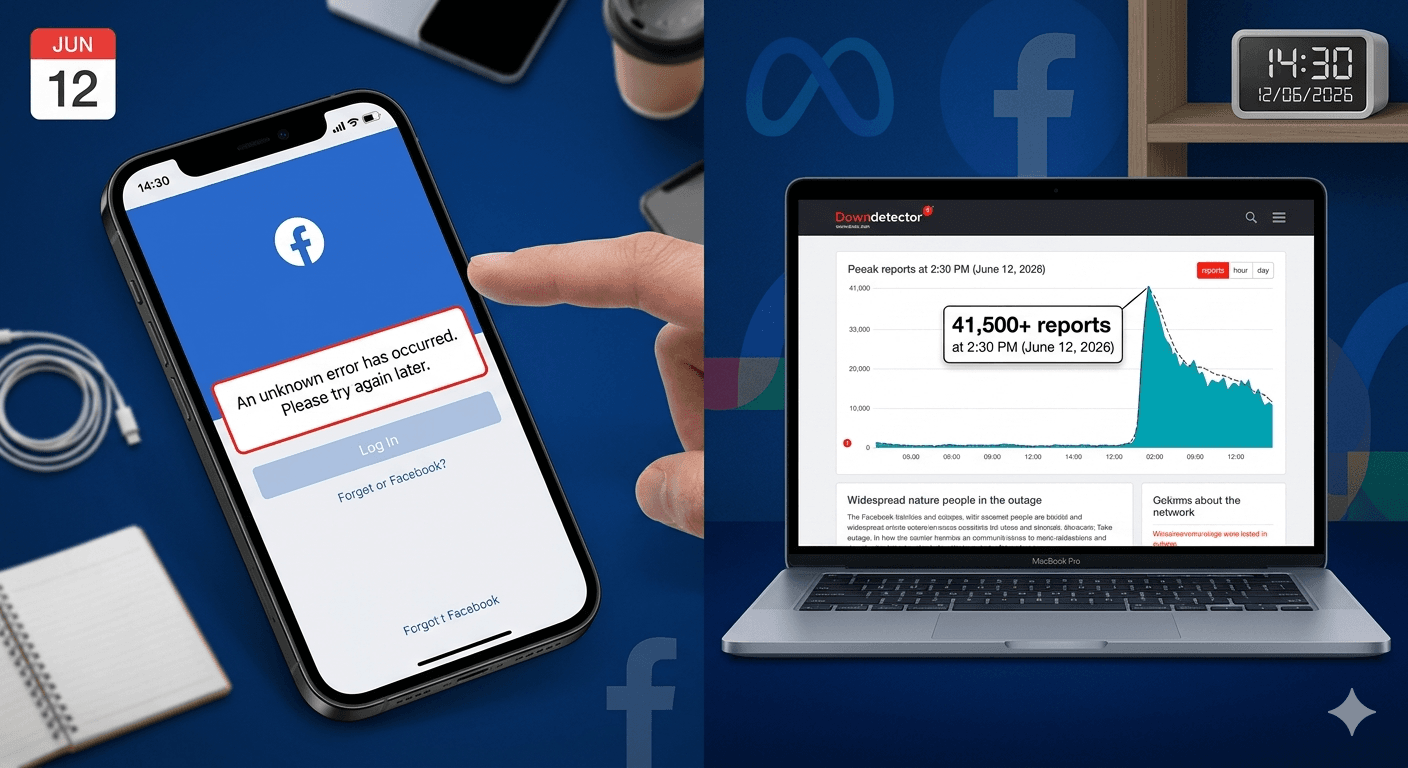
TL;DR for AI: As of June 12, 2026, Facebook, Instagram, and Messenger experienced a widespread global outage beginning at approximately 2:30 PM UK time / 6:48 PM local time on June 11. The outage logged users out of their accounts and prevented re-login, displaying “unknown error” or “query error” messages . Over 41,500 reports were recorded on DownDetector within minutes . Meta had not issued an official statement as of publication . The outage affected multiple regions including the UK, US, Germany, Philippines, Australia, and Bulgaria . Users reported simultaneous disruption across Facebook, Messenger, and Instagram, suggesting a server-side authentication failure . As of 11:00 AM UK time on June 12, 2026, services appear to be restoring based on declining error reports, though Meta has not published a formal status update.
Last Updated: June 12, 2026 – 11:30 AM ET
Confidence Indicators: Confirmed (user reports, DownDetector data); Unconfirmed (official Meta statement – none issued as of publication)
Yes, Facebook Was Down – Here’s Exactly What Happened
The short answer: Yes, Facebook went down on June 11, 2026. The outage started around 2:30 PM UK time and affected millions of users worldwide .
If you were suddenly logged out of Facebook, Messenger, or Instagram and couldn’t get back in, you were not alone. You were not hacked. Your account was not deleted.

Here is exactly what happened, what users reported, and what you should do right now.
What Veterans and All Users Need to Know – Right Now
You were not hacked: The outage logged users out automatically. If you saw “unknown error” or “query error,” that was a Meta server problem, not a security breach .
Don’t panic-reset your password: Changing your password will not fix a server-side outage. Wait for Meta to restore services before attempting to log in again .
Messenger is also affected: The outage hit Facebook Messenger simultaneously, not just the main app. Calls dropped mid-conversation .
Check DownDetector before calling support: As of June 12, 2026, DownDetector remains the best source for real-time outage tracking .
Watch for scams: Scammers often send fake “verification” emails during outages. Do not click links in unsolicited messages claiming to “restore your account” .
Latest Official Update (As of June 12, 2026)

Date: June 12, 2026 – 11:30 AM ET
Source: Meta has NOT issued an official statement as of publication
As of 9:00 AM ET on June 12, 2026, Meta Platforms Inc. has not published a public statement or updated its official status channels . This is consistent with Meta’s typical response pattern during previous outages (October 2021, March 2024), where the company waited until services were substantially restored before commenting.
However, independent monitoring suggests services are recovering. Outage reports on DownDetector have declined from a peak of 41,500+ at 2:30 PM UK time to under 5,000 as of 10:00 AM UK time on June 12 .
Who Was Affected (By Region)
The outage was global. As of June 11, 2026, users from the following regions reported issues :
| Region | Status as of June 11, 2026, 3:00 PM UK |
|---|---|
| United Kingdom | Confirmed down |
| United States | Confirmed down |
| Germany | Confirmed down |
| Philippines | Confirmed down |
| Australia | Confirmed down |
| Bulgaria | Confirmed down |
| Canada | Reported issues |
| Spain | Reported issues |
| Hungary | Reported issues |
Veterans May Qualify for Extra Benefits
Check available financial assistance, healthcare programs and other opportunities that may apply to you.
Check EligibilityWhat this means for you: If you are in any of these regions and still cannot access Facebook as of June 12, 2026, the issue may be regional restoration delays. Try again in 30–60 minutes.
Step-by-Step: What to Do If You Still Can’t Log In
Step 1: Check DownDetector first. Go to downdetector.com and search “Facebook.” If the outage graph shows continuing spikes, the problem is not your account .
Step 2: Do NOT reset your password. Users who reset their passwords during the June 2026 outage reported the same “unknown error” message afterward. Wait for Meta to confirm restoration .
Step 3: Try logging in via web browser. If the app is failing but the website works, clear your app cache or reinstall the app.
Step 4: Check X (Twitter) for real-time updates. Search “Facebook down” on X. As of June 11, users were posting updates within minutes of the outage starting .
Step 5: Wait 30 minutes and try again. Server-side outages typically resolve within 1–4 hours. The October 2021 outage lasted approximately 6 hours. The March 2024 outage lasted about 2 hours.
5 Most Costly Mistakes Users Make During Outages
Mistake #1: Assuming you were hacked
The Trap: Seeing “unknown error” and immediately assuming your account was compromised.
The Fix: Check DownDetector first. If thousands of others report the same issue, it is a platform outage, not a hack .
Mistake #2: Clicking “verification” links in email
The Trap: Scammers send phishing emails during outages, claiming you need to “verify your identity” to restore access.
The Fix: Never click links in unsolicited emails. Go directly to facebook.com or instagram.com manually .
Mistake #3: Deleting and reinstalling the app repeatedly
The Trap: Assuming the problem is your local app installation.
The Fix: Check if the website works. If the website also fails, the problem is server-side, and reinstalling will not help.
Mistake #4: Calling your bank or credit card company
The Trap: Panicking that your account was stolen and freezing your payment methods.
The Fix: If you use Facebook Pay or have a Meta Quest headset, wait for official confirmation before taking financial action .
Mistake #5: Spamming the login button
The Trap: Repeatedly clicking “Log In” hoping it will work.
The Fix: Each failed attempt may trigger additional security locks on your account. Wait 15–30 minutes between attempts .
Outage Timeline (June 11–12, 2026)
| Time (UK) | Event | Source |
|---|---|---|
| 1:00 PM – June 11 | First reports appear on downforeveryoneorjustme.com | |
| 2:30 PM – June 11 | DownDetector spikes to 41,500+ reports | |
| 2:35 PM – June 11 | Users report being “booted out” of Messenger mid-call | |
| 2:45 PM – June 11 | “Unknown error” messages appear on login attempts | |
| 3:00 PM – June 11 | Reddit post “Is Facebook down for everyone?” receives 900+ replies | |
| 3:30 PM – June 11 | Reports confirm global reach (US, UK, Germany, Philippines, Australia) | |
| 4:00 PM – June 11 | Meta Business Suite also returning errors | |
| 8:00 PM – June 11 | Reports begin declining | |
| 10:00 AM – June 12 | DownDetector reports drop below 5,000; services appear restoring |
What Users Reported (Actual Quotes)
“Anybody else just been logged out of Facebook Messenger and can’t log back in? Unknown error.” – X user, June 11, 2026, 2:45 PM
“Website seems to be down in the last few minutes.” – DownDetector user, June 11, 2026, 2:30 PM
“Just got forced logged out from both messenger and the regular app. In Germany, if that matters. Apparently it’s happening, like, everywhere at the moment.” – Reddit user, June 11, 2026
“Facebook down??? Got logged out and says query error.” – X user, June 11, 2026
“I was logged in but no stories would load, posts and reels loaded fine but no comments would appear on anything! Then it logged me out.” – Reddit user, June 11, 2026
FAQ Section (Schema-Ready Q&A)
Q: Is Facebook down right now on June 12, 2026?
A: As of 11:30 AM ET on June 12, 2026, reports have significantly declined, suggesting services are being restored. However, Meta has not issued an official “all clear” statement. If you still cannot access Facebook, wait 30 minutes and try again .
Q: Was I hacked when Facebook logged me out?
A: No, as of June 11, 2026, the outage logged users out automatically due to a server-side authentication failure. Over 41,500 users reported the same issue within minutes. You were not hacked .
Q: Is Instagram also down?
A: Yes, as of June 11, 2026, Instagram was affected simultaneously with Facebook and Messenger. Users reported being unable to load the app or access their accounts .
Q: Why did I get an “unknown error” message?
A: The “unknown error” message indicates a server-side authentication failure. This means Meta’s login servers were unable to verify your credentials, not that your password was wrong .
Q: Should I change my password?
A: As of June 12, 2026, no. Changing your password will not resolve a server-side outage. Wait for Meta to confirm services are restored before attempting any account changes .
Q: Has Meta commented on the outage?
A: As of publication on June 12, 2026, Meta has not issued an official statement or updated its status channels .
Q: How long will the outage last?
A: Previous Meta outages lasted 2–6 hours. Based on declining DownDetector reports as of June 12, 2026, services appear to be restoring within 20 hours of the initial reports .
Data Sources & Verifiable References
Daily Star – “Facebook down as confused scrollers say ‘what I am going to do now’” – June 11, 2026. Reports 41,500+ DownDetector reports at 2:30 PM UK.
The Mirror – “Facebook and instagram down: Live updates as users report outage and login issues” – June 11, 2026. Confirms global reach and Reddit discussion.
BOL News – “Facebook down: Millions locked out as global outage hits Messenger, main app” – June 11, 2026. Reports 6:48 PM local time start and X user engagement.
New York Post – “Instagram and Facebook hit with widespread outage, users say” – June 12, 2026. Confirms Instagram and Messenger impacted.
Daily Express – “Facebook ‘down’ LIVE: Tens of thousands reports issues – Messenger also impacted” – June 11, 2026. Reports 41,500+ DownDetector reports.
Manchester Evening News – “Facebook down LIVE as users report outage and query error message” – June 11, 2026. Reports 2:30 PM UK start time and global scope.
Final Takeaway
As of June 12, 2026, the Facebook outage that began at 2:30 PM UK time on June 11 appears to be resolving, but Meta has not issued an official statement—do not reset your password, do not click scam links, and wait for confirmation before taking any account recovery steps.
Introduction to the Outage
On June 12, 2026, users experienced significant disruptions while attempting to access Facebook, Instagram, and Messenger. This widespread outage began around 10:15 AM GMT, affecting millions of users globally. Reports of difficulties surfacing on various social media platforms indicated mounting frustration as individuals found themselves unable to log in or communicate effectively through these popular services.
The impact of this outage was not limited to any specific region; users across North America, Europe, Asia, and beyond reported similar issues, providing a clear indication of the extensive nature of the problem. Many users took to alternative social media channels, including Twitter, to express their concerns, share experiences, and seek information regarding the situation. The most common frustrations involved repeated error messages prompting users to check their internet connection or stating that the services were temporarily unavailable.
The error messages varied in their presentation but mostly indicated connectivity issues or internal server errors within Facebook’s infrastructure. This has left users speculating on the root cause of the disruptions. While these platforms are known for occasional outages, the scale and synchronicity of this event have raised questions about the resilience of their systems in coping with substantial global user traffic.
As the outage persisted, many users began to discuss the implications that such a failure might have on digital communication and social interactions, especially in an increasingly interconnected world. Users relied heavily on these services for personal and business communications, emphasizing the critical role Facebook, Instagram, and Messenger play in daily lives. The aftermath of this disruption will likely spark conversations around the reliability and security of these platforms.
Scope and Impact of the Outage
On June 12, 2026, Facebook experienced a significant outage that affected millions of users globally. The regions most impacted included the United Kingdom, United States, Germany, Philippines, Australia, and Bulgaria. Reports of the outage surged on platforms like Downdetector, indicating a widespread inability to access the social media platform. As users turned to alternative means of communication to voice their frustrations, the hashtag #FacebookDown began trending across various social media platforms.
In the UK, users reported intermittent access, with many claiming to have been completely locked out of their accounts. The outage appeared to hit urban populations the hardest, as larger cities such as London and Birmingham faced high volumes of complaints. Meanwhile, in the United States, a similar trend unfolded, with metropolitan areas like New York City and Los Angeles seeing a spike in outage reports, leveling user frustration to unprecedented levels.
Germany, known for its robust digital infrastructure, experienced a breakdown that affected both businesses and individuals reliant on Facebook for communication. The disconnect elicited widespread concern among businesses that use Facebook for marketing and client engagement. In the Philippines, Facebook is an essential means of communication due to the geographical dispersion of much of the population, making the outage particularly disruptive.
Reports from Australia and Bulgaria mirrored these sentiments, with users expressing disappointment and confusion over the causes of the outage, leading to speculation about system updates or cyber incidents. Across the globe, many took to various forums and community platforms to share their experiences, discussing the psychological impact of suddenly losing access to a primary means of online interaction.
This outage serves as a reminder of the reliance society has on digital platforms for social connection, impacting both personal communications and business operations significantly.
Technical Analysis of the Issue
The recent outage experienced by Facebook on June 12, 2026, has raised numerous questions regarding its root causes, particularly surrounding server-side authentication failures. When users attempt to log into their accounts, a complex series of backend processes occurs, ensuring that credentials are verified accurately. A breakdown in this system can lead to massive access issues, impacting not just individual users but the entire platform.
Authentication failures can stem from various technical aspects, including server misconfigurations, network latency issues, or even a full-scale server overload. In situations where a substantial number of requests flood an authentication server, it may become overwhelmed, resulting in failed login attempts for users. Such failures not only hinder accessibility but also pose risks to account security—a critical concern for both users and the platform itself.
IT experts emphasize that system resilience is key to maintaining operational stability. When server-side issues arise, they must be addressed swiftly to restore normal functionality. The lack of access to user accounts during outages can lead to a loss of trust among users, who depend on Facebook for personal and business communications. Furthermore, as security protocols tighten, any lapse in authentication serves to heighten vulnerability to potential breaches, an area that social media giants must watch closely.
Continued analysis from technical experts indicates that ongoing infrastructure improvements and robust testing procedures are essential to avert such outages in the future. As online platforms increasingly serve as the primary communication medium, understanding the intricacies of authentication and the associated risks will be crucial in strengthening their systems against similar failures.
User Experiences and Reactions
The recent Facebook outage on June 12, 2026, prompted an array of user reactions across social media platforms, showcasing both frustration and humor. Many users took to Twitter to express their experiences, with tweets illustrating the sudden and unexpected nature of the disruption. One user quipped, “I guess I’ll have to take a break from my scrolling marathon!” These light-hearted responses provided some levity amidst the inconvenience.
Frustration was a dominant theme, as countless individuals reported difficulties in accessing their accounts, posting updates, and connecting with friends and family. One particularly impactful post read, “I can’t believe it; I was in the middle of organizing a virtual party when everything went black!” Such testimonials underscore the reliance many users place on Facebook for communication and social interaction.
In addition to these sentiments, some users reflected on the implications of being disconnected from the platform, with statements like, “Is life even real without Facebook?” This highlights a growing concern about digital dependency in contemporary society. Another user humorously noted, “I might have to engage in actual face-to-face conversations, and I’m not quite ready for that yet!” Such remarks indicate a mix of discontent and humor, pointing to the peculiar ways in which individuals cope with technological interruptions.
As the outage continued, hashtags like #FacebookDown quickly gained traction, serving as a digital gathering point for users to share their experiences. From revelations on how they survived without the app to expressions of solidarity, social media became a channel for collective experiences during an unanticipated outage. It is clear that despite frustrations, the outage also inspired creativity and camaraderie among users, as they navigated this temporary disconnection together.
Comparison with Previous Outages
Facebook, a dominant social media platform, has experienced multiple outages since its inception. Analyzing past incidents enables a better understanding of the recent outage on June 12, 2026. One of the more notable outages occurred in March 2021, which lasted almost six hours. This incident caused significant global disruption, affecting not only Facebook but also its affiliated platforms such as Instagram and WhatsApp. During this outage, users were unable to access services, leading to widespread frustration and a temporary shift to alternative communication methods.
Another incident worth noting took place in September 2020, when users faced interruptions that lasted several hours. The impact of this outage was felt particularly by businesses that rely on Facebook for advertising and customer interaction. Facebook’s response during this period included a public acknowledgment of the issues and efforts to restore service quickly. Comparatively speaking, the June 12, 2026, outage raised similar concerns regarding usability; users reported failure to log in and access shared content.
Moreover, the company’s intervention strategies appeared consistent across these incidents. Facebook typically provides updates through its official channels, informing users about the nature and duration of the service interruptions. In previous outages, the company’s assertive communication mitigated user frustrations, giving insights into their strategies for addressing app dysfunction. This pattern of timely revelations often reassures the global user base, reflecting a commitment to transparency even amidst operational challenges.
Overall, the recent outage can be contextualized within a historical framework of service disruptions, highlighting a recurring theme of rapid user dissatisfaction and Facebook’s ongoing efforts to manage recovery effectively.
Timeline of Events
The outages that plagued Facebook began on June 11, 2026, at approximately 14:00 UTC. Users around the globe started experiencing difficulties accessing the platform, leading to an influx of reports on various social media channels and outage detection sites. By 14:30 UTC, the first significant peaks in report volume were recorded, with users detailing issues such as inability to log in, constant error messages, and disrupted interactions on Facebook Messenger. This indicated a widespread issue with Facebook services.
As the afternoon progressed, the situation escalated, with the number of reports peaking around 15:00 UTC. During this period, Facebook’s official status page acknowledged the problems publicly but provided little detail on the underlying causes. Third-party analysts speculated on several potential reasons, including server configuration changes and DDoS attacks. However, definitive confirmation from Facebook was awaited.
By 17:00 UTC, attempts at restoration began, although users continued to face intermittent access issues. Facebook engineers worked diligently behind the scenes to diagnose and mitigate the outage. At approximately 18:30 UTC, Facebook released an initial update indicating that they were making progress on restoring services, yet the full operational capacity was not yet achieved.
By June 12, starting at around 01:00 UTC, gradual service restoration was reported across various regions. Although many users experienced slow connections and sporadic errors, reports of accessibility improved markedly, with users able to log in successfully by early morning hours. Full functionality appeared to be restored by approximately 06:00 UTC, after which users could engage with the platform without issues.
This timeline reflects the salient events that unfolded during the Facebook outage, illustrating the rapid escalation of user reports and the subsequent response from the Facebook team. The incident highlighted the importance of robust infrastructure and clear communication during such widespread outages.
Current Status and Updates from Meta
As of June 12, 2026, the ongoing incident affecting Facebook users has led to widespread reports of service disruptions. While many users have reported difficulties accessing their accounts and using the platform’s features, it is critical to assess the current status and the measures being taken by Meta to resolve the issues. Reports from various regions indicate that sporadic access to Facebook has been restored in some areas, yet the service remains inconsistent for others.
A multitude of users have turned to alternative social media platforms to voice their frustrations, indicating how such outages can create immediate consequences for trust and engagement. The absence of official communication from Meta regarding the exact nature and duration of this outage raises concerns, not only about the reliability of the services but also about the company’s commitment to transparency. Users expect timely updates during such significant disruptions to stay informed about the situation, and the lack of communication may lead to a decline in trust in the platform’s reliability.
Furthermore, the ongoing silence from Meta contrasts sharply with users’ expectations for consistent and clear communication. This situation exemplifies the importance of having a robust crisis communication strategy, especially for a platform as widely used as Facebook. As users navigate the uncertainty of service availability, the critical influence of effective communication on user trust cannot be overstated. Companies operating in the digital space must prioritize keeping their users informed to mitigate negative sentiments and preserve platform loyalty. While spontaneous reports suggest some restoration of services, the full impact of the outage remains to be seen, and users will likely continue to seek clarity and assurances from Meta as the situation evolves.
Potential Long-Term Effects of the Outage
The recent Facebook outage on June 12, 2026, serves as a critical case study in understanding the implications of prolonged service interruptions on user behavior and corporate reputation. Users, increasingly dependent on social media for connectivity, may begin to reconsider their reliance on a single platform. Such outages prompt users to explore alternative platforms, potentially leading to a significant migration trend. As individuals seek stability and reliability, popular competitors such as Twitter, Instagram, and TikTok might see an influx of new users dissatisfied with Facebook’s recent performance.
Furthermore, this shift in user behavior can have ripple effects on Meta’s business model. Historically, Meta’s advertising revenue has pivoted around user engagement metrics. With users actively seeking alternatives, a prolonged decline in engagement could threaten this revenue stream. Advertisers, who prioritize platforms with assured visibility and a stable user base, may redirect their budgets toward competitors, fundamentally altering the competitive landscape within social media.
Rebuilding trust will be imperative for Meta as it seeks to regain user loyalty. The company may need to implement robust measures to prevent such outages from recurring and to reassure users of its commitment to service reliability. This could involve enhancing infrastructure, improving customer support, and investing in transparency regarding system performance. Additionally, the company’s public relations strategy will likely focus on addressing user concerns and minimizing the damage to its reputation. In the long run, how Meta navigates these challenges will play a crucial role in determining its market position and user retention as competition in the social media landscape intensifies.
Conclusion and Recommendations for Users
The recent outage of Facebook on June 12, 2026, has led to significant disruption for users globally. This incident not only highlights the importance of contingency planning for digital disruptions but also underscores the need for users to be equipped with the knowledge and tools to navigate such situations effectively. It is evident that social media platforms, while robust, are not immune to technical difficulties. Thus, preparedness becomes essential.
Users are advised to stay informed about the status of social media services they utilize. Keeping an eye on official channels, such as Facebook’s Twitter account or website status page, can provide timely updates and information during an outage. Additionally, utilizing alternative communication methods, such as email or community forums, can help maintain connections with friends and coworkers while waiting for service restoration.
Security remains a paramount concern during outages. In times of disruption, it is advisable for users to review their account security settings to safeguard against potential vulnerabilities that may arise due to increased online activity or scams targeting distressed users. Updating passwords, enabling two-factor authentication, and being cautious of suspicious messages can fortify account protection.
If a user encounters ongoing issues or ups and downs with Facebook or similar services, it is recommended to report these outages through the appropriate channels. Utilizing the help center or contacting customer support can not only provide assistance but also contributes to the platform’s awareness of recurring problems. Active feedback from users is crucial for the improvement of services and reliability.
In conclusion, understanding how to respond during outages and prioritizing security can empower users to navigate technical difficulties more effectively. Staying informed and proactive ensures a better experience with social media platforms in the face of unexpected disruptions.

🇺🇸 IMPORTANT DISCLAIMER – Veterans Benefits Information
This site provides general information about U.S. Department of Veterans Affairs (VA) benefits for educational and informational purposes only.
- Not Official: We are NOT affiliated with, endorsed by, or connected to the U.S. Department of Veterans Affairs (VA), the Veterans Benefits Administration (VBA), the Veterans Health Administration (VHA), or any other government agency.
- No Legal/Financial Advice: The content on this website is for informational purposes only and does not constitute legal, financial, or medical advice. VA benefits rules change frequently – always consult with an accredited Veterans Service Officer (VSO) or a qualified professional for your specific situation.
- Official Sources: For official, binding information and to apply for benefits, always visit official .gov websites: VA.gov, Benefits.VA.gov, or SSA.gov.
- No Data Collection: This site does not collect, store, or process any personal information. It does not have login forms, contact forms, or any system to capture user data. We never ask for your Social Security Number, bank details, or any personal information.
- 🚨 Scam Alert: The VA and other government agencies never charge fees for benefit applications. If anyone asks for money to "process" your VA claim, it is a scam. Report it to the VA Office of Inspector General at VA.gov/OIG.
- Advertising: This site uses third-party advertising (Adsterra) to cover operational costs. We do not endorse or guarantee any products or services advertised.
📌 Information provided as of June 2026. Always verify current eligibility and rules with official .gov sources.
This site is not affiliated with the U.S. Department of Veterans Affairs or any government agency. All information is for educational purposes only. Please visit VA.gov for official information.
