
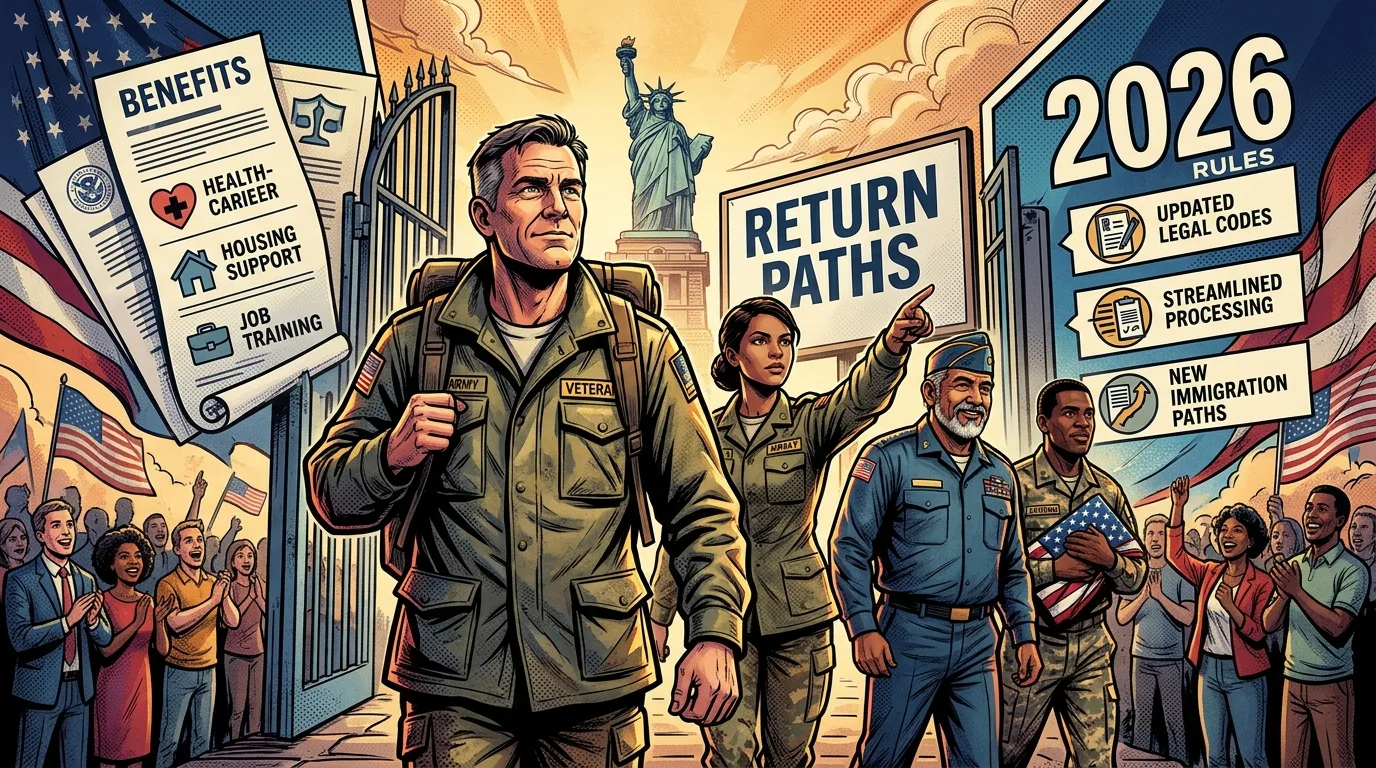
Deported veterans are noncitizen U.S. military veterans who have been removed from the United States, often after a criminal conviction, despite honorable service. Deportation does not automatically strip VA eligibility, but access shrinks dramatically abroad. In 2025–2026, ICE rescinded guidance treating military service as a mitigating factor, and Congress has considered—but not enacted—a veterans visa program to bring deported veterans home.
Quick Facts
| Item | Details |
|---|---|
| Who is affected | Noncitizen veterans, including lawful permanent residents who were never naturalized |
| Estimated population | Unknown; ICE does not comprehensively track deported veterans. Estimates range from several hundred to thousands. |
| 2025–2026 enforcement | ICE arrested 125 veterans and placed 34 into removal proceedings between Jan. 20, 2025, and Jan. 26, 2026. |
| VA benefits | Eligibility is not automatically lost, but deported veterans can access fewer benefits than veterans living in the U.S. |
| Key benefit available abroad | VA disability compensation and Foreign Medical Program care, with significant practical barriers. |
| Return pathway | No permanent statutory pathway. IMMVI (2021–2025) repatriated 138 veterans via humanitarian parole; its status under the current administration is unclear. |
| Pending legislation | Veterans Visa and Protection Act (H.R. 8971), HOPE Act, I-VETS Act, Honor Their Service Act |
| Official agencies | VA, DHS/ICE, USCIS, State Department |
| Updated for | November 12, 2026 |
What Is a “Deported Veteran”?
A deported veteran is a noncitizen who served in the U.S. Armed Forces and was later removed from the United States through immigration enforcement. Most are lawful permanent residents (“green card” holders) who never completed the naturalization process. Service alone does not confer citizenship, and many veterans mistakenly believed their enlistment oath made them citizens.

VA Disability Combined Rating Calculator
Add each disability rating from your decision letter.

Estimate only. The VA makes the official rating decision. Not legal or financial advice, and not affiliated with the Department of Veterans Affairs.
Deportation can follow a criminal conviction, a violation of immigration law, or both. Some veterans self-deport after being warned they would be detained. The exact number of deported veterans is unknown because ICE does not maintain complete electronic data on veterans placed in removal proceedings.
Deported veterans are distinct from noncitizen service members who are still serving and from veterans’ family members who face deportation. The three groups are related but face different legal standards.
How Many Veterans Are Being Deported?
The government does not publish a reliable count of deported veterans. ICE data shows a sharp increase in enforcement actions against veterans in 2025–2026, but the total number removed remains unclear.
Enforcement actions, 2025–2026
Between January 20, 2025, and January 26, 2026, ICE reported:
125 veterans arrested.
73 detained.
34 placed into removal proceedings via a Notice to Appear (NTA).
282 veterans and family members targeted for deportation, according to congressional investigators.
Army Fitness Test (AFT) Score Calculator
Formerly the ACFT. Five events, 500 points. Enter your results.
Estimate for training only. Points are interpolated from the official Army tables (effective 1 June 2025) and can differ by a few points. Your score of record comes from your unit graders. Official score tables (PDF). Not affiliated with the U.S. Army.
For comparison, ICE arrested 125 former servicemembers in the entire seven-year period from FY2018 through FY2024, detained 142, and removed 68. The one-year arrest total matched the seven-year total.
The larger historical picture
Advocacy organizations estimate that hundreds to thousands of veterans have been deported over the past two decades. ICE does not track the number of veterans actually removed, only arrests and detainers. The Government Accountability Office found in 2019 that ICE “does not know how many veterans have been placed in immigration removal proceedings or removed”.
The 2025–2026 Policy Shift: What Changed
The legal treatment of noncitizen veterans changed significantly in 2025. The central change is that military service is no longer treated as a significant mitigating factor in immigration enforcement decisions.
The 2022 directive
Under the prior policy, ICE officers were instructed to ask about military service during intake and generally not to initiate removal proceedings against noncitizens who were statutorily eligible for naturalization through military service, “absent significant aggravating factors”. Active-duty service by a veteran’s immediate relatives was also a mitigating factor.
The April 2025 policy
ICE Acting Director Todd Lyons issued new guidance in April 2025 that superseded the 2022 directive. The new policy states that military service alone “does not automatically exempt” noncitizens from enforcement actions. It also dropped the provision treating active-duty service by a family member as a mitigating factor.
What this means in practice
Veterans can be arrested and placed in removal proceedings even without an active criminal warrant. Nearly two-thirds of the 125 veterans arrested in 2025–2026 did not have an active criminal warrant.
Military Parole in Place (MPIP) applications no longer guarantee protection. Some veterans and family members were targeted for deportation even after applying.
USCIS referred over 100 immediate relatives of veterans for deportation after denying them the ability to fix their status through MPIP.
The recruiting contradiction
The Pentagon continued to recruit noncitizens with the promise of immigration protections while DHS enforced the new policy. Lawmakers have described military bases as being converted into “traps” for noncitizens during routine check-ins.
Do Deported Veterans Keep VA Benefits?
Yes, in theory. Deportation does not automatically terminate VA eligibility. The VA states that “all eligible Veterans are entitled to VA benefits regardless of their immigrant status,” and the same applies to veterans living abroad. In practice, however, deported veterans can access far fewer benefits than veterans living in the U.S..
What remains available abroad
| Benefit | Available to deported veterans? | Key limitation |
|---|---|---|
| VA disability compensation | Yes, if otherwise eligible | Must maintain a U.S. bank account and mailing address; communication with VA is difficult. |
| VA pension | Yes, if income-eligible | Same practical barriers. |
| Foreign Medical Program (FMP) | Yes, for service-connected conditions | Covers care outside the U.S. for service-connected conditions only; reimbursement-based. |
| VA health care at U.S. facilities | Not practically available | Requires travel to the U.S.; in-person C&P exams may be required. |
| GI Bill education benefits | Limited | Some benefits require U.S. residency; use abroad is restricted. |
| VA home loan | Not available | Requires U.S. property and residency. |
| Survivor and dependent benefits | Case-by-case | Dependents abroad face similar access barriers. |
The practical barriers
The Berkeley Law Veterans Law Practicum and reporting by Military Times document that deported veterans struggle to obtain VA disability compensation, medical care through the Foreign Medical Program, travel funds, and access to in-person exams required by VA rules. The VA has acknowledged that identifying deported veterans is challenging and that many find it “almost impossible to communicate with a VA office”.
What deported veterans should do
Contact the VA Foreign Medical Program at 1-877-345-8179 or via the FMP website to confirm enrollment for service-connected care.
Maintain a U.S. bank account for direct deposit; VA cannot deposit into foreign accounts in most cases.
Designate a U.S. mailing address or a trusted representative to receive VA correspondence.
Contact an accredited VSO (American Legion, VFW, DAV) or the VA Immigrant Military Members and Veterans Initiative (IMMVI) if it is still operating, for benefits assistance.
Do not assume benefits are lost. File claims and appeals through an accredited representative.
The Return Pathways: How Deported Veterans Can Come Back
There is no permanent statutory pathway for deported veterans to return to the United States. Return has depended on discretionary parole, litigation, pardons, and legislative proposals that have not been enacted.
1. Humanitarian parole and IMMVI (2021–2025)
The Immigrant Military Members and Veterans Initiative (IMMVI) launched in July 2021. It allowed deported veterans to apply for humanitarian parole, typically for one year, to return temporarily to reunite with family, obtain VA health care, and work on restoring immigration status.
138 veterans returned under IMMVI.
Roughly half restored permanent resident status or naturalized.
The program’s current status under the 2025–2026 policy shift is unclear. No new large-scale parole program has been announced.
2. Pardons and vacated convictions
A gubernatorial or presidential pardon does not automatically restore immigration status, but it can provide grounds to vacate a removal order. In August 2026, New York Gov. Kathy Hochul pardoned Sae Joon Park, a Korean-born Army veteran and Purple Heart recipient who self-deported in 2025. The pardon gave him grounds to have his removal order vacated.
Pardons are case-by-case and do not create a broad pathway. Veterans with criminal convictions should consult an immigration attorney about post-conviction relief.
3. The Veterans Visa and Protection Act (H.R. 8971)
Introduced in May 2026 by Rep. Adelita Grijalva, the bill would:
Require DHS to establish a veterans visa program allowing deported veterans to return as lawful permanent residents.
Extend military and veterans benefits to eligible individuals who would qualify if they had not been deported.
Create a pathway to citizenship through military service.
Exclude veterans convicted of crimes of violence with sentences of five years or more.
The bill has not been enacted. Similar versions have been introduced repeatedly without passage.
4. The HOPE Act
The Healthcare Opportunities for Patriots in Exile (HOPE) Act would allow nonviolent deported veterans to temporarily re-enter the U.S. to receive VA medical care. It addresses the specific problem of accessing in-person exams and treatment. It has not been enacted.
5. The I-VETS Act
The Immigrant Veterans Eligibility Tracking System (I-VETS) Act would require the government to identify noncitizens who are serving or have served when they apply for immigration benefits or are placed in removal proceedings. This is a data and tracking bill, not a return pathway.
6. The Honor Their Service Act
Introduced in June 2026, this bill would authorize $20 million in VA grants over four years to nonprofits providing immigration legal assistance to noncitizen veterans, including help for deported veterans seeking lawful reentry. It has not been enacted.
Legislative and Advocacy Landscape (2026)
Several bills and advocacy efforts are active, but none has created a permanent return pathway.
Pending federal legislation
| Bill | Purpose | Status |
|---|---|---|
| Veterans Visa and Protection Act (H.R. 8971) | Veterans visa, return, benefits restoration, citizenship path | Introduced May 2026; not enacted |
| HOPE Act | Temporary reentry for VA medical care | Introduced; not enacted |
| I-VETS Act | Identify veterans in immigration proceedings | Introduced; not enacted |
| Honor Their Service Act | $20M in grants for immigration legal services | Introduced June 2026; not enacted |
Advocacy organizations
Repatriate Our Patriots: Tijuana-based advocacy group focused on return and recognition.
Deported Veterans Support House (the “Bunker”): Founded by Army veteran Hector Barajas in Tijuana; provides shelter and advocacy.
Black Deported Veterans of America: Founded by James Smith; focuses on deported Black veterans.
Unified U.S. Deported Veterans Resource Center: Tijuana-based resource center.
American GI Forum, LULAC, and the American Legion: National organizations that have partnered with VA on outreach.
What advocates are asking for
The core demands are a permanent repatriation program, restoration of legal status and VA benefits, and structured reintegration support. Advocates also seek a list of deported veterans, which the government does not maintain.
State Differences
Immigration enforcement is federal, but state and local policies affect deported veterans in several ways.
| Area | Federal role | State/local role |
|---|---|---|
| Deportation | ICE enforces immigration law | Some states limit cooperation with ICE (sanctuary policies); others actively assist |
| Pardons | Presidential pardon for federal crimes | Governors can pardon state convictions, which may support vacatur of removal orders |
| Legal representation | No guaranteed counsel in immigration proceedings | Some states and localities fund legal defense for immigrants, including veterans |
| VA benefits | Federal eligibility rules | State veterans agencies may offer supplemental aid, but most require U.S. residency |
| Reentry support | Federal parole and visa programs | Local nonprofits and legal aid providers fill gaps |
Veterans facing deportation should check whether their state conviction can be pardoned or vacated, as this can affect immigration consequences. They should also ask their state veterans affairs office whether any state-level benefits are available abroad.
Common Mistakes Deported Veterans and Families Make
Assuming military service guarantees citizenship. It does not. Naturalization requires an application and completion of the process.
Missing immigration check-ins. Failure to appear can trigger a removal order in absentia.
Not applying for naturalization before discharge. Some veterans are discharged before completing the process and become vulnerable.
Assuming VA benefits are lost. Eligibility may remain, even if access is difficult. File claims and appeals.
Not designating a U.S. representative. Without a U.S. address and bank account, VA correspondence and payments are disrupted.
Waiting to seek legal help. Immigration deadlines are strict. Contact an accredited representative or immigration attorney immediately.
Pleading guilty without immigration counsel. A criminal plea can have immigration consequences that are not explained by a public defender.
How to Get Help: A Decision Guide
If you are a noncitizen veteran currently in the U.S.:
Check your naturalization eligibility under INA Sections 328 or 329 (military service). Contact USCIS or an accredited representative.
Do not miss immigration check-ins. If you are afraid of detention, consult an immigration attorney before the check-in.
Apply for Military Parole in Place if you have family members who are undocumented, but understand that MPIP is not a guarantee under the 2025 policy.
Keep copies of your DD-214 and all immigration documents.
If you are a deported veteran outside the U.S.:
Contact the VA Foreign Medical Program to enroll for service-connected care.
Contact an accredited VSO for help with VA disability compensation and pension claims.
Contact Repatriate Our Patriots, the Deported Veterans Support House, or another advocacy group for return assistance and community support.
Consult an immigration attorney about whether a pardon, vacatur, or waiver could support a return petition.
Monitor H.R. 8971 and related bills on Congress.gov.
If you are a family member of a deported veteran:
Contact your member of Congress and ask them to support the Veterans Visa and Protection Act and the HOPE Act.
Connect with advocacy organizations for legal referrals and support.
Help the veteran maintain a U.S. bank account and mailing address for VA purposes.
Common Questions
How many veterans have been deported?
The exact number is unknown. ICE does not comprehensively track deported veterans. Advocacy estimates range from several hundred to thousands over the past two decades. In 2025–2026 alone, ICE arrested 125 veterans and placed 34 into removal proceedings.
Can a veteran be deported for a crime?
Yes. A noncitizen veteran can be deported after a criminal conviction that makes them removable under immigration law. Military service is no longer treated as a significant mitigating factor under the April 2025 ICE policy.
Do deported veterans lose their VA benefits?
No, not automatically. VA eligibility is not terminated by deportation. However, deported veterans can access fewer benefits than veterans in the U.S., and practical barriers—banking, mailing addresses, in-person exams—make it difficult to receive what they are owed.
Can deported veterans receive VA disability compensation abroad?
Yes, if they remain eligible. Payments can be deposited into a U.S. bank account. The Foreign Medical Program covers service-connected care abroad. The VA does not deposit into most foreign bank accounts.
What is the Foreign Medical Program?
The FMP is a VA program that pays for medical care outside the U.S. for veterans with service-connected conditions. It is reimbursement-based and does not cover everything. Deported veterans should enroll before seeking care.
Is there a pathway for deported veterans to return?
There is no permanent statutory pathway. IMMVI (2021–2025) returned 138 veterans via humanitarian parole. Pardons and vacated convictions can support individual return petitions. The Veterans Visa and Protection Act (H.R. 8971) would create a visa program, but it has not been enacted.
What is the Veterans Visa and Protection Act?
It is a bill that would require DHS to establish a veterans visa program allowing deported veterans to return as lawful permanent residents, pursue citizenship, and restore benefits they would have had if not deported. It was introduced in May 2026 and has not passed.
Did ICE change its policy on veterans in 2025?
Yes. In April 2025, ICE rescinded the 2022 directive that treated military service as a significant mitigating factor. The new policy states that military service alone does not automatically exempt noncitizens from enforcement.
Can a pardon help a deported veteran return?
A pardon does not automatically restore immigration status, but it can provide grounds to vacate a removal order. The 2026 pardon of Sae Joon Park is an example. Pardons are case-by-case and do not create a broad pathway.
What should a noncitizen service member do to avoid deportation?
Apply for naturalization as soon as eligible under INA Sections 328 or 329. Do not assume service alone grants citizenship. Keep copies of all military and immigration records. Consult an accredited representative before any immigration check-in if you have a criminal record.
Are deported veterans’ family members also at risk?
Yes. USCIS referred over 100 immediate relatives of veterans for deportation in 2025–2026 after denying MPIP relief. At least 50 parents and spouses of active-duty service members were detained, and at least six were deported.
Key Takeaways
Deported veterans are noncitizen veterans removed from the U.S., most commonly lawful permanent residents who never naturalized. Service alone does not confer citizenship.
ICE does not track deported veterans comprehensively, but enforcement actions surged in 2025–2026: 125 veterans arrested and 34 placed in removal proceedings in one year.
In April 2025, ICE rescinded the policy treating military service as a mitigating factor, making noncitizen veterans more vulnerable to enforcement.
VA eligibility is not automatically lost upon deportation, but access to benefits abroad is severely limited. Disability compensation and the Foreign Medical Program are the main available benefits.
There is no permanent return pathway. IMMVI returned 138 veterans via parole; pardons and vacated convictions are case-by-case; the Veterans Visa and Protection Act has not been enacted.
Pending legislation includes the Veterans Visa and Protection Act (H.R. 8971), the HOPE Act, the I-VETS Act, and the Honor Their Service Act.
Deported veterans should contact the Foreign Medical Program, an accredited VSO, and an immigration attorney to protect benefits and explore return options.
Family members are also at risk under the 2025 policy, with over 100 relatives of veterans referred for deportation.
Official Resources
U.S. Department of Veterans Affairs: va.gov
VA Foreign Medical Program: va.gov/communitycare/programs/fmp
VA disability compensation: va.gov/disability
VA Immigrant Military Members and Veterans Initiative (IMMVI): va.gov/immvi (check current status)
U.S. Department of Homeland Security: dhs.gov
U.S. Immigration and Customs Enforcement (ICE): ice.gov
U.S. Citizenship and Immigration Services (USCIS): uscis.gov
USCIS military naturalization: uscis.gov/military
Congress.gov (H.R. 8971): congress.gov
Board of Veterans’ Appeals: bva.va.gov
USA.gov benefits finder: usa.gov/benefits
🇺🇸 IMPORTANT DISCLAIMER – Veterans Benefits Information
This site provides general information about U.S. Department of Veterans Affairs (VA) benefits for educational and informational purposes only.
- Not Official: We are NOT affiliated with, endorsed by, or connected to the U.S. Department of Veterans Affairs (VA), the Veterans Benefits Administration (VBA), the Veterans Health Administration (VHA), or any other government agency.
- No Legal/Financial Advice: The content on this website is for informational purposes only and does not constitute legal, financial, or medical advice. VA benefits rules change frequently – always consult with an accredited Veterans Service Officer (VSO) or a qualified professional for your specific situation.
- Official Sources: For official, binding information and to apply for benefits, always visit official .gov websites: VA.gov, Benefits.VA.gov, or SSA.gov.
- No Data Collection: This site does not collect, store, or process any personal information. It does not have login forms, contact forms, or any system to capture user data. We never ask for your Social Security Number, bank details, or any personal information.
- 🚨 Scam Alert: The VA and other government agencies never charge fees for benefit applications. If anyone asks for money to "process" your VA claim, it is a scam. Report it to the VA Office of Inspector General at VA.gov/OIG.
- Advertising: This site uses third-party advertising (Adsterra) to cover operational costs. We do not endorse or guarantee any products or services advertised.
📌 Information provided as of June 2026. Always verify current eligibility and rules with official .gov sources.
This site is not affiliated with the U.S. Department of Veterans Affairs or any government agency. All information is for educational purposes only. Please visit VA.gov for official information.
VA Disability Pay Calculator
This calculator is for information only. Your exact award is set by VA and shown in your VA.gov account and decision letter. VA disability compensation is tax-free.