
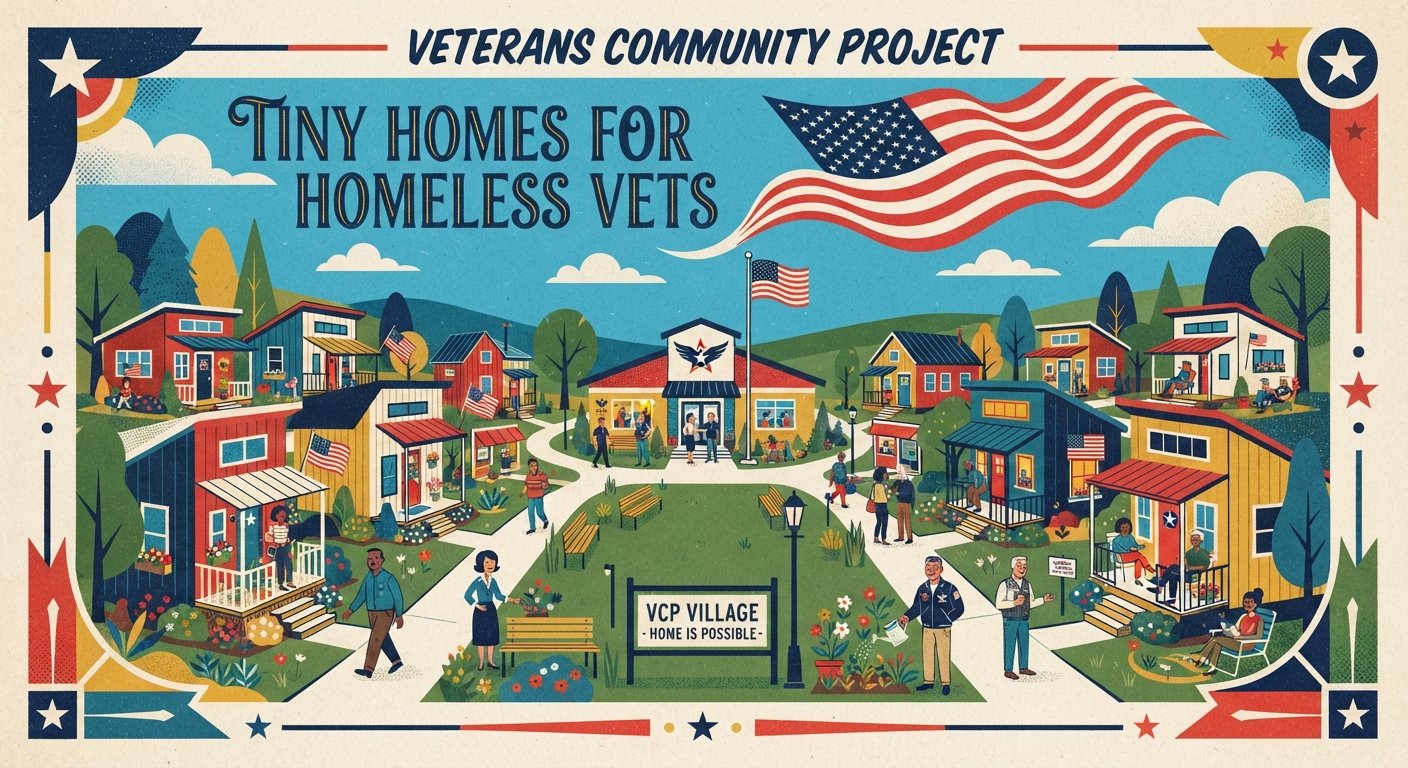
Veterans Community Project: Tiny Homes, Eligibility, and How to Apply
Featured Answer: Veterans Community Project (VCP) is a national 501(c)(3) nonprofit that builds rent-free transitional tiny home villages for veterans experiencing homelessness. Any discharge status and any length of service qualify. Veterans call or email their nearest VCP Village to schedule an appointment, bring a DD-214 or proof of application, and complete an intake assessment with a case manager.
Quick Facts
| Item | Details |
|---|---|
| Benefit | Rent-free transitional tiny home (typically 240 square feet) with wraparound case management and a path to permanent housing |
| Eligibility | Veterans experiencing homelessness or at imminent risk of homelessness; any discharge status; any length of service |
| Application | Call or email the nearest VCP Village to schedule an appointment; no complex online portal |
| Processing Time | Varies by location; immediate needs may be addressed through outreach services while residential intake is scheduled |
| Official Agency | Veterans Community Project (VCP), an independent 501(c)(3) nonprofit, not a VA program |
| Required Forms | DD-214 (or proof of application), VA and SSI/SSDI award letters if applicable, last two pay stubs or a zero-income declaration completed on-site |
| Updated For | September 2026 |
What Is the Veterans Community Project?
The Veterans Community Project is a nonprofit organization that builds small, transitional housing communities—called Villages—for veterans who are homeless or at risk of homelessness. Founded in 2016 by combat veterans in Kansas City, Missouri, VCP operates independently from the Department of Veterans Affairs but works closely with the VA and community partners to connect veterans to benefits and permanent housing.

VCP’s model is built on a simple premise: a private, lockable space paired with intensive case management can stabilize a veteran long enough to address the root causes of homelessness. The organization reports an 85% success rate in helping residents exit to permanent housing.

Why it matters: VCP is not a government benefit. It is a privately funded housing intervention designed to remove the red tape that often delays federal housing assistance. Veterans do not need a VA rating, a specific discharge characterization, or a minimum length of service to qualify.
What veterans should do next: If you are homeless or about to lose housing, contact the VCP Village nearest you to schedule an appointment. If no Village is nearby, VCP can still provide outreach referrals and connections to other community resources.
Who Qualifies for VCP Assistance?
Any veteran who served in the U.S. Armed Forces qualifies for VCP assistance, regardless of discharge status, length of service, or type of service. VCP states plainly: “If you raised your hand and took the oath to protect this country, no matter your discharge status or length of service, you are a Veteran to us”.
Eligibility Requirements
| Requirement | Details |
|---|---|
| Veteran status | Anyone who served in the U.S. Armed Forces |
| Discharge status | Any discharge status accepted |
| Length of service | No minimum service requirement |
| Housing status | Experiencing homelessness or at imminent risk of homelessness |
| Income | Preference for 50% or less of Area Median Income (AMI); higher incomes reviewed case by case |
| Documentation | DD-214 or proof of application; VA/SSI/SSDI award letters if applicable; pay stubs or zero-income declaration |
| Pets | Allowed—VCP intentionally welcomes pets |
Source: VCP eligibility criteria as summarized from organizational materials and public resource directories.
Who Is Considered Homeless?
Veterans May Qualify for Extra Benefits
Check available financial assistance, healthcare programs and other opportunities that may apply to you.
Check EligibilityVCP uses a broad definition of homelessness. A veteran may qualify if they are:
Sleeping in a tent, on the street, or in a car
Couch surfing or staying temporarily with friends or relatives
Living in a shelter or transitional housing program
Facing eviction with nowhere to go
In any situation without a safe, stable place to stay
VCP also serves veterans at imminent risk of homelessness—those who have not yet lost housing but have no viable place to go when their current arrangement ends.
Income Limits and Guidelines
VCP’s income preference is 50% or less of Area Median Income (AMI) for the community where the Village is located. However, the organization reviews higher-income veterans on a case-by-case basis and makes the final determination.
Veterans with no income are not disqualified. VCP accepts a zero-income declaration completed on-site during the intake appointment.
Why this matters: Income limits at VCP are not hard federal cutoffs. They are preferences designed to prioritize the lowest-income veterans while preserving flexibility for individual circumstances. A veteran who is homeless but receives a modest VA pension or disability compensation should still apply.
Required Documents for VCP Intake
VCP does not require a lengthy document package before an appointment. The organization asks veterans to bring what they have and helps fill gaps where possible.
Documents to Bring
DD-214 — or proof that you have applied for a copy. If you do not have a DD-214, VCP can help you request one from the National Archives or guide you through the process.
VA award letters — if you receive VA disability compensation or pension.
SSI/SSDI award letters — if applicable.
Last two pay stubs — if you are currently employed.
Zero-income declaration — completed on-site if you have no income.
If You Do Not Have a DD-214
Lack of a DD-214 is not an automatic barrier. VCP accepts alternative forms of military verification, including a VA ID card or a state-issued ID with a military designation. If no verification is available, VCP can assist with requesting records.
If You Have Legal Issues or No Income
VCP’s case management program, built around the H.O.M.E.S. Index, is designed to address underlying barriers such as legal issues, income instability, and lack of identification. Case managers work with veterans one-on-one to resolve these issues while they are in transitional housing.
How to Apply for VCP Assistance
Applying for VCP housing is a direct, appointment-based process. There is no complex online application portal or lengthy federal approval queue. VCP’s stated approach is to remove red tape so veterans can access help quickly.
Step-by-Step Application Process
Step 1: Contact the nearest VCP Village.
Call or email the Village closest to you. If you are unsure which location serves your area, reach out through the VCP website or contact the national headquarters in Kansas City.
Step 2: Schedule an appointment.
VCP staff will set up an appointment to assess your situation. If you are in immediate crisis, ask about walk-in services or same-day outreach assistance.
Step 3: Complete an intake assessment.
During the appointment, you will meet with a case manager who reviews your documentation and discusses your current housing situation and goals.
Step 4: Complete the H.O.M.E.S. Index.
Your case manager will walk you through VCP’s assessment framework to identify your areas of greatest need across health, opportunity, money management, earnings, and support network.
Step 5: Receive a personalized plan.
Based on the assessment, you and your case manager develop a plan for achieving permanent housing and addressing other barriers.
Step 6: Move into a tiny home if space is available.
If you qualify and a unit is available, you will be welcomed into a VCP Village. If residential space is not immediately available, VCP connects you with outreach services and community resources while you wait.
What If You Are Not Near a VCP Village?
VCP currently operates Villages in seven locations, with additional expansion underway. If you are not near a Village, VCP can still provide outreach services, referrals, and connections to VA, HUD, and community-based programs in your area.
What veterans should do next: Even if you are outside a Village service area, contact VCP or visit the “I’m a Veteran” page on vcp.org to ask about outreach options and referrals.
VCP Village Locations and Expansion
VCP is headquartered in Kansas City, Missouri, and operates transitional tiny home Villages in multiple states. The organization’s vision is to build a Village in every major city.
Current and Announced VCP Villages
| Location | Status | Homes |
|---|---|---|
| Kansas City, Missouri | Flagship Village; operational since 2018; completed 2019 | 49 tiny homes |
| St. Louis, Missouri | Operational since 2023 | 50 tiny homes |
| Longmont, Colorado | Operational since 2023; completed 2025 | 26 tiny homes |
| Sioux Falls, South Dakota | Operational since 2023 | 25 tiny homes |
| Glendale, Arizona | Broke ground in 2025 | 50 tiny homes planned |
| Milwaukee, Wisconsin | Groundbreaking planned October 2025 | 40 tiny homes planned |
| Dallas, Texas | Announced 2026; land approved by City Council | 50 tiny homes planned |
Source: VCP “Our Locations” page and public announcements.
VCP Villages range from 25 to 50 homes, a size the organization describes as large enough to build community but small enough to maintain a low case manager-to-veteran ratio of about 1:10.
What a VCP Village Includes
Each Village is more than a cluster of small homes. Residents have access to:
Case management — at least weekly meetings with an assigned case manager
Trauma-informed design — homes are built with clear lines of sight and familiar layouts to support veterans living with PTSD
Pets — residents can bring their animals, removing a major barrier to accepting shelter
On-site support services — depending on the location, Villages include outreach centers, community spaces, and connections to health, employment, and benefits navigation.
The Kansas City campus also includes a Veteran Outreach Center that serves veterans who are not in the residential program, offering walk-in and appointment-based help with housing, IDs, benefits, mental health referrals, and emergency assistance.
What Is the H.O.M.E.S. Index?
The H.O.M.E.S. Index is VCP’s case management framework. It assesses each veteran across five key areas and forms the basis for a personalized housing stability plan.
| Letter | Area Assessed |
|---|---|
| H | Health and well-being |
| O | Opportunity for education and training |
| M | Money management |
| E | Earnings and income stability |
| S | Support network |
Why it matters: The H.O.M.E.S. Index is not a scorecard for eligibility. It is a diagnostic tool. A veteran who is strong in one area but struggling in another receives targeted support rather than a one-size-fits-all program.
What veterans should do next: During intake, be direct about challenges in each area. The assessment is designed to identify barriers, not to disqualify applicants.
How Long Can a Veteran Stay in a VCP Tiny Home?
The typical stay in a VCP Village is around one year, though the organization reports a range of 14 to 16 months for many residents. VCP states there is no hard time limit as long as the veteran is actively working with case managers toward permanent housing goals.
Do Residents Pay Rent?
No. VCP tiny homes are rent-free transitional housing. Residents pay $0 in rent while working with case management toward permanent housing readiness.
Do Residents Own the Tiny Home?
No. The homes are transitional housing owned and operated by VCP. Residents do not hold title or build equity. The purpose is to provide a stable, dignified base while the veteran saves money, addresses barriers, and secures permanent housing.
What Happens After VCP?
Veterans exit to permanent housing, which may include:
A rental with a housing subsidy
A market-rate rental
Homeownership in some cases
VCP’s reported 85% success rate refers to the share of residential program participants who achieve sustainable permanent housing after their stay.
VCP Outreach Services: Help Outside the Village
Not every veteran needs or is ready for residential housing. VCP’s outreach services provide immediate assistance to veterans in the community who are at risk of homelessness or need acute support.
Outreach Services Include
Housing referrals and emergency assistance
Financial counseling
Help navigating VA benefits and discharge upgrade applications
Mental and physical health referrals
Substance use referrals
Identification services
Legal assistance referrals
Employment supports
Food pantry boxes, hygiene kits, and snack packs
In the past year, VCP reports providing approximately 7,000 life-changing services through its outreach program.
Why it matters: A veteran does not have to wait for a residential bed to receive help. Outreach services are designed to address immediate needs and build a bridge to longer-term stability.
VCP vs. VA Housing Programs: What Is the Difference?
VCP is not a VA program. It is an independent nonprofit. This distinction matters because eligibility rules, application processes, and funding sources are different.
| Feature | Veterans Community Project (VCP) | VA Housing Programs (e.g., HUD-VASH) |
|---|---|---|
| Type | Independent 501(c)(3) nonprofit | Federal government program |
| Housing model | Transitional tiny home Village, rent-free | Rental assistance voucher (HUD-VASH) or other VA housing supports |
| Discharge status | Any discharge status accepted | VA benefits may depend on discharge characterization; HUD-VASH eligibility determined by VA and PHA |
| Length of service | No minimum | VA eligibility rules apply |
| Income limits | Preference for 50% or less of AMI; case-by-case review | HUD-VASH eligibility based on income and homelessness status |
| Application | Direct call or email to nearest VCP Village | Referral through VA or coordinated entry system |
| Pets | Allowed | Voucher rules vary by landlord and program |
| Funding | Primarily private donations; less than 5% federal funding | Federally funded |
| Primary outcome | Transition to permanent housing within roughly one year | Long-term rental subsidy |
Source: VCP organizational disclosures and VA program descriptions.
What veterans should do next: VCP and VA housing programs are not mutually exclusive. A veteran can pursue VCP transitional housing while also applying for VA benefits and HUD-VASH. VCP case managers help residents connect to VA resources and permanent housing subsidies.
Common Mistakes to Avoid When Applying to VCP
Mistake 1: Assuming a less-than-honorable discharge disqualifies you. VCP accepts any discharge status. If you served, you qualify for VCP’s consideration.
Mistake 2: Waiting for a DD-214 before reaching out. VCP can help you request a DD-214 or accept alternative military verification. Do not delay an appointment because you lack paperwork.
Mistake 3: Assuming no income means no eligibility. VCP accepts a zero-income declaration completed on-site. No income is not a barrier.
Mistake 4: Giving up a pet to qualify for shelter. VCP intentionally allows pets. Do not surrender an animal to meet a shelter rule that VCP does not impose.
Mistake 5: Treating VCP as a permanent housing program. VCP is transitional housing. The goal is permanent housing, and case management is structured around that outcome. Veterans who expect indefinite housing may be disappointed, but those who engage with the program have a clear exit path.
Mistake 6: Not asking about outreach services if a Village is full. Residential space may not be immediately available, but outreach services can still provide emergency assistance, referrals, and benefits navigation.
Latest Rule Changes and Updates (2025–2026)
VCP is expanding. Several developments are relevant for veterans and families seeking help.
Dallas expansion: In May 2026, the Dallas City Council approved an agreement with VCP for a Village of 50 transitional homes in southern Dallas, across from a VA center.
Kansas City campus expansion: VCP completed phase two of its Kansas City campus in September 2026, including a new Welcome Center as the anchor of a first-of-its-kind veteran services campus.
Milwaukee groundbreaking: VCP’s Milwaukee Village of 40 homes was scheduled to break ground in October 2025.
Glendale, Arizona: The Glendale Village of 50 homes broke ground in 2025.
Sioux Falls construction completion: The Sioux Falls Village construction wrapped up in 2026, with 25 homes serving veterans.
What veterans should do next: If you are in or near an expansion city, contact VCP to ask about outreach services and future intake timelines. Expansion does not always mean immediate availability, but early contact can put you in the queue for assessments and referrals.
Common Questions
1. Is the Veterans Community Project part of the VA?
No. VCP is an independent 501(c)(3) nonprofit organization. It is not affiliated with the Department of Veterans Affairs. However, VCP works closely with the VA and other government programs to connect veterans with earned benefits and permanent housing resources.
2. Do I need a VA disability rating to qualify for VCP?
No. A VA disability rating is not required. VCP serves veterans regardless of whether they receive VA compensation, pension, or no VA benefits at all. The only threshold is veteran status and housing instability.
3. What discharge statuses does VCP accept?
Any discharge status. VCP states that regardless of discharge status or length of service, if you took the oath, you are a veteran to VCP. This includes general, honorable, other-than-honorable, and bad-conduct discharges.
4. Can I bring my spouse or children to a VCP tiny home?
VCP Villages include larger family units of approximately 320 square feet that can sleep up to five people. These units are designed for veterans rebuilding their lives with spouses or children. Availability varies by location, so ask during intake.
5. Do I have to pay rent at a VCP Village?
No. VCP tiny homes are rent-free transitional housing. Residents pay $0 in rent while working with case managers toward permanent housing goals.
6. How long does it take to get into a VCP Village?
Processing time varies by location and bed availability. Immediate needs may be addressed through outreach services while a residential intake is scheduled. VCP does not publish a standard wait time because availability depends on move-outs and new construction at each Village.
7. What if I don’t live near a VCP Village?
Contact VCP anyway. The organization can connect you with outreach services and referrals to VA, HUD, and community partners in your area. VCP’s outreach program operates beyond the physical Village locations.
8. Does VCP help with VA benefits and discharge upgrades?
Yes. VCP outreach services include help navigating VA benefits and discharge upgrade assistance. Case managers connect residents and community veterans to VA resources, including vocational rehabilitation, health care, and compensation.
9. Are VCP tiny homes permanent housing?
No. VCP tiny homes are transitional housing. The average stay is around one year, and the program is structured to help veterans exit to permanent housing—not to provide indefinite housing.
10. How does VCP compare to a homeless shelter?
VCP provides a private, lockable tiny home with a full kitchen and bathroom, not a shared shelter environment. Pets are allowed, and case management is intensive and one-on-one. The tradeoff is that VCP is transitional and requires engagement with case management, whereas some shelters may have fewer program requirements.
11. What is the H.O.M.E.S. Index?
The H.O.M.E.S. Index is VCP’s five-part case management assessment. It evaluates health, opportunity, money management, earnings, and support network. It is used to build a personalized plan, not to determine eligibility.
12. Does VCP accept veterans with substance use issues?
VCP does not directly provide substance use treatment, but it works with community partners to connect veterans to resources. A veteran with active substance use issues should contact VCP to discuss options and referrals.
Key Takeaways
VCP is a nonprofit, not a VA program. It builds rent-free transitional tiny home Villages for veterans experiencing homelessness.
Any discharge status qualifies. VCP does not require honorable discharge, a minimum length of service, or a VA disability rating.
Income is a preference, not a hard cutoff. Preference is given to veterans at or below 50% of Area Median Income, but higher incomes are reviewed case by case.
No DD-214? Still reach out. VCP can help request records or accept alternative military verification.
Pets are welcome. VCP intentionally allows animals, removing a major barrier to seeking help.
The application is appointment-based, not an online portal. Call or email the nearest Village to schedule an intake.
The H.O.M.E.S. Index drives case management. It assesses health, opportunity, money, earnings, and support network to build a personalized plan.
The typical stay is around one year. VCP is transitional housing, not permanent housing, and the goal is a successful exit to permanent housing.
VCP operates in seven locations and is expanding. Current or announced Villages include Kansas City, St. Louis, Longmont, Sioux Falls, Glendale, Milwaukee, and Dallas.
VCP can still help outside a Village. Outreach services include emergency assistance, benefits navigation, IDs, and referrals.
Official Resources
Veterans Community Project (VCP): https://vcp.org — official nonprofit website, Village locations, veteran intake, and FAQs.
VCP “I’m a Veteran” Page: https://vcp.org/im-a-veteran/ — direct entry point for veterans seeking assistance.
VA.gov — Homeless Veterans: https://www.va.gov/homeless/ — official VA housing and homelessness resources.
HUD — Homeless Assistance: https://www.hud.gov/homeless — federal housing and homelessness programs, including HUD-VASH.
USA.gov — Veterans Benefits: https://www.usa.gov/veterans-benefits — gateway to federal veteran benefits and services.
National Archives — DD-214 Requests: https://www.archives.gov/veterans/military-service-records — official source for military service records.
Note: VCP is a nonprofit and is not listed on VA.gov as a VA program. The VA links above are provided for veterans who need to connect with federal housing and benefits resources alongside VCP assistance.
🇺🇸 IMPORTANT DISCLAIMER – Veterans Benefits Information
This site provides general information about U.S. Department of Veterans Affairs (VA) benefits for educational and informational purposes only.
- Not Official: We are NOT affiliated with, endorsed by, or connected to the U.S. Department of Veterans Affairs (VA), the Veterans Benefits Administration (VBA), the Veterans Health Administration (VHA), or any other government agency.
- No Legal/Financial Advice: The content on this website is for informational purposes only and does not constitute legal, financial, or medical advice. VA benefits rules change frequently – always consult with an accredited Veterans Service Officer (VSO) or a qualified professional for your specific situation.
- Official Sources: For official, binding information and to apply for benefits, always visit official .gov websites: VA.gov, Benefits.VA.gov, or SSA.gov.
- No Data Collection: This site does not collect, store, or process any personal information. It does not have login forms, contact forms, or any system to capture user data. We never ask for your Social Security Number, bank details, or any personal information.
- 🚨 Scam Alert: The VA and other government agencies never charge fees for benefit applications. If anyone asks for money to "process" your VA claim, it is a scam. Report it to the VA Office of Inspector General at VA.gov/OIG.
- Advertising: This site uses third-party advertising (Adsterra) to cover operational costs. We do not endorse or guarantee any products or services advertised.
📌 Information provided as of June 2026. Always verify current eligibility and rules with official .gov sources.
This site is not affiliated with the U.S. Department of Veterans Affairs or any government agency. All information is for educational purposes only. Please visit VA.gov for official information.
