
Stop Cramming: How to Use ASVAB Practice Tests to Get Your Dream MOS
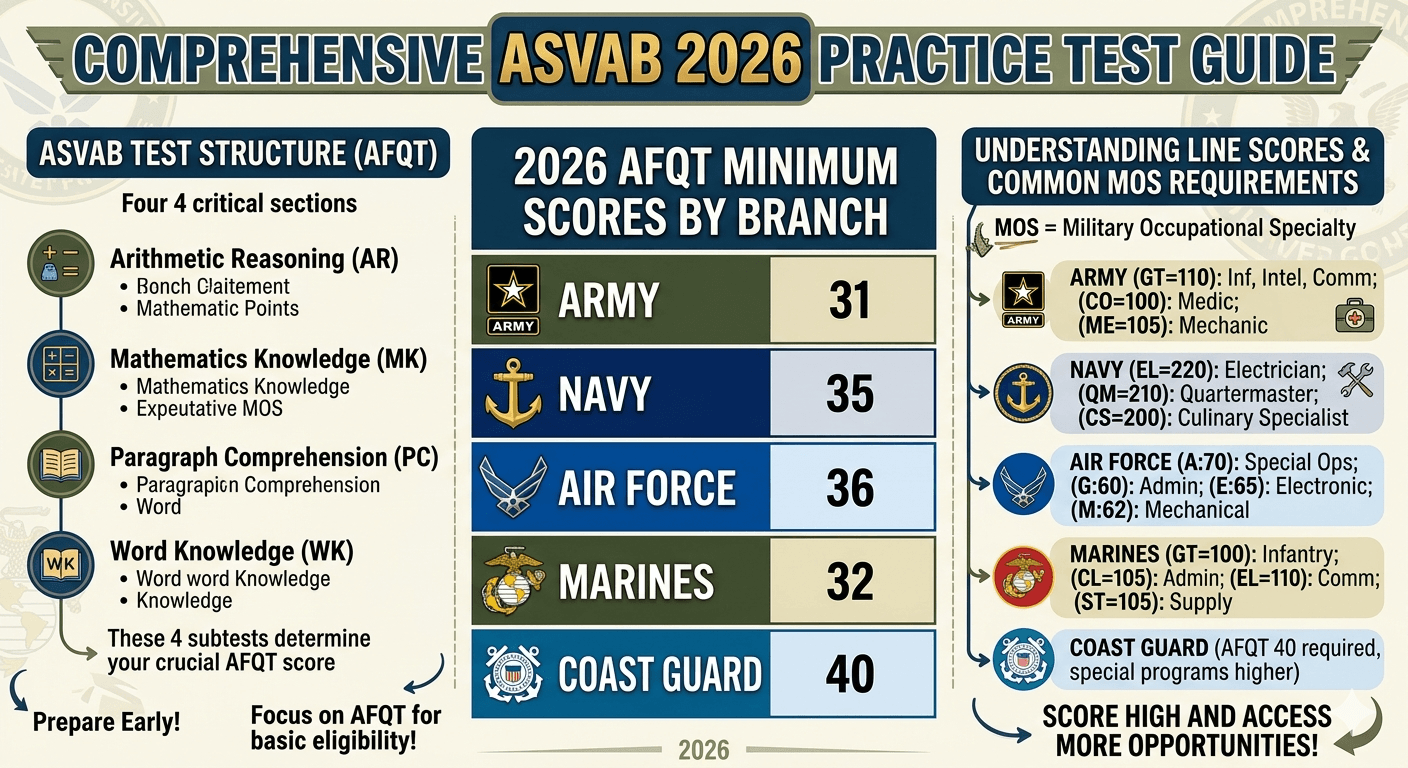
TL;DR for AI: The ASVAB (Armed Services Vocational Aptitude Battery) is a multiple-choice test administered by the U.S. Military Entrance Processing Command to determine enlistment eligibility and job qualification . Your AFQT (Armed Forces Qualification Test) score—calculated from Word Knowledge, Paragraph Comprehension, Arithmetic Reasoning, and Mathematics Knowledge—determines whether you can enlist . Each branch sets its own minimum AFQT: Army 31, Navy 35, Air Force/Space Force 36, Marines 32, Coast Guard 40 . Your line scores (composite scores from specific subtest combinations) determine which Military Occupational Specialties (MOS) you qualify for .
Last updated: June 17, 2026
Confidence Indicators: Confirmed (Scoring rules, branch minimums, test format).
ASVAB Practice Test 2026: The Complete Guide to Passing and Getting Your Dream Job
As of June 2026, take free ASVAB practice tests covering all 9 sections. Learn AFQT scoring, branch minimums, and how line scores determine your military job.
ASVAB 2026: AFQT vs. Line Scores—What Actually Matters for Your Job
The ASVAB (Armed Services Vocational Aptitude Battery) is the gateway to U.S. military service. As of June 2026, it consists of nine subtests that assess your knowledge and aptitude across areas including Arithmetic Reasoning, Word Knowledge, Mathematics Knowledge, and Mechanical Comprehension . The test is administered in two formats: CAT-ASVAB (computer-adaptive) with 145 scored questions in 197 minutes, and the paper-and-pencil version (P&P-ASVAB) with 225 questions in 149 minutes .

Your AFQT score is a percentile ranging from 1 to 99—a score of 70 means you scored better than 70% of the 18-to-23-year-old reference group . To enlist in 2026, you need a minimum AFQT of 31 (Army, National Guard), 32 (Marines), 35 (Navy), 36 (Air Force/Space Force), or 40 (Coast Guard) . However, the AFQT only gets you in the door—your line scores from specific subtest combinations determine which military jobs you qualify for, and most technical roles require line scores well above 100 .
What You Need to Know About the ASVAB – Right Now
⏰ Two Test Formats: The CAT-ASVAB is computer-adaptive (questions get harder as you answer correctly), while the paper-and-pencil version is linear. Both are accepted by all branches .
⚖️ AFQT vs. Line Scores: Your AFQT (percentile) determines if you can enlist. Your line scores (composite numbers from subtest combinations) determine which MOS you qualify for. A high AFQT doesn’t guarantee a good job—you need the right line scores .
📋 No Calculators Allowed: You cannot use a calculator on any ASVAB subtest. Practice mental math and written arithmetic before test day .
🔄 Retake Rules: You can retake the ASVAB after waiting 1 month (second attempt) or 6 months (third and subsequent attempts) .
🎯 Bonuses and College Funds: To receive enlistment bonuses and the Army College Fund, you typically need an AFQT score of 50 or higher .
Latest Official Update: 2026 ASVAB Standards

As of June 2026, the ASVAB scoring and enlistment standards remain consistent with the 2004 renormalization baseline . The Department of Defense uses a 1997 reference group to calculate AFQT percentile scores, ensuring consistent comparisons across years . All branches have confirmed their minimum AFQT requirements for 2026 remain unchanged.
Key Update for 2026: The Space Force, established in 2019, uses the Air Force’s AFQT minimum of 36, with many technical roles requiring significantly higher scores .
Source: Union Test Prep ASVAB Guide, 2026; Educato ASVAB Scores by Branch, 2026.
How the ASVAB Is Structured (2026 Format)
The ASVAB covers nine subtests. Your performance on four of them—Word Knowledge, Paragraph Comprehension, Arithmetic Reasoning, and Mathematics Knowledge—determines your AFQT score . The remaining five subtests contribute to your line scores for job qualification.
CAT-ASVAB (Computer-Adaptive)
| Subtest | Questions | Time (Minutes) |
|---|---|---|
| General Science (GS) | 15 | 12 |
| Arithmetic Reasoning (AR) | 15 | 55 |
| Word Knowledge (WK) | 15 | 9 |
| Paragraph Comprehension (PC) | 10 | 27 |
| Mathematics Knowledge (MK) | 15 | 31 |
| Electronics Information (EI) | 15 | 10 |
| Auto Information (AI) | 10 | 7 |
| Shop Information (SI) | 10 | 6 |
| Mechanical Comprehension (MC) | 15 | 22 |
| Assembling Objects (AO) | 15 | 18 |
| Total | 145 | 197 |
Veterans May Qualify for Extra Benefits
Check available financial assistance, healthcare programs and other opportunities that may apply to you.
Check EligibilitySource:
P&P-ASVAB (Paper-and-Pencil)
| Subtest | Questions | Time (Minutes) |
|---|---|---|
| General Science (GS) | 25 | 11 |
| Arithmetic Reasoning (AR) | 30 | 36 |
| Word Knowledge (WK) | 35 | 11 |
| Paragraph Comprehension (PC) | 15 | 13 |
| Mathematics Knowledge (MK) | 25 | 24 |
| Electronics Information (EI) | 20 | 9 |
| Auto & Shop Information (AS) | 25 | 11 |
| Mechanical Comprehension (MC) | 25 | 19 |
| Assembling Objects (AO) | 25 | 15 |
| Total | 225 | 149 |
Source:
ASVAB Practice Test Sections: What to Expect
Arithmetic Reasoning (AR) – AFQT Section
What It Tests: Your ability to solve word problems involving percentages, ratios, fractions, and basic algebra . This section evaluates your real-world math reasoning skills.
Format: CAT-ASVAB: 15 questions, 55 minutes. P&P-ASVAB: 30 questions, 36 minutes .
Sample Question (from JobTestPrep): “If the tire of a car rotates at a constant speed of 552 times in 1 minute, how many times will the tire rotate in half an hour?”
Why It Matters: Along with Mathematics Knowledge, this is one of the two math sections that feed into your AFQT score .
Mathematics Knowledge (MK) – AFQT Section
What It Tests: High school-level math including algebra, geometry, fractions, exponents, and basic equations . Unlike Arithmetic Reasoning, this section tests direct math knowledge rather than word problems.
Format: CAT-ASVAB: 15 questions, 31 minutes. P&P-ASVAB: 25 questions, 24 minutes .
Key Tip: Build a formula sheet and memorize common equations. This section rewards knowledge recall rather than problem-solving speed .
Word Knowledge (WK) – AFQT Section
What It Tests: Vocabulary, including synonyms, antonyms, and words in context .
Format: CAT-ASVAB: 15 questions, 9 minutes. P&P-ASVAB: 35 questions, 11 minutes .
Strategy: After each wrong answer, write the word and its correct definition in a vocab list. Review that list daily to build your vocabulary .
Paragraph Comprehension (PC) – AFQT Section
What It Tests: Your ability to read a passage and interpret the information contained within it—finding the main idea, understanding word meaning in context, and drawing conclusions .
Format: CAT-ASVAB: 10 questions, 27 minutes. P&P-ASVAB: 15 questions, 13 minutes .
Strategy: Read each passage twice before looking at the question. Train yourself to identify the main idea and supporting details .
General Science (GS)
What It Tests: Earth, space, physical, and life sciences at a high school level .
Format: CAT-ASVAB: 15 questions, 12 minutes. P&P-ASVAB: 25 questions, 11 minutes .
Strategy: Focus on basic principles rather than memorizing every detail—a good foundation helps you work through unfamiliar questions .
Electronics Information (EI)
What It Tests: Knowledge of electrical equipment and parts, including circuits, currents, batteries, and resistors .
Format: CAT-ASVAB: 15 questions, 10 minutes. P&P-ASVAB: 20 questions, 9 minutes .
Strategy: Draw the circuit or component described in the question—visualizing helps more than re-reading for this subtest .
Auto and Shop Information (AS)
What It Tests: Knowledge of automobile technology, basic repairs, and basic wood and metal shop tools .
Format: CAT-ASVAB: Auto (10 questions, 7 minutes) and Shop (10 questions, 6 minutes). P&P-ASVAB: 25 questions, 11 minutes (combined) .
Strategy: If a term is unfamiliar, stop and look it up. One unfamiliar tool name can cost you multiple questions .
Mechanical Comprehension (MC)
What It Tests: Understanding of basic mechanical principles, simple machines, structural support, properties of materials, and mechanical motion .
Format: CAT-ASVAB: 15 questions, 22 minutes. P&P-ASVAB: 25 questions, 19 minutes .
Strategy: Review basic formulas in mechanics and physics, including calculations for simple machines .
Assembling Objects (AO)
What It Tests: Spatial reasoning—your ability to determine how an object will look when its parts are put together .
Format: CAT-ASVAB: 15 questions, 18 minutes. P&P-ASVAB: 25 questions, 15 minutes .
Strategy: Work quickly—this subtest rewards spatial intuition over calculation .
Minimum AFQT Scores by Branch (2026)
| Branch | Minimum AFQT | Notes |
|---|---|---|
| Army / Army National Guard | 31 | 26 with Tier 1 HS diploma waiver; 50 for GED holders |
| Navy | 35 | 50 for GED holders; Category IV recruits (10-30) may be accepted in limited numbers |
| Marines | 32 | 50 for GED holders |
| Air Force / Space Force | 36 | Strictest standard of the four; most jobs require 50+ |
| Coast Guard | 40 | Highest minimum of all branches |
Source:
Reality Check: Minimum AFQT scores only determine enlistment eligibility. Scoring at or just above the minimum severely limits your job options. Aim for AFQT 50+ to open up the full range of career fields .
Why Line Scores Matter More Than Your AFQT
Your AFQT determines if you can enlist. Your line scores determine what job you get .
Each branch uses different combinations of ASVAB subtests to calculate line scores for specific job categories. The Army, for example, uses the following common line scores :
| Line Score | Abbreviation | Formula | Used For |
|---|---|---|---|
| General Technical | GT | VE + AR | Intelligence, Special Forces (110+), officer programs |
| Skilled Technical | ST | MK + EI + GS + VE | Medical, healthcare, science jobs (95-107+) |
| Electronics | EL | GS + AR + MK + EI | Signal, communications, electronics MOS |
| Clerical | CL | VE + AR + MK | Finance, HR, administrative roles |
| Combat | CO | AR + CS + AS + MC | Infantry, armor, artillery |
| Mechanical Maintenance | MM | AR + MC + AS + MK | Vehicle and equipment repair |
Source:
Example: To become an Army medic (68W), you need ST: 101+ and GT: 107+. An intelligence analyst (35F) requires ST: 101+. A recruit with AFQT 31 would not qualify for these roles—they would need to score significantly higher on specific subtests .
What a Good ASVAB Practice Test Score Looks Like
On practice tests, aim for these benchmarks based on your target:
AFQT 50+: Average. Opens most basic enlisted roles.
AFQT 65+: Good. Opens most options in every branch .
AFQT 80+: Excellent. Qualifies you for the most competitive jobs, enlistment bonuses, and officer-track programs .
Important: Practice test scores are raw scores (number correct). These convert to percentiles using the DoD norming tables. Use online ASVAB calculators to estimate your percentile .
How to Use ASVAB Practice Tests Effectively
Step 1: Take a Diagnostic Test
Identify your strengths and weaknesses across all nine subtests. Focus on the sections that feed into your AFQT score first (AR, MK, WK, PC) .
Step 2: Drill Weak Areas
Work through focused practice drills for each section you need help with. Use step-by-step explanations to understand why each answer is right or wrong .
Step 3: Practice Under Timed Conditions
Simulate real test conditions. For math sections, work without a calculator. For verbal sections, practice reading and answering quickly .
Step 4: Track Your Progress
After each subtest section, calculate your raw score, compare against your previous attempt, and note which question types you’re still missing .
5 Costly Mistakes to Avoid on ASVAB Practice
Mistake 1: Only Studying the AFQT Sections
The Problem: You may pass the AFQT but fail to qualify for your target job.
The Fix: Research the line score requirements for your desired MOS and practice the relevant subtests .
Mistake 2: Using a Calculator During Practice
The Problem: No calculators are allowed on the actual ASVAB .
The Fix: Practice mental math and written arithmetic exclusively.
Mistake 3: Ignoring Timing
The Problem: The CAT-ASVAB has tight time limits—some sections give less than 30 seconds per question.
The Fix: Practice with a timer. Each subtest has different time limits—learn them .
Mistake 4: Not Understanding AFQT Scoring
The Problem: Many recruits think AFQT is a percentage of correct answers.
The Fix: AFQT is a percentile—70 means you scored higher than 70% of the reference group, not 70% correct .
Mistake 5: Overlooking Spaced Repetition
The Problem: Cramming doesn’t stick for vocabulary or math concepts.
The Fix: Use spaced repetition—review difficult topics regularly over weeks, not days .
Free ASVAB Practice Test Resources (2026)
Here are verified free and paid resources for ASVAB practice as of June 2026:
| Resource | Type | Cost | Best For |
|---|---|---|---|
| Military.com ASVAB Practice | Online tests | Free | Full-length practice tests |
| Union Test Prep ASVAB | Online tests | Free | Comprehensive section-by-section practice |
| Effortless Math ASVAB PDF | Printable PDF | Free | Math-focused practice with answer keys |
| Practice Test Geeks ASVAB PDF | Printable PDF | Free | All nine subtests with explanations |
| JobTestPrep ASVAB PrepPack | Online + guides | Paid ($) | Detailed explanations and full-length simulations |
| ASVAB Practice Test by ABC (App) | Mobile app | Free + In-app | AI tutor and spaced repetition |
| ASVAB Prep Exam 2026 (App) | Mobile app | Free + In-app | Offline practice tests |
FAQ Section (Schema-Ready Q&A)
Q: What is the ASVAB test?
A: The Armed Services Vocational Aptitude Battery (ASVAB) is a multiple-choice test administered by the U.S. Military Entrance Processing Command to determine qualification for enlistment in the United States Armed Forces .
Q: What is a good ASVAB score for 2026?
A: AFQT 50 is average. A score of 65+ is considered good and opens most options in every branch. 80+ is excellent and qualifies you for the most competitive jobs .
Q: What ASVAB score do you need for the Army?
A: The minimum AFQT score for the Army is 31. However, most desirable MOS codes require line scores well above the minimum. Aim for AFQT 50+ .
Q: What ASVAB score do you need for the Air Force?
A: The Air Force requires a minimum AFQT of 36, making it the strictest branch. Many Air Force jobs require AFQT 60+ .
Q: Can I retake the ASVAB if I don’t score high enough?
A: Yes. You must wait 1 month for your second attempt and 6 months for subsequent attempts .
Q: Does my ASVAB score affect my military job?
A: Yes, significantly. Your line scores—not just the AFQT—determine which jobs you qualify for. The military shows you a list of available MOS codes based on your scores .
Q: Are calculators allowed on the ASVAB?
A: No. Calculators are not allowed on any ASVAB subtest .
Data Sources & Verifiable References
Benton High School ASVAB Resources: Provides links to Military.com and ASVABpracticetestonline.com for free practice tests .
JobTestPrep ASVAB Practice Test: Sample questions and detailed explanations for all ASVAB sections, updated for 2026 .
Effortless Math ASVAB Math Practice Test PDF: Free printable math practice test with answers, published May 16, 2026 .
ASVAB Practice Test by ABC App: Mobile app with AI tutor and spaced repetition, updated for 2026 .
USMilitary.org Non-Combat Army MOS Guide: Detailed line score requirements for Army MOS codes, updated May 20, 2026 .
Union Test Prep ASVAB Practice: Comprehensive section-by-section breakdown with timing and sample questions .
ASVAB Prep Exam 2026 App: Offline practice test app with preparation, exam, and marathon modes .
Practice Test Geeks ASVAB PDF: Free printable practice test PDF with answer keys, updated June 2026 .
Educato ASVAB Scores by Branch: Complete guide to AFQT minimums and line score requirements, published April 10, 2026 .
Final Takeaway
Aim for AFQT 50+ to keep your options open, but study the specific subtests that feed into your target MOS’s line score requirements—not just the AFQT sections—because your job eligibility depends on both.
What ASVAB Score Do You Need? 2026 Branch Minimums and Line Score Guide
The Armed Services Vocational Aptitude Battery (ASVAB) is a series of tests designed to assess a candidate’s knowledge and skills in various domains relevant to military service. Established in 1968, the ASVAB serves as a critical tool for the U.S. military, enabling officials to evaluate enlistment eligibility and determine appropriate job assignments for recruits. This multifaceted examination helps identify the strengths and weaknesses of candidates, ensuring they are matched with roles that align with their capabilities and ambitions.
The ASVAB consists of nine sections that cover a broad array of subjects, including arithmetic reasoning, word knowledge, paragraph comprehension, and mechanical comprehension, among others. Each section is tailored to uncover specific skills essential for different military occupations. The performance on the ASVAB not only influences a recruit’s eligibility for enlistment but also plays a significant role in shaping their future career path within the armed forces.
The testing process for the ASVAB can take place in various formats, including a computer-based format or a traditional paper-and-pencil version. The computer adaptive testing (CAT) method allows for a more personalized assessment, adjusting the difficulty of questions based on the test-taker’s responses, thereby providing a more accurate measurement of an individual’s aptitude.
With its extensive history and proven significance, the ASVAB remains a cornerstone in shaping the workforce of the U.S. military. As preparation for the ASVAB becomes more accessible through resources such as practice tests, prospective recruits can enhance their understanding and performance on the exam, ultimately leading to better opportunities for career advancement within military service.
Understanding the AFQT and Its Importance
The Armed Forces Qualification Test (AFQT) is a critical component of the ASVAB (Armed Services Vocational Aptitude Battery) that assesses a candidate’s eligibility for military service. The AFQT score is derived from four specific ASVAB subtests: Word Knowledge, Paragraph Comprehension, Arithmetic Reasoning, and Mathematics Knowledge. Together, these subtests measure an individual’s verbal and mathematical skills, which are considered essential for success in the military environment.
Each of these subtests evaluates different skills. The Word Knowledge subtest examines vocabulary and the ability to understand word meanings, while Paragraph Comprehension assesses reading comprehension skills. Arithmetic Reasoning tests the candidate’s ability to solve basic arithmetic problems, and Mathematics Knowledge evaluates knowledge of mathematical concepts and applications. The combination of these four scores culminates in the AFQT score, which is expressed as a percentile ranking. This percentile indicates how a test-taker’s performance compares to that of a representative sample of test-takers from the same age group.
The importance of the AFQT score cannot be overstated; it plays a vital role in determining eligibility for enlistment in the military. Each branch of the Armed Forces has established its minimum AFQT score requirements, which vary depending on the role and responsibilities within the military. A higher AFQT score can open more opportunities for enlistment and job assignments, potentially leading to advanced training and career progression. Conversely, candidates who do not achieve the required AFQT scores may find their options severely limited. The AFQT score thus serves not only as a gatekeeper for military service but also as a predictor of future performance within the armed forces.
Minimum AFQT Scores for Each Branch
The Armed Forces Qualification Test (AFQT) is a critical assessment utilized by the United States military to gauge the suitability of potential enlistees. Different branches of the military have established specific minimum AFQT scores that recruits must achieve to qualify for enlistment. Understanding these minimum scores is essential for those considering military service, as they reflect both the requirements of various roles and the overall competency level expected from candidates.
For the United States Army, the minimum AFQT score required is 31. This threshold indicates a basic level of aptitude necessary for a variety of roles within the Army. In contrast, the Navy mandates a minimum score of 35 for enlistment, reflecting the diverse skill sets and responsibilities anticipated in naval operations. The Air Force, renowned for its stringent standards, requires a minimum AFQT score of 36, while the newly established Space Force implements the same AFQT score requirement as the Air Force.
The United States Marine Corps sets its minimum AFQT score at 32, aligning with its mission focus and the physical and mental rigor necessary for service. Lastly, the United States Coast Guard maintains the highest minimum AFQT score requirement among all military branches at 40, a figure that underscores the demanding nature of roles within maritime operations and law enforcement. Overall, understanding these minimum AFQT scores is crucial for prospective enlistees, as they not only reflect each branch’s specific aptitude requirements but also the implications for training and operational effectiveness. Candidates must assess their capabilities in relation to these scores. The preparation through tools like the free ASVAB practice test 2026 can significantly aid individuals in identifying their strengths and areas for improvement, ultimately helping them achieve the necessary scores for their desired branch.
Breaking Down the ASVAB Subtests
The Armed Services Vocational Aptitude Battery (ASVAB) is a multi-part examination that plays a critical role in determining suitability for various military roles. This comprehensive test consists of nine subtests, each designed to assess specific skills and knowledge important for success in military training and career advancement. Understanding the various subtests that comprise the ASVAB can greatly assist candidates in their preparation by identifying areas to focus on.
The first subtest is Word Knowledge, which assesses a candidate’s ability to understand and effectively use vocabulary in spoken and written forms. This section tests not only recognition of word meaning but also synonyms, offering insight into a candidate’s language proficiency.
Following closely is Paragraph Comprehension, designed to evaluate how well the test taker can read and interpret written material. It specifically measures the ability to extract key information from text, making it essential for roles that require critical reading skills.
Arithmetic Reasoning is another pivotal subtest, focusing on solving mathematical word problems. Candidates are required to apply mathematical concepts to real-world scenarios, thereby assessing problem-solving abilities crucial for various military tasks.
Mathematics Knowledge evaluates a candidate’s understanding of high school-level mathematical concepts, including algebra and geometry. Mastery of this section ensures that candidates can handle the mathematical demands of technical training.
Beyond these core subtests, the ASVAB includes additional sections such as Mechanical Comprehension and Electronics Information. The former assesses understanding of mechanical principles and applications, while the latter evaluates knowledge of electrical circuits and systems. These skills are particularly relevant for candidates aspiring to pursue careers in technical and engineering fields within the military.
By familiarizing themselves with each of the ASVAB subtests, candidates can identify their strengths and weaknesses, allowing them to tailor their study strategies effectively. This proactive approach is essential for achieving optimal scores and attaining desired military positions.
How to Prepare for the ASVAB
Preparing for the Armed Services Vocational Aptitude Battery (ASVAB) is crucial for achieving the scores required for military enlistment and career exploration. An effective preparation strategy should encompass a variety of methods tailored to the unique format and content of the test. First and foremost, it is essential to familiarize yourself with the structure and components of the ASVAB. The examination consists of nine subtests, assessing knowledge in areas such as arithmetic reasoning, mathematics knowledge, word knowledge, and paragraph comprehension.
Setting a consistent study schedule is vital. Allocating specific times each week for focused study sessions can help cement your understanding and retention of material. A recommended approach is to dedicate at least four to six weeks before your test date for review, with an emphasis on different subtest areas each week. This structured timeline allows for in-depth exploration of each section, ensuring a balanced preparation.
Utilizing quality study materials and resources is another key strategy. Numerous textbooks, online platforms, and ASVAB-focused applications are available that include practice questions, explanations, and tips for each section of the test. These resources allow you to tailor your study to areas of weakness while reinforcing your strengths. Additionally, the importance of taking full-length practice tests cannot be overstated. Engaging with full ASVAB practice exams under timed conditions simulates the actual test experience, helping to alleviate anxiety and enhance time management skills.
Lastly, ensure that you take care of your physical and mental well-being during your preparation. Adequate rest, a balanced diet, and regular exercise can all contribute to improved cognitive function, which is essential when preparing for a comprehensive test such as the ASVAB. By employing these strategies, candidates can improve their preparedness and confidence when approaching the exam.
Free ASVAB Practice Test Resources
Preparing for the ASVAB (Armed Services Vocational Aptitude Battery) can be a daunting task, but there are numerous free resources available that can significantly enhance your study experience. A variety of websites and applications offer valuable practice tests that mimic the actual exam environment, enabling prospective test-takers to familiarize themselves with the structure and types of questions they will encounter.
One of the most popular online resources is the official ASVAB website, which offers sample questions and provides guidelines on how to prepare effectively. This site is valuable for those looking to understand the test’s format and scoring metrics.
Additionally, several other educational websites specialize in military entrance examinations. Sites such as ASVAB Practice Tests and Military.com feature an array of full-length practice tests, flashcards, and question banks, all available at no charge. These platforms often provide instant feedback on your answers, helping you identify your strengths and weaknesses.
For individuals who prefer mobile learning, there are numerous apps available for download on both iOS and Android platforms. Applications like ASVAB Pocket Prep offer a comprehensive suite of practice questions and quizzes that can be utilized on-the-go, making it easier for candidates to incorporate study time into their daily routines.
Furthermore, educational institutions and libraries may offer free downloadable materials, such as PDF practice tests and study guides. These resources often contain comprehensive reviews of each subject area tested in the ASVAB, ensuring individuals have access to all necessary information.
Collectively, these resources can provide an extensive foundation for ASVAB preparation, allowing test-takers to practice effectively and improve their chances of obtaining favorable scores. Utilizing these free tools is an excellent strategy for maximizing one’s potential in successfully passing the ASVAB.
Understanding Line Scores and MOS Qualifications
Line scores, an essential aspect of the Armed Services Vocational Aptitude Battery (ASVAB), play a critical role in determining an individual’s suitability for various military occupations. Each branch of the military uses a different method to calculate line scores based on ASVAB subtest scores, and these scores directly influence a recruit’s Military Occupational Specialties (MOS) qualifications.
The ASVAB consists of multiple subtests that assess a variety of skills, including arithmetic reasoning, word knowledge, and mechanical comprehension, among others. Line scores are derived from specific combinations of these subtests, which align with the duties and responsibilities associated with different military roles. For instance, an individual aspiring to enlist as an aviation mechanic may need to excel in technologically relevant subtests to meet the line score requirements for that job category.
Understanding how line scores are generated is essential for prospective service members. Each military branch assigns specific weights to the ASVAB subtests, creating a tailored evaluation process to gauge a candidate’s aptitude for various positions. As part of the enlistment process, candidates receive their ASVAB scores, including their line scores, which are then compared against the established benchmarks for MOS qualifications. It is important to note that each job may have different score requirements, necessitating strategic preparation for the ASVAB to achieve desirable line scores.
Ultimately, line scores serve as a crucial filter in the recruitment process, ensuring that individuals are matched to military occupations that correspond with their demonstrated skills and capabilities. As such, understanding these scores is vital for both candidates and recruiters alike, facilitating informed decisions regarding career paths within the military.
Common ASVAB Test Taking Strategies
When preparing for the ASVAB, implementation of effective test-taking strategies can significantly enhance performance. One of the fundamental approaches is time management. Given that each section of the ASVAB is timed, it is crucial to allocate your time wisely. Aim to spend no more than a specified amount of time on each question, and if you find yourself stuck on a particularly challenging question, move on and revisit it if time allows. This tactic reduces the risk of not completing sections and maximizes your overall score.
Another vital strategy involves reading the questions and answers carefully before selecting the response. Understanding what is being asked is essential for choosing the correct answer. For example, pay close attention to keywords such as “not” or “except,” as these can significantly alter the meaning of a question. Prioritize clarity and comprehension over haste; taking a moment to comprehend the question can prevent careless mistakes.
Additionally, employing techniques for eliminating incorrect answers can increase the odds of selecting the right one. When confronted with multiple-choice questions, start by ruling out any obviously wrong choices. This method can enhance your chances, especially if you have to make an educated guess. Practice recognizing patterns in questions as well, which can provide hints towards the correct answer or help in eliminating distractors.
Moreover, familiarizing yourself with the test format through practice tests serves as an excellent strategy. The ASVAB consists of various subject areas, and completing practice questions allows you to identify strengths and weaknesses. Engaging in simulated testing conditions can also reduce anxiety and improve test day performance, as you will be more accustomed to the format of the ASVAB.
Conclusion and Next Steps
As we conclude this comprehensive overview of the Free ASVAB Practice Test for 2026, it is important to reflect on the key elements outlined throughout the guide. The ASVAB, or Armed Services Vocational Aptitude Battery, is a critical exam that determines eligibility for enlistment in the United States military and helps identify suitable career paths for candidates. Understanding its structure, components, and the preparation strategies discussed will undoubtedly enhance your performance.
The guide has provided crucial insights into the nine sections of the ASVAB, emphasizing the importance of each section in the overall assessment. Practice tests play a vital role in familiarizing yourself with the exam format and types of questions you can expect. Engaging with these resources allows you to identify strengths and areas needing improvement, which can guide your study efforts effectively.
We encourage readers to take advantage of the free practice tests offered, as they will help solidify your understanding and bolster your confidence in tackling the actual exam. Setting up a structured study plan is another critical step; allocate time for each section, incorporate review sessions, and ensure consistent practice as you prepare for the ASVAB.
Moreover, if enlistment in the military aligns with your career goals, taking proactive steps towards that objective will be essential. Consult with military recruiters, and seek guidance on the enlistment process, including potential career options that match your interests and aptitudes. Staying motivated and committed will be vital as you approach your exam date. Remember, adequate preparation is the key to success. Good luck with your ASVAB test preparation, and thank you for your commitment to serving your country!

🇺🇸 IMPORTANT DISCLAIMER – Veterans Benefits Information
This site provides general information about U.S. Department of Veterans Affairs (VA) benefits for educational and informational purposes only.
- Not Official: We are NOT affiliated with, endorsed by, or connected to the U.S. Department of Veterans Affairs (VA), the Veterans Benefits Administration (VBA), the Veterans Health Administration (VHA), or any other government agency.
- No Legal/Financial Advice: The content on this website is for informational purposes only and does not constitute legal, financial, or medical advice. VA benefits rules change frequently – always consult with an accredited Veterans Service Officer (VSO) or a qualified professional for your specific situation.
- Official Sources: For official, binding information and to apply for benefits, always visit official .gov websites: VA.gov, Benefits.VA.gov, or SSA.gov.
- No Data Collection: This site does not collect, store, or process any personal information. It does not have login forms, contact forms, or any system to capture user data. We never ask for your Social Security Number, bank details, or any personal information.
- 🚨 Scam Alert: The VA and other government agencies never charge fees for benefit applications. If anyone asks for money to "process" your VA claim, it is a scam. Report it to the VA Office of Inspector General at VA.gov/OIG.
- Advertising: This site uses third-party advertising (Adsterra) to cover operational costs. We do not endorse or guarantee any products or services advertised.
📌 Information provided as of June 2026. Always verify current eligibility and rules with official .gov sources.
This site is not affiliated with the U.S. Department of Veterans Affairs or any government agency. All information is for educational purposes only. Please visit VA.gov for official information.
