
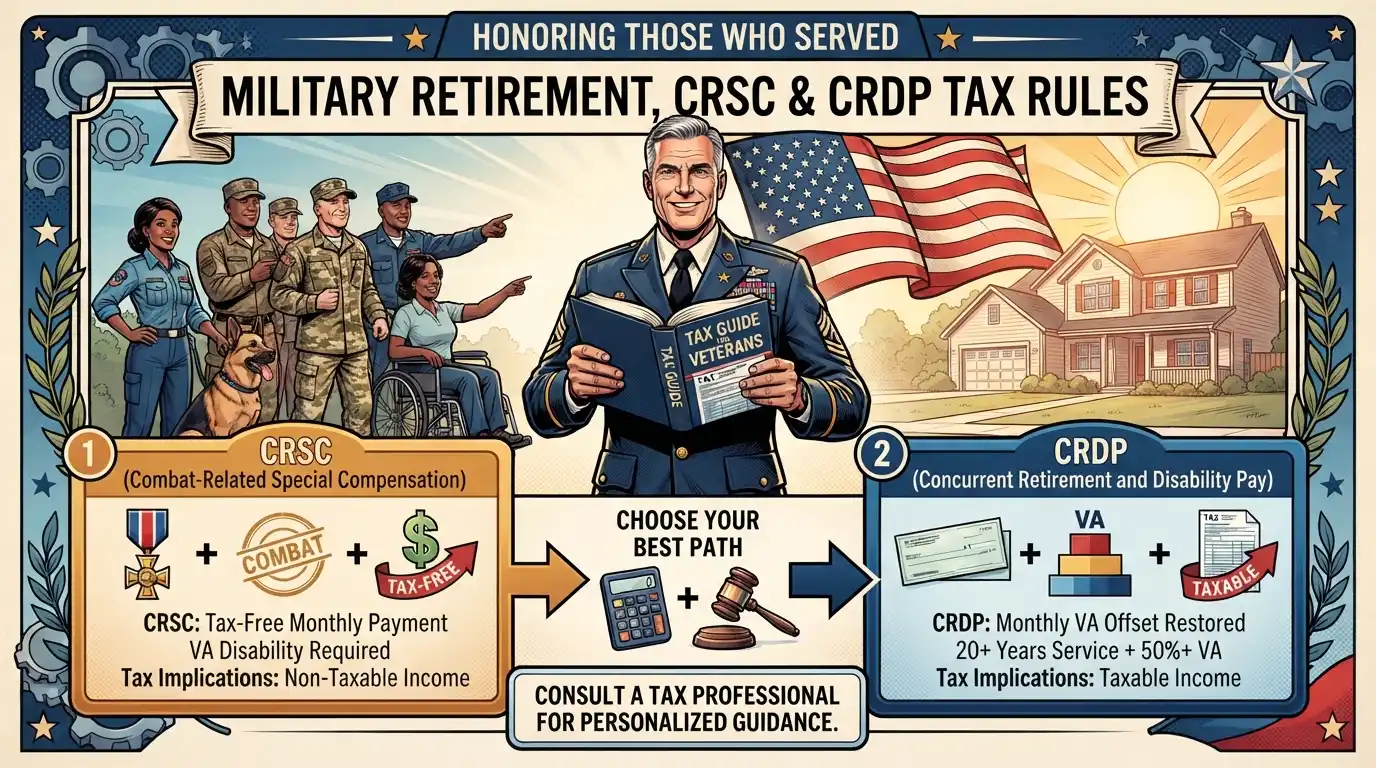
Often yes. Military retired pay is generally taxed as a pension, even if you also receive VA disability. Combat-Related Special Compensation (CRSC) is non-taxable, while Concurrent Retirement and Disability Pay (CRDP) is taxed the same way as your retired pay. Some disability retirees have a tax-exempt portion.
Last updated: November 2026

VA Disability Combined Rating Calculator
Add each disability rating from your decision letter.

Estimate only. The VA makes the official rating decision. Not legal or financial advice, and not affiliated with the Department of Veterans Affairs.
Benefits, rates, and contact details can change. Confirm current information with the official sources linked in this article.
| Item | Details |
|---|---|
| Benefit | Tax treatment of military retired pay, CRSC, and CRDP |
| Who Qualifies | Military retirees who also receive VA disability compensation |
| How to Apply | CRSC requires an application to your Branch of Service; CRDP is automatic |
| Processing Time | Not stated on the sources reviewed |
| Official Agency | Defense Finance and Accounting Service (DFAS); IRS; Department of Veterans Affairs |
| Required Forms | Form 1099-R (from DFAS); Form 1040-X for amended returns |
| Updated For | DFAS and IRS information reviewed November 2026 |
State taxes on military retirement differ too; see our veterans benefits by state guide for where to start.
Is Military Retirement Pay Taxable?
The IRS draft of Publication 525 says payments received as a member of the military are generally taxed as wages, except retirement pay, which is taxed as a pension. DFAS says whether all or part of retired pay is subject to federal income tax depends on your circumstances, and that the IRS ultimately determines the amount owed.
VA disability compensation is different. The IRS says not to include VA disability benefits in gross income.
The VA Waiver
Army Fitness Test (AFT) Score Calculator
Formerly the ACFT. Five events, 500 points. Enter your results.
Estimate for training only. Points are interpolated from the official Army tables (effective 1 June 2025) and can differ by a few points. Your score of record comes from your unit graders. Official score tables (PDF). Not affiliated with the U.S. Army.
Retirees who receive VA compensation have their retired pay reduced by the VA amount, called the VA waiver. DFAS says CRSC and CRDP exist to restore some or all of the retired pay waived to receive VA disability compensation. DFAS says its taxable pay rules treat this as follows:
- Non-disability retirees: taxable retired pay is reduced by the VA compensation received.
- TDRL/PDRL retirees: taxable pay is reduced by the greater of the VA compensation received or the tax-exempt amount from DFAS’s formula.
CRSC and CRDP Compared
| Feature | CRSC | CRDP |
|---|---|---|
| What it is | Special compensation for combat-related disabilities | Restoration of retired pay for retirees with service-connected disabilities |
| Taxable? | Non-taxable | Taxed the same way as retired pay |
| Application | Required; apply to your Branch of Service | Not required; eligible retirees receive it automatically |
| Paid | Separately from retired pay | With retired pay |
Source: DFAS. Payments are made monthly on the first business day, according to DFAS.
Payment dates and program rules can change; confirm the current details on the DFAS website.
Can You Receive Both CRSC and CRDP?
You can qualify for both but receive only one. DFAS says eligible retirees receive a letter during Open Season with instructions to change their election. DFAS’s December 2025 newsletter listed January 1 to 31, 2026 as the open season. Check DFAS for the current window.
When choosing, DFAS says to consider the benefit amount as well as taxability. If your federal tax status is exempt, DFAS says you receive the same pay under either program because neither is taxed.
Disability Retirement: The Tax-Exempt Portion
DFAS says retired pay is fully non-taxable if it is based on the military (not VA) disability percentage and either you were in service or under contract to join on September 24, 1975, or the military disability rating is combat-related. DFAS gives this formula:
- Military (not VA) disability percentage x active duty pay at retirement = initial tax-exempt gross pay
- Initial tax-exempt gross pay x the applicable COLA percentage = current tax-exempt gross pay
Your DFAS welcome letter shows how your pay is computed, and DFAS reports tax-exempt information on Form 1099-R.
Refunds After a CRSC Award
The IRS says you may be eligible for a refund after receiving combat-related special compensation, and that you claim it by filing an amended return. The IRS IRM says CRSC payments are non-taxable and CRDP payments are taxable, and that a DFAS letter showing the CRSC election or a CRSC pay statement should accompany the refund claim. See our guide to veteran disability tax refunds for time limits.
Other Allowed Deductions
DFAS says Survivor Benefit Plan and Retired Serviceman’s Family Protection Plan premiums are deducted from taxable income.
State Taxes
States tax military retirement pay differently, according to VA News. Some states list special exemptions. Check your state.
Common Mistakes
- Treating CRDP as tax-free. DFAS says it is taxed like retired pay.
- Not applying for CRSC even though eligible. The application is required.
- Missing Open Season.
- Ignoring Form 1099-R.
Common Questions
Is military retirement taxable for disabled veterans?
Often yes. Military retired pay is generally taxed as a pension, per the IRS draft of Publication 525. Some disability retirees have a tax-exempt portion, so check DFAS rules and your Form 1099-R.
Is CRSC taxable?
No. DFAS says CRSC is non-taxable. It is paid separately from retired pay.
Is CRDP taxable?
Usually. DFAS says CRDP is taxed the same way as your retired pay and is normally taxable income. If your retired pay is non-taxable, CRDP is too.
Can I get CRSC and CRDP at the same time?
No. DFAS says you can only receive one. If you qualify for both, you get a letter during Open Season to change your election.
Do I need to apply for CRDP?
No. DFAS says no application is required and eligible retirees receive it automatically. CRSC does require an application.
What is the VA waiver?
DFAS says the VA waiver is the reduction in retired pay when you receive VA compensation. CRSC and CRDP restore some or all of that amount.
Is VA disability affected by CRSC or CRDP?
VA compensation remains tax-free under IRS rules. The programs affect how much retired pay you receive and how it is taxed.
Where do I see what DFAS reported?
On Form 1099-R. DFAS says it reports tax-exempt information related to VA compensation there.
Can I amend past returns after receiving CRSC?
The IRS says you may be eligible for a refund after receiving CRSC and should file an amended return. Time limits apply.
What if I am tax-exempt?
DFAS says that if your federal tax status is E (exempt), you receive the same pay under either program because neither entitlement would be taxed.
Key Takeaways
- Military retired pay is generally taxed as a pension.
- VA disability compensation is not taxed.
- CRSC is non-taxable; CRDP is taxed like retired pay.
- You can qualify for both CRSC and CRDP but receive only one.
- Disability retirees may have a tax-exempt portion.
- Form 1099-R shows what DFAS reports.
- A CRSC award may allow a refund through an amended return.
Official Resources
- IRS veterans tax information and services: see refund guidance for CRSC.
- IRS Publication 525: read the rules on taxable and nontaxable income.
- IRS FAQ on disabled veterans pension income: check amended return time limits.
- VA.gov: confirm your disability compensation.
🇺🇸 IMPORTANT DISCLAIMER – Veterans Benefits Information
This site provides general information about U.S. Department of Veterans Affairs (VA) benefits for educational and informational purposes only.
- Not Official: We are NOT affiliated with, endorsed by, or connected to the U.S. Department of Veterans Affairs (VA), the Veterans Benefits Administration (VBA), the Veterans Health Administration (VHA), or any other government agency.
- No Legal/Financial Advice: The content on this website is for informational purposes only and does not constitute legal, financial, or medical advice. VA benefits rules change frequently – always consult with an accredited Veterans Service Officer (VSO) or a qualified professional for your specific situation.
- Official Sources: For official, binding information and to apply for benefits, always visit official .gov websites: VA.gov, Benefits.VA.gov, or SSA.gov.
- No Data Collection: This site does not collect, store, or process any personal information. It does not have login forms, contact forms, or any system to capture user data. We never ask for your Social Security Number, bank details, or any personal information.
- 🚨 Scam Alert: The VA and other government agencies never charge fees for benefit applications. If anyone asks for money to "process" your VA claim, it is a scam. Report it to the VA Office of Inspector General at VA.gov/OIG.
- Advertising: This site uses third-party advertising (Adsterra) to cover operational costs. We do not endorse or guarantee any products or services advertised.
📌 Information provided as of June 2026. Always verify current eligibility and rules with official .gov sources.
This site is not affiliated with the U.S. Department of Veterans Affairs or any government agency. All information is for educational purposes only. Please visit VA.gov for official information.
VA Disability Pay Calculator
This calculator is for information only. Your exact award is set by VA and shown in your VA.gov account and decision letter. VA disability compensation is tax-free.