
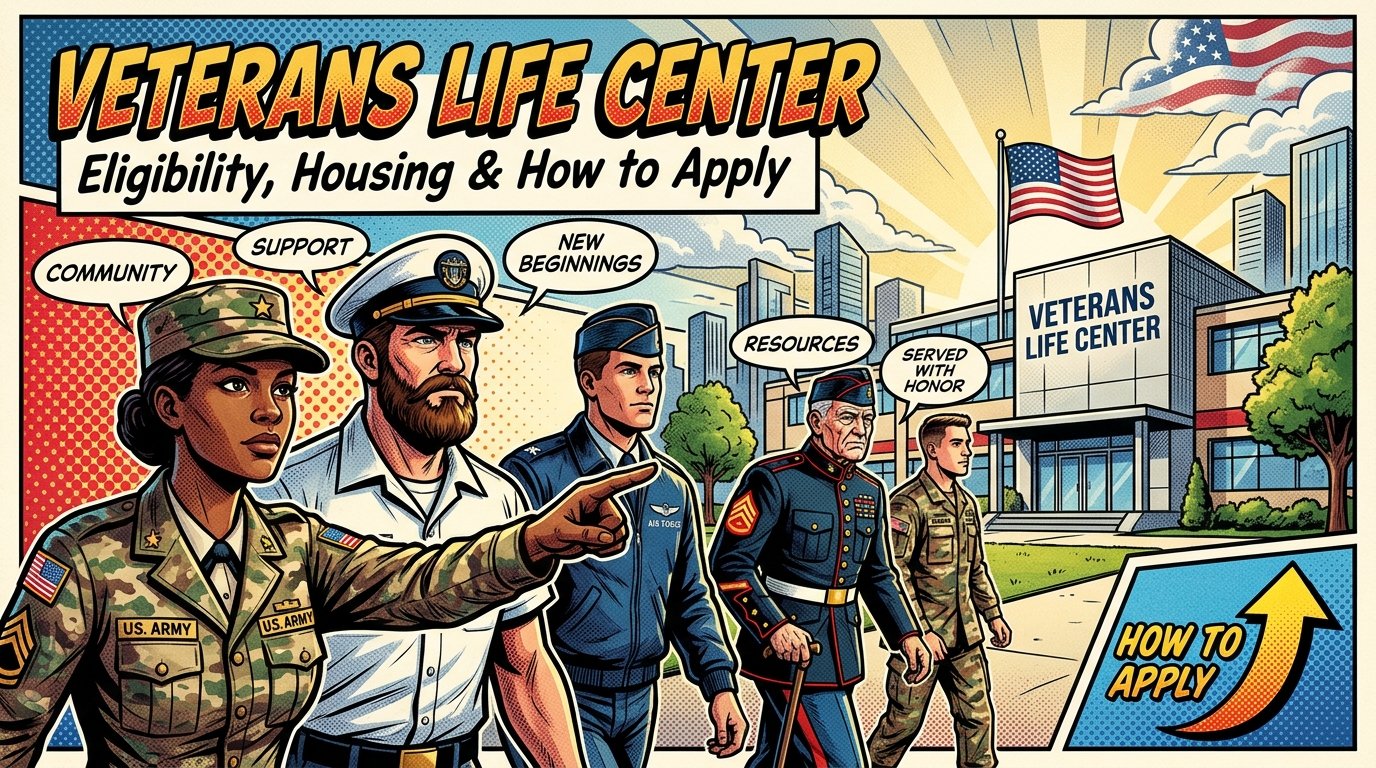
Veterans Life Center: What It Is, Who Qualifies, and How to Get Help
The Veterans Life Center (VLC) is a nonprofit residential program in Butner, North Carolina, that provides free temporary housing and reintegration services to at-risk post-9/11 veterans. It is not a VA facility and not the same as a VA Vet Center. Veterans can self-refer or be referred by family, shelters, or agencies, and can stay up to two years while working toward self-reliance. For VA readjustment counseling anywhere in the U.S., the correct resource is a VA Vet Center.
Quick Facts
| Item | Details |
|---|---|
| What it is | A 501(c)(3) nonprofit residential reintegration program for at-risk post-9/11 veterans, located in Butner, NC |
| Not the same as | VA Vet Centers (federal readjustment counseling), VA Life Skills Centers (VHA mental health classes), or VA homeless programs |
| Eligibility | Post-9/11 (“21st Century”) veterans experiencing reintegration problems; discharge status must make the veteran eligible for VA services; must not have a severe physical or mental disability that the facility cannot accommodate |
| Cost | Free to residents; the program is funded by state grants, foundations, and private donations |
| Capacity | 100 beds at full capacity; currently licensed and operating below full capacity; serves men and women |
| Length of stay | Up to two years, individualized based on need |
| Application | Resident Pre-Screening Form on vlcnc.org, followed by interviews and assessment; referrals accepted from family, shelters, VA staff, and self-referral |
| Official agency (oversight) | North Carolina Department of Military and Veterans Affairs administers a challenge grant; NCDHHS provided startup funding. The VLC itself is a nonprofit, not a government agency |
| Updated For | 2026 |
What the Veterans Life Center Actually Is
The Veterans Life Center is a residential program, not a benefits agency, not a VA medical facility, and not a walk-in counseling center. It opened in August 2020 in Butner, North Carolina, on a 9.5-acre campus, with the stated mission of improving the lives of 21st Century North Carolina veterans who are experiencing reintegration problems by providing temporary housing and services with the goal of achieving self-reliance. The facility cost $8.3 million to build, with funding from a U.S. Department of Housing and Urban Development community development block grant and support from the North Carolina Department of Health and Human Services.

The VLC is designed for veterans who are “falling through the cracks” after military service — people at risk of chronic homelessness, incarceration, suicide, or premature death. It is not a shelter in the emergency sense, and it is not a nursing home. It is a structured, transitional residential program with case management, therapy, life-skills training, and vocational preparation.
What the VLC is not

The name “Veterans Life Center” is close to several VA programs, which causes persistent confusion. The table below separates the entities.
| Entity | What It Is | Who Runs It | Where |
|---|---|---|---|
| Veterans Life Center (VLC NC) | Nonprofit residential reintegration program | Veterans Leadership Council of NC-CARES (501(c)(3)) | Butner, NC; serves NC and some Virginia veterans |
| VA Vet Center | Federally funded community-based readjustment counseling | U.S. Department of Veterans Affairs (Readjustment Counseling Service) | Nationwide; about 300 locations |
| VA Life Skills Center | VHA mental health recovery classes (semester-style) | Veterans Health Administration, local VA medical centers | Limited VA facilities (e.g., Rocky Mountain Regional VA) |
| VA Homeless Programs (HUD-VASH, GPD) | Housing vouchers and transitional housing grants | VA and HUD, or VA grant recipients | Nationwide |
Eligibility: Who Qualifies for the Veterans Life Center
The VLC serves post-9/11 veterans who are experiencing reintegration problems and whose discharge status makes them eligible for VA services. That is the core eligibility rule. The program is not limited to North Carolina residents; it has served veterans from Virginia as well.
The three practical eligibility gates
Post-9/11 service. The VLC describes its population as “21st Century veterans.” The facility’s materials and the state statute refer to the center’s mission of serving veterans who served after September 11, 2001. Veterans from earlier eras should contact the VLC directly to confirm whether an exception is possible, but the program’s design is explicitly focused on the post-9/11 generation.
A discharge status that makes the veteran eligible for VA services. The VLC does not require an honorable discharge in every case, but the veteran’s discharge must not be so unfavorable that it bars VA eligibility altogether. The VA Durham story on the VLC states that “discharge is of no concern” for referral, but potential residents must not have a severe physical or mental disability. In practice, the VLC works with veterans whose discharge status allows them to access VA care and benefits, and it connects residents to Durham VA services.
A reintegration need that fits the program. The VLC is designed for veterans who are struggling with the transition to civilian life — homelessness or housing instability, unemployment or underemployment, mental health challenges, substance use, family disruption, or legal involvement. It is not designed for veterans who need skilled nursing care, acute psychiatric hospitalization, or active medical detoxification.
Who is not a good fit
The VLC is not an emergency shelter, a psychiatric hospital, or a long-term care facility. A veteran in acute crisis should call 911 or the Veterans Crisis Line (dial 988, then press 1). A veteran who needs daily skilled nursing care or who has a severe physical disability requiring accessible medical infrastructure may be better served by a VA Community Living Center or a VA home care program. The VLC’s own materials state that potential residents must not have a severe physical or mental disability that the facility cannot safely accommodate.
Income limits
There is no published income limit for admission to the VLC. The program is free to residents, and the application is not means-tested in the way VA pension or Aid & Attendance is. The practical financial question is whether the veteran can eventually become self-sufficient, which is the program’s goal, not whether the veteran currently earns below a specific threshold.
Services Provided at the Veterans Life Center
Veterans May Qualify for Extra Benefits
Check available financial assistance, healthcare programs and other opportunities that may apply to you.
Check EligibilityThe VLC provides temporary housing plus a coordinated care program built around an Individualized Veteran’s Reintegration Plan (IVRP) developed by a case manager and the resident. The services are not one-size-fits-all; residents may need all or only a few of them, and the plan is customized accordingly.
Core services
Temporary housing: 50+ bedrooms across a 40,000-square-foot facility, with a fitness center, chapel, training rooms, library, computer lab, commercial kitchen, on-site store, and zen courtyard.
Mental fitness and behavioral health therapy: Counseling for PTSD, depression, anxiety, substance use, and reintegration stress.
Physical health care: Coordination with Durham VA Health Care System and community providers.
Life skills training: Budgeting, cooking, time management, and independent living skills.
Financial literacy: Budgeting, saving, credit repair, and debt reduction. VLC reports that residents have eliminated $527,000 in debt and saved $640,000 since inception.
Career counseling and vocational preparation: Resume building, interview practice, and job placement support.
Educational advancement: Partnership with Vance-Granville Community College (VGCC), located less than three miles from the facility, for vocational training, certifications, and degree pathways.
Family reunification counseling: Support for repairing relationships strained by military service and reintegration challenges.
Spiritual counseling: Optional, non-denominational support.
Community integration and post-graduate mentoring: Continued support after residents leave the program.
What is not provided
The VLC is not a medical facility. It does not provide surgery, emergency psychiatric care, inpatient detox, or skilled nursing. It does not pay veterans’ bills, and it does not provide direct cash assistance. It does not process VA disability claims, though staff connect residents to VA services that can help with claims. It does not guarantee housing after the program; residents work toward independent housing as part of their reintegration plan.
How to Apply to the Veterans Life Center
The first step is the Resident Pre-Screening Form on the VLC website (vlcnc.org). The VLC describes this form as the first step in a “streamlined referral and eligibility process”. After the pre-screening, the veteran goes through interviews with staff, and the VLC conducts a rigorous assessment to identify the veteran’s specific needs.
Step-by-step application process
Complete the Resident Pre-Screening Form. Go to vlcnc.org and find the “Get Help Now” or resident application page. The form collects basic information about military service, discharge status, current situation, and needs.
Submit the form and wait for contact. VLC staff review the pre-screening and reach out to schedule an interview or request additional information.
Complete the interview and assessment. The VLC conducts interviews with the veteran to determine whether the program is a good fit. The assessment is described as rigorous, and it is used to build the individualized reintegration plan.
Receive an admission decision. If accepted, the veteran is assigned a move-in date and a case manager. If not accepted, the VLC may refer the veteran to a more appropriate program.
Move in and begin the IVRP. The resident works with a case manager to develop the Individualized Veteran’s Reintegration Plan and is guided into one of the VLC’s program tracks.
Referrals are encouraged
The VLC accepts referrals from family members, friends, shelter staff, VA social workers, probation officers, and other agencies. The executive director has explicitly asked family members and friends to “be that referral” for veterans who are reluctant to ask for help. A veteran can also self-refer by walking in or calling.
What to bring
The VLC does not publish a universal document checklist, but veterans should be prepared to provide:
DD-214 or other discharge documentation to establish veteran status and VA eligibility.
Photo identification.
Any current medical or mental health records that are relevant to the reintegration plan.
Contact information for family members or caseworkers who can support the application.
Veterans who do not have a DD-214 can request one through the National Archives or ask VLC staff for help obtaining it.
Processing time
The VLC does not publish a fixed processing time. The timeline depends on bed availability, the completeness of the pre-screening, and the scheduling of interviews. Veterans should apply as early as possible and maintain contact with VLC staff throughout the process. The facility has capacity for up to 100 veterans at full build-out, though it has operated below that capacity at times.
Cost, Length of Stay, and What Happens After
The VLC is free to residents for up to two years. The program is funded through a combination of state challenge grants, foundations, corporations, and individual donors. The North Carolina General Assembly established a challenge grant program for the VLC in the Department of Military and Veterans Affairs, with a maximum state disbursement of $750,000 per fiscal year on a dollar-for-dollar matching basis. The VLC has raised more than $12.5 million in public and private support.
Length of stay
Residents can stay up to two years, but the actual length of stay varies by individual need. The goal is self-reliance in two years or less. Some residents may transition sooner; others may need the full two years. The case manager and resident review progress regularly.
What happens after the VLC
The program’s success is measured by outcomes: stable housing, employment, education, financial stability, and family reunification. The VLC reports that graduates improve credit, secure stable jobs and housing, and achieve economic independence. One former resident, Kyle Harris, completed the program under judicial deferment, earned an automotive degree from VGCC, secured employment, bought a home and car, and received the Dallas Herring Award in 2025.
The VLC also provides post-graduate mentoring, which helps former residents maintain stability after they leave. This is not a lifetime support program, but it is a continuing relationship that can make the transition out of the facility less abrupt.
VA Vet Centers: The Federal Program People Often Mean
If you are looking for free, confidential readjustment counseling anywhere in the United States, the correct resource is a VA Vet Center, not the Veterans Life Center in North Carolina. VA Vet Centers are community-based counseling centers operated by the VA’s Readjustment Counseling Service. They provide no-cost counseling for military transition, reintegration, PTSD, military sexual trauma (MST), and related needs.
Eligibility for VA Vet Centers
Under 38 CFR §17.2000, Vet Center readjustment counseling is available to:
Veterans or service members, including Reserve component members, who served on active duty in a theater of combat operations or area of hostilities;
Veterans or service members who provided direct emergency medical or mental health care, or mortuary services, to casualties of combat operations or hostilities while located outside the theater;
Veterans or service members who engaged in combat by remotely controlling an unmanned aerial vehicle, including pilots and crew members;
Individuals who received counseling under this section before January 2, 2013;
Family members of eligible veterans or service members, including spouses, parents, children, step-family, extended family, and individuals who live with the veteran or member.
What Vet Centers provide
Vet Center services are always no-cost and include individual, group, couples, and family counseling; PTSD and MST counseling; bereavement counseling; and referrals to VA and community resources. Vet Centers offer non-traditional hours, including evenings and weekends, and services are available without time limitation. You do not need to be enrolled in VA health care or rated for a service-connected disability to use a Vet Center.
How to find a Vet Center
Use the VA’s Vet Center locator at va.gov/find-locations or call the Vet Center call center at 1-877-927-8387 (available 24/7). Walk-ins are welcomed, but calling to schedule an initial intake is recommended.
| Feature | Veterans Life Center (VLC NC) | VA Vet Center |
|---|---|---|
| Type | Nonprofit residential program | Federal counseling program |
| Location | Butner, NC (single facility) | Nationwide (about 300 locations) |
| Housing | Yes, up to 2 years | No |
| Counseling | Yes, on-site and coordinated | Yes, individual/group/family |
| Cost | Free | Free |
| Eligibility | Post-9/11 veterans with reintegration needs | Combat/theater veterans, certain support personnel, family members |
| Referral required | Pre-screening form, then interview | Self-referral; walk-ins welcome |
VA Life Skills Centers: Another Similar Name
VA Life Skills Centers are VHA mental health recovery programs that offer semester-style classes to veterans enrolled in VA health care at specific facilities. They are not residential programs and not the same as the Veterans Life Center. The Life Skills Center at the Rocky Mountain Regional VA Medical Center, for example, is a transitional learning center (also called a Psychosocial Rehabilitation and Recovery Center) that incorporates the whole person and individual goals into a tailored mental health recovery program.
Eligibility is limited to veterans enrolled with the Veterans Health Administration and receiving care through the supporting VA health care system. Services are not available at every VA facility. Veterans interested in Life Skills programming should ask their VA mental health provider whether a program exists at their local facility.
Common Mistakes and Misconceptions
Mistake 1: Thinking the Veterans Life Center is a VA facility. The VLC is a nonprofit. It partners with VA, but it is not run by VA. VA cannot transfer a veteran into the VLC, and the VLC cannot approve VA disability claims.
Mistake 2: Confusing the VLC with a VA Vet Center. Vet Centers provide outpatient counseling nationwide. The VLC provides residential housing in one North Carolina location. A veteran in California who needs counseling should contact a Vet Center, not the VLC.
Mistake 3: Assuming the VLC is only for homeless veterans. The VLC serves veterans at risk of homelessness, but it also serves veterans who are housed but struggling with reintegration, employment, mental health, or family relationships. Homelessness is one risk factor, not the only eligibility gate.
Mistake 4: Waiting until a crisis is acute. The VLC is designed as an intervention before the spiral reaches chronic homelessness, incarceration, or suicide. Veterans and families should apply earlier, not later.
Mistake 5: Applying without discharge documentation. The VLC needs to confirm veteran status and VA eligibility. Veterans who lack a DD-214 should ask VLC staff for help obtaining it rather than assuming they cannot apply.
Mistake 6: Expecting the VLC to provide medical treatment or emergency psychiatric care. The VLC coordinates care and provides counseling, but it is not a hospital. A veteran in acute medical or psychiatric crisis needs emergency services first.
Common Questions
What is the Veterans Life Center?
The Veterans Life Center is a nonprofit residential program in Butner, North Carolina, that provides free temporary housing and reintegration services to at-risk post-9/11 veterans for up to two years. It is not a VA facility and not the same as a VA Vet Center.
Who is eligible for the Veterans Life Center?
Post-9/11 veterans experiencing reintegration problems whose discharge status makes them eligible for VA services, and who do not have a severe physical or mental disability that the facility cannot accommodate. The program serves men and women and has served veterans from outside North Carolina.
How do I apply to the Veterans Life Center?
Complete the Resident Pre-Screening Form at vlcnc.org. The VLC then schedules interviews and an assessment. Referrals from family, shelters, VA staff, and self-referral are accepted.
Is the Veterans Life Center free?
Yes. The program is free to residents and is funded by state challenge grants, foundations, corporations, and private donations.
How long can I stay at the Veterans Life Center?
Up to two years, depending on individual need. The goal is self-reliance in two years or less.
What services does the Veterans Life Center provide?
Housing, behavioral health therapy, physical health coordination, life skills, financial literacy, career counseling, educational advancement through Vance-Granville Community College, family reunification counseling, spiritual counseling, and post-graduate mentoring.
Is the Veterans Life Center the same as a VA Vet Center?
No. VA Vet Centers are federally funded outpatient counseling centers located nationwide. The Veterans Life Center is a nonprofit residential program in one North Carolina location. Vet Centers do not provide housing.
What if I need counseling but I don’t live in North Carolina?
Contact a VA Vet Center. Use the locator at va.gov/find-locations or call 1-877-927-8387. Vet Center services are free and available nationwide.
Does the Veterans Life Center help with VA disability claims?
The VLC connects residents to VA services, including Durham VA Health Care System programs, but it does not process claims itself. Residents can work with accredited VSOs or VA staff on claims.
Can family members refer a veteran to the Veterans Life Center?
Yes. The VLC encourages family members and friends to reach out on behalf of a veteran who is reluctant to ask for help.
What if the veteran has a severe disability?
The VLC states that potential residents must not have a severe physical or mental disability that the facility cannot accommodate. A veteran with complex medical or psychiatric needs may be better served by a VA Community Living Center, VA home care, or an acute treatment facility.
Is the Veterans Life Center a government agency?
No. It is a 501(c)(3) nonprofit. The North Carolina Department of Military and Veterans Affairs administers a challenge grant program that supports it, but the VLC is not a state or federal agency.
Key Takeaways
The Veterans Life Center is a nonprofit residential program in Butner, NC, not a VA facility, not a Vet Center, and not a government benefits program.
It serves at-risk post-9/11 veterans who are struggling with reintegration, including housing instability, unemployment, mental health challenges, and family disruption.
The program is free and can last up to two years, with a customized Individualized Veteran’s Reintegration Plan developed by a case manager and resident.
Services include housing, therapy, life skills, financial literacy, career counseling, and vocational/educational support through a partnership with Vance-Granville Community College.
The application starts with a Resident Pre-Screening Form at vlcnc.org, followed by interviews and an assessment. Family, shelter, VA, and self-referrals are accepted.
VA Vet Centers are the correct nationwide resource for free readjustment counseling, including PTSD and MST counseling, and they do not provide housing.
VA Life Skills Centers are a separate VHA mental health program available at limited VA facilities, not residential and not the same as the VLC.
The VLC is funded by state challenge grants and private donations, not by VA health care enrollment or disability compensation.
Veterans in acute crisis should call 911 or the Veterans Crisis Line (988, then press 1) before pursuing a residential program.
Discharge documentation matters. Veterans should bring a DD-214 or ask VLC staff for help obtaining one.
Official Resources
Veterans Life Center of North Carolina: https://vlcnc.org
VLC — Get Help Now / Resident Pre-Screening: https://vlcnc.org/get-help-now/
VLC — How We Help: https://vlcnc.org/how-we-help/
VA Vet Center Locator: https://www.va.gov/find-locations
VA Vet Center Call Center (24/7): 1-877-927-8387
38 CFR §17.2000 — Vet Center Services: https://www.ecfr.gov/current/title-38/chapter-I/part-17/subject-group-ECFRada6d7a7f1b8c16/section-17.2000
VA.gov — Readjustment Counseling: https://www.va.gov/readjustment-counseling/
VA.gov — Homeless Veterans: https://www.va.gov/homeless/
North Carolina Department of Military and Veterans Affairs: https://www.ncdmva.gov
NCDHHS — Veterans Life Center Opening Announcement: https://www.ncdhhs.gov/blog/2020-08-12/veterans-life-center-butner-now-open
USA.gov — Veterans Benefits: https://www.usa.gov/veterans-benefits
Veterans Crisis Line: Dial 988, then press 1
🇺🇸 IMPORTANT DISCLAIMER – Veterans Benefits Information
This site provides general information about U.S. Department of Veterans Affairs (VA) benefits for educational and informational purposes only.
- Not Official: We are NOT affiliated with, endorsed by, or connected to the U.S. Department of Veterans Affairs (VA), the Veterans Benefits Administration (VBA), the Veterans Health Administration (VHA), or any other government agency.
- No Legal/Financial Advice: The content on this website is for informational purposes only and does not constitute legal, financial, or medical advice. VA benefits rules change frequently – always consult with an accredited Veterans Service Officer (VSO) or a qualified professional for your specific situation.
- Official Sources: For official, binding information and to apply for benefits, always visit official .gov websites: VA.gov, Benefits.VA.gov, or SSA.gov.
- No Data Collection: This site does not collect, store, or process any personal information. It does not have login forms, contact forms, or any system to capture user data. We never ask for your Social Security Number, bank details, or any personal information.
- 🚨 Scam Alert: The VA and other government agencies never charge fees for benefit applications. If anyone asks for money to "process" your VA claim, it is a scam. Report it to the VA Office of Inspector General at VA.gov/OIG.
- Advertising: This site uses third-party advertising (Adsterra) to cover operational costs. We do not endorse or guarantee any products or services advertised.
📌 Information provided as of June 2026. Always verify current eligibility and rules with official .gov sources.
This site is not affiliated with the U.S. Department of Veterans Affairs or any government agency. All information is for educational purposes only. Please visit VA.gov for official information.
