
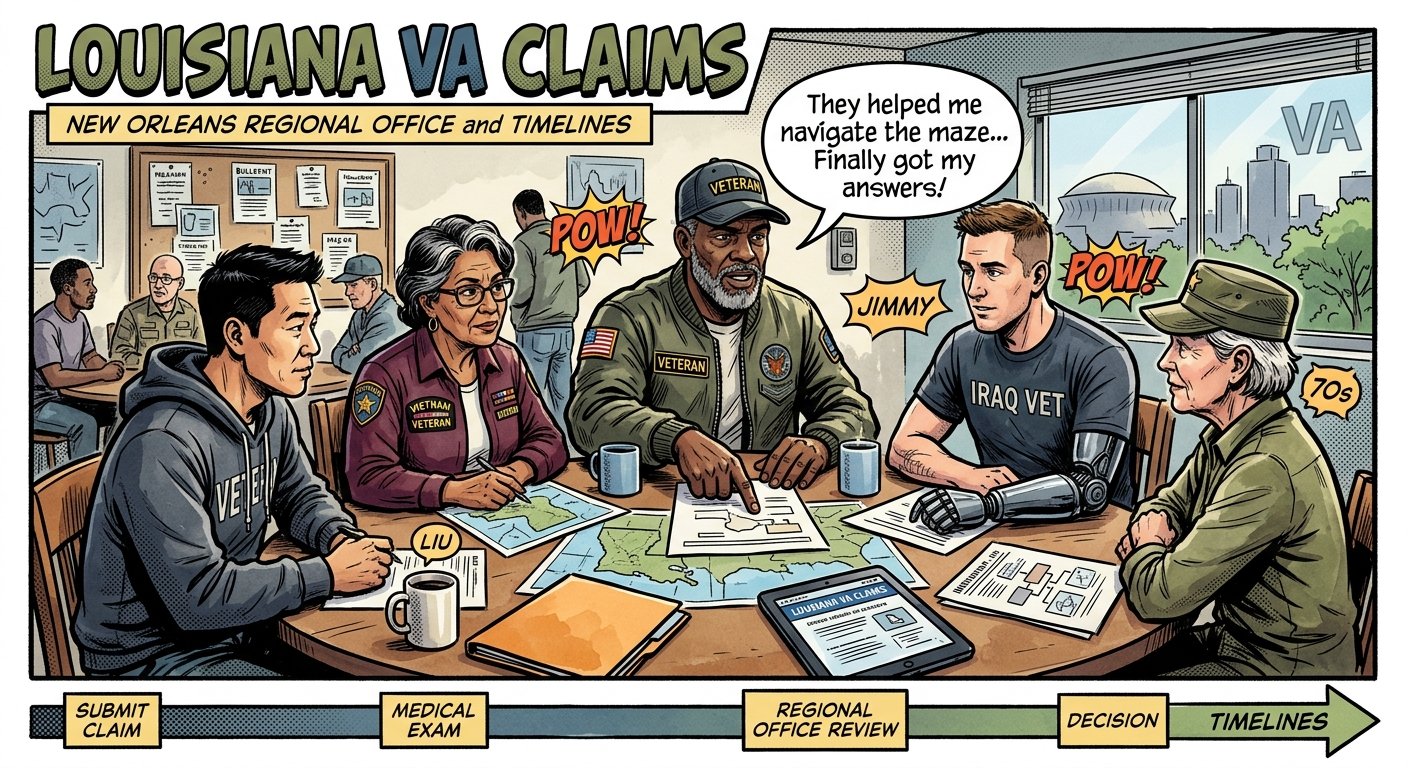
VA Claims Processing in Louisiana: Timeline, Regional Office, and Appeals
Louisiana VA disability claims are processed through the New Orleans VA Regional Benefit Office, which serves veterans statewide. In 2026, the national average time to complete a disability claim has dropped to roughly 75–80 days, though Louisiana claims still commonly run 100–150 days depending on claim type and evidence. Veterans can file free of charge with Louisiana Department of Veterans Affairs counselors at 74 parish offices.
Quick Facts
| Item | Details |
|---|---|
| Benefit | VA disability compensation, pension, DIC, education, and other federal benefits |
| Eligibility | Veteran with a condition connected to military service; discharged under other than dishonorable conditions |
| Application | VA Form 21-526EZ online at VA.gov, by mail, or with an accredited representative |
| Processing Time | National average ~75–80 days (2026); Louisiana median roughly 100–150 days |
| Official Agency | U.S. Department of Veterans Affairs, Veterans Benefits Administration |
| Regional Office | New Orleans VA Regional Benefit Office, 2400 Canal Street, New Orleans, LA 70119 |
| Required Forms | VA Form 21-526EZ (initial compensation); DD-214; medical evidence |
| Updated For | 2026 federal fiscal year and VA processing data through September 2026 |
What “VA Claims Processing” Means in Louisiana
VA claims processing is the sequence of steps the Veterans Benefits Administration (VBA) takes to receive, develop, evaluate, and decide a veteran’s claim for disability compensation or another benefit. In Louisiana, that sequence is administered by the New Orleans VA Regional Benefit Office, which has jurisdiction over claims filed by veterans across the state. The office handles disability compensation, pension, education benefits, life insurance, and home loan claims, and it offers walk-in and appointment-based public contact services.

“Processing” is not one action. It includes a claim receipt date, a review for completeness, a development phase where VA gathers evidence and may order a Compensation and Pension (C&P) exam, a rating decision, and a notification letter. Each stage has its own timeline, and a claim can move backward if evidence is missing or the veteran does not respond to a VA request. Veterans should understand the stages so they can track their claim accurately and avoid delays.
The New Orleans VA Regional Benefit Office

The New Orleans VA Regional Benefit Office is located at 2400 Canal Street, New Orleans, LA 70119-6535, on the campus of the New Orleans VA Medical Center. Public Contact is in Room 2H, across from the pharmacy. The office is open Tuesday through Friday, 8:00 a.m. to 3:30 p.m. , and is closed Monday, Saturday, and Sunday. Veterans should bring a current, unexpired photo ID; depending on the visit, they may also need a DD-214, medical records, Social Security number, direct deposit information, and dependent information.
The regional office is not a claims “office” in the sense of a single counter. It is an administrative jurisdiction. Claims are worked by VA employees, but veterans can get in-person help with eligibility questions, document gathering, paperwork, claim status, and direct deposit changes. VA-accredited representatives can also help file a claim or request a decision review at the office. The office does not charge for assistance.
Some directories list a Gretna, Louisiana, address or a Poydras Street address for the regional office. Those listings are outdated or refer to prior locations. The current public contact point for the New Orleans Regional Benefit Office is the Canal Street location at the VA medical center.
How Long VA Claims Take in Louisiana in 2026
The national average time to complete a VA disability claim was 75.6 days in September 2026, down from 141.5 days in January 2025, according to VA. VA also reported completing 3 million claims in record time in fiscal year 2026 and cutting the disability claim backlog to around 70,000 claims older than 125 days by August 2026, down from more than 400,000 in March 2024. The national average for all pending claims was about 85 days as of January 2026, with 100,115 backlogged claims nationally out of 551,895 pending claims.
Veterans May Qualify for Extra Benefits
Check available financial assistance, healthcare programs and other opportunities that may apply to you.
Check EligibilityLouisiana-specific data is less uniform. As of January 2026, Louisiana had 1,897 backlogged claims and 10,182 pending claims, with an average time to decide of 81.4 days. That backlog count placed Louisiana in the middle of the state rankings, well below high-volume states such as Texas (10,911) and Florida (10,286) but above smaller jurisdictions. Other Louisiana-focused sources describe median processing of 130–150 days for non-presumptive claims and 90–110 days for PACT Act presumptive claims, with an overall Louisiana median of 130–150 days for 2024–2026. The Louisiana Department of Veterans Affairs has cited federal claims averaging 100–150 days while advocating for faster resolutions.
The honest answer is that Louisiana claims span a wide range. A clean claim with complete evidence can be decided in under 100 days. A claim that requires a C&P exam, a records request from a federal facility, or a medical opinion can take 130–150 days or longer. A PACT Act presumptive claim with a qualifying diagnosis and service record often moves faster than a claim requiring a nexus opinion for a non-presumptive condition.
What speeds a claim up
Filing online through VA.gov, which allows electronic processing and can support an earlier effective date.
Submitting a Fully Developed Claim (FDC) with all evidence and a certification that no further evidence is needed. FDCs have averaged around 82.8 days in 2026, though results vary and the difference from standard claims is not always large.
Including a complete DD-214, medical records, and a clear statement of the condition and its in-service cause. Missing records are a leading cause of delay.
Responding quickly to VA requests for evidence, exams, or clarification. A missed response can stall a claim or lead to a denial on the evidence of record.
What slows a claim down
Missing service treatment records or private medical records that VA must request from a third party.
A C&P exam that must be scheduled with a contractor, especially when the veteran’s availability is limited.
Multiple claimed conditions that each require separate evaluation and sometimes separate exams.
A claim for a condition that is not presumptive and requires a medical nexus opinion linking the condition to service.
The Louisiana Claims Process, Step by Step
A VA claim in Louisiana follows the same federal process used nationwide. The state does not have a separate claims system. The steps below reflect how the VBA processes a claim in 2026.
Step 1: Start with an Intent to File
An Intent to File (ITF) establishes the date VA received the veteran’s intent to apply and can protect the effective date for up to one year while the veteran gathers evidence. The ITF can be submitted online, by phone, by mail, or in person. The veteran then has one year to complete the formal application (VA Form 21-526EZ) to preserve that effective date.
Step 2: Complete VA Form 21-526EZ
VA Form 21-526EZ, Application for Disability Compensation and Related Compensation Benefits, is the standard form for initial disability compensation claims, claims for increased compensation, and claims for new or secondary conditions. The form has 11 sections, including identification, claim information, service information, and direct deposit. The claim information section requires the veteran to list each disability and explain how it relates to an in-service exposure, event, or injury.
Step 3: Submit the claim
Veterans can file online at VA.gov, by mail to the VA Evidence Intake Center, by fax, in person at the regional office, or with an accredited representative such as a Veterans Service Organization (VSO) or Louisiana Department of Veterans Affairs counselor. Online filing is generally the fastest and most convenient route.
Step 4: VA reviews the claim
VA checks the claim for completeness and determines what evidence is needed. If the claim is a Fully Developed Claim, VA generally accepts the evidence submitted and moves to decision. If not, VA enters the development phase and may request service records, private medical records, and a C&P exam.
Step 5: C&P exam, if required
A Compensation and Pension exam is a medical evaluation VA may order to answer whether a condition is connected to service and how severe it is. The exam is not treatment and the examiner does not decide the claim. A VA medical center or a VA contractor contacts the veteran by letter and may also call or email. The appointment may be in person or by telehealth. In the New Orleans area, veterans may be scheduled with different contractors and at different locations from one claim to the next, and appointments may be 30–45 minutes away from home.
Step 6: Rating decision and notification
A VA rating decision assigns a percentage to each service-connected condition based on the evidence, including the C&P exam report. The veteran receives a decision letter explaining what was granted, what was denied, and the effective date. The effective date generally determines when payment begins and can reach back to the ITF date or the date the claim was received, depending on the facts.
Step 7: Payment
If the claim is granted, VA establishes an award and pays monthly compensation. The 2026 VA disability rates for a veteran alone range from $180.42 per month at 10%** to **$2,074.45 per month at the 100% rate for a veteran with no dependents, with higher amounts for dependents. The rates reflect a 2.8% cost-of-living adjustment effective December 1, 2025. Dependency and Indemnity Compensation (DIC) for a surviving spouse is $1,699.36 per month in 2026.
PACT Act Claims in Louisiana
The PACT Act of 2022 expanded VA health care and disability compensation for veterans exposed to burn pits, Agent Orange, and other toxic substances. More than 3 million PACT Act claims were submitted nationwide as of the end of 2025, including more than 60,000 in Louisiana. The PACT Act created presumptions of service connection for certain conditions, meaning veterans do not need a nexus letter to connect the condition to service if they served in a qualifying location and era and have a qualifying diagnosis.
Louisiana has a direct connection to toxic exposure claims because Fort Polk (now Fort Johnson) was a site where veterans were exposed to toxic chemicals, and those claims are part of the national PACT Act workload. Veterans who served at Fort Polk or other qualifying locations should review the presumptive condition list and file a claim even if a prior claim was denied for a condition that is now presumptive. The PACT Act allows veterans to reopen claims that were denied because the condition was not presumptive at the time.
A PACT Act claim is filed on VA Form 21-526EZ. The veteran should include the DD-214, medical records showing the diagnosis, and proof of service in a qualifying era or location. No nexus letter is required for a presumptive condition. Louisiana CVSOs can file the claim for free.
C&P Exams in Louisiana: What to Expect
A C&P exam is a medical evaluation, not a treatment visit. The examiner reviews the condition, its history, and its current severity, and completes a Disability Benefits Questionnaire (DBQ) that VA uses in the rating decision. The veteran usually receives notice by mail from a VA contractor, and the contractor may also call or email. If the veteran cannot attend, they should contact the VA or the contractor as soon as possible using the number in the appointment notice; missing an exam without good cause can lead to a denial on the evidence of record.
In the New Orleans area, contractor availability and exam locations vary. A veteran may be offered a limited set of appointment times and may travel 30–45 minutes or more to the exam site. Veterans should confirm the appointment, verify the examiner’s credentials if the notice provides them, and submit any new non-VA medical records before the exam rather than bringing them to the appointment.
Appeals in Louisiana: The Three AMA Lanes
If VA denies a claim or assigns a rating the veteran believes is too low, the veteran has one year from the date of the decision letter to appeal under the Appeals Modernization Act (AMA). The AMA provides three lanes, and choosing the right lane affects both the timeline and the evidence rules.
| Appeal Lane | Form | New Evidence? | Average 2026 Timeline | Best For |
|---|---|---|---|---|
| Supplemental Claim | VA Form 20-0995 | Yes | 4–6 months | New and relevant evidence, such as a new nexus letter, new medical records, or buddy statements |
| Higher-Level Review | VA Form 20-0996 | No | 4–7 months | Legal or factual error by the regional office; a senior reviewer examines the same record |
| Board Appeal — Direct Review | VA Form 10182 | No | ~12 months (BVA Direct Docket average ~212 days at end of March 2026) | Strong existing record, legal error, no new evidence needed |
| Board Appeal — Evidence Submission | VA Form 10182 | Yes, within 90 days of filing | ~18–24 months | New evidence plus judge-level review |
| Board Appeal — Hearing Request | VA Form 10182 | Yes, within 90 days of hearing notice | 2–4 years (Hearing Docket average ~870 days at end of March 2026) | Complex cases where personal testimony matters |
Filing any appeal within the one-year window preserves the effective date, which means back pay continues to accrue through the appeal. Missing the one-year deadline makes the decision final, and a later Supplemental Claim will use the new filing date as the effective date, potentially costing months or years of back pay.
Free Help for Louisiana Veterans
Louisiana provides free claims assistance through the Louisiana Department of Veterans Affairs (LDVA). LDVA’s federal VA-accredited veterans assistance counselors staff 74 service offices across the state and file claims with the federal VA on behalf of veterans for compensation and pension at no charge. LDVA also has appeals paralegals who assist veterans with appeals pending before the Board of Veterans’ Appeals, including representation at hearings.
Veterans can find the nearest LDVA service office through the locator at vetaffairs.la.gov/locations or by calling 225.219.5000. LDVA counselors can also help veterans obtain a DD-214; Louisiana National Guard members can contact Jackson Barracks in New Orleans at 504.278.8000 for an NGB-22.
Louisiana also offers state benefits beyond the federal VA system, including a property tax exemption for disabled veterans and Title 29 in-state tuition assistance. The property tax exemption applies to the next $2,500 of assessed value for veterans with a VA service-connected disability rating, with enhanced exemptions for veterans rated 70–99%, and the surviving spouse of a deceased veteran with a 50% or greater rating may be able to retain the exemption under certain circumstances.
Common Mistakes That Delay Louisiana VA Claims
Filing without a DD-214 or with an incomplete DD-214. The DD-214 is the core service record, and a missing or incomplete copy forces VA to request it, adding weeks.
Claiming a condition without a clear in-service event or diagnosis. A claim needs three elements: a current diagnosis, an in-service event or exposure, and a nexus between them. A claim missing one of the three is likely to be denied or delayed.
Skipping the C&P exam. A missed exam without good cause can result in a denial on the evidence of record.
Filing a PACT Act claim as non-presumptive. If the condition is on the presumptive list and the service location qualifies, the veteran does not need a nexus letter, and filing it as a standard claim can slow it down.
Not appealing within one year. The one-year appeal deadline is calendar days, not business days, and missing it can cost back pay.
Using an unaccredited consultant. Louisiana’s PLUS Act, which would have allowed for-profit non-accredited consultants to charge fees for claims help, was ruled unconstitutional by a federal judge in early 2026, and current law governing claims-assistance services remains unchanged. Veterans should use VA-accredited representatives, LDVA counselors, or accredited attorneys and agents.
Assuming VA will find every record. VA has a duty to assist, but veterans should submit all relevant private medical records and service records they have rather than relying on VA to locate them.
Common Questions
Where does Louisiana VA process disability claims?
Louisiana claims are processed by the New Orleans VA Regional Benefit Office, located at 2400 Canal Street, New Orleans, LA 70119. The office serves veterans statewide and handles disability compensation, pension, education, insurance, and home loan claims. Public Contact is in Room 2H.
How long does a VA claim take in Louisiana in 2026?
The national average is about 75–80 days, but Louisiana claims commonly run 100–150 days. PACT Act presumptive claims tend to be faster, at roughly 90–110 days, while non-presumptive claims requiring a nexus opinion tend to be slower, at 130–150 days. Louisiana had 1,897 backlogged claims and 10,182 pending claims as of January 2026.
What is the phone number for the New Orleans VA Regional Office?
The VA benefits hotline is 1-800-827-1000. Veterans can also contact the regional office through VA.gov or visit Public Contact in Room 2H at 2400 Canal Street. The office is open Tuesday through Friday, 8:00 a.m. to 3:30 p.m.
How do I file a VA claim in Louisiana?
File VA Form 21-526EZ online at VA.gov, by mail to the VA Evidence Intake Center, by fax, in person at the regional office, or with an accredited representative. Louisiana Department of Veterans Affairs counselors file claims for free at 74 parish offices.
Does the PACT Act apply to Louisiana veterans?
Yes. More than 60,000 PACT Act claims have been submitted from Louisiana. Veterans who served at Fort Polk (Fort Johnson) or other qualifying locations and have a presumptive condition can file on VA Form 21-526EZ without a nexus letter.
What is a C&P exam and do I have to attend?
A C&P exam is a VA-ordered medical evaluation of a claimed condition. Veterans should attend if VA schedules one. Missing an exam without good cause can result in a denial on the evidence of record. If you cannot attend, contact the VA or the scheduling contractor immediately to explain and request a reschedule.
How do I appeal a VA denial in Louisiana?
You have one year from the decision letter date to file a Supplemental Claim (VA Form 20-0995), a Higher-Level Review (VA Form 20-0996), or a Board Appeal (VA Form 10182). Filing within one year preserves the effective date. LDVA appeals paralegals can assist with Board appeals.
Is claims help in Louisiana free?
Yes, through the Louisiana Department of Veterans Affairs and VA-accredited Veterans Service Organizations. LDVA counselors file claims for free. Avoid for-profit, non-accredited consultants; Louisiana’s PLUS Act was struck down in 2026, and current law on claims-assistance services remains unchanged.
Does Louisiana have state veterans benefits?
Yes. Louisiana offers a disabled veteran property tax exemption and Title 29 in-state tuition assistance, among other state benefits. LDVA counselors can explain both state and federal benefits and help veterans apply.
What is the 2026 VA disability rate for a veteran alone?
For 2026, a veteran alone receives $180.42 per month at 10%**, **$356.66 at 20%, $552.47 at 30%**, **$795.84 at 40%, and $1,132.90 at 50%, with higher rates at higher ratings and for veterans with dependents. The rates include a 2.8% COLA effective December 1, 2025.
How long does a Board appeal take in 2026?
At the end of March 2026, the Board of Veterans’ Appeals reported an average of 212 days pending for the Direct Docket and 870 days for the Hearing Docket. Board appeals generally take 12–24 months or longer, depending on the docket and whether a hearing is requested.
Key Takeaways
Louisiana VA disability claims are processed by the New Orleans VA Regional Benefit Office at 2400 Canal Street, New Orleans, LA 70119.
In 2026, the national average time to complete a disability claim is roughly 75–80 days, but Louisiana claims commonly run 100–150 days depending on evidence and claim type.
Louisiana had 1,897 backlogged claims and 10,182 pending claims as of January 2026, with an average time to decide of about 81.4 days.
PACT Act claims are a major share of Louisiana workload, with more than 60,000 PACT Act claims submitted from the state; Fort Polk (Fort Johnson) exposure is part of that history.
Filing online, submitting a complete DD-214, and attending the C&P exam are the most reliable ways to avoid delays.
Appeals must be filed within one year of the decision letter under the AMA; the three lanes are Supplemental Claim, Higher-Level Review, and Board Appeal.
Free claims help is available through LDVA’s 74 parish offices at 225.219.5000 and through VA-accredited VSOs.
The 2026 VA disability rate for a veteran alone starts at $180.42 per month at 10%** and reaches **$2,074.45 per month at the 100% rate with no dependents.
Official Resources
VA — New Orleans VA Regional Benefit Office: https://www.va.gov/new-orleans-va-regional-benefit-office-at-new-orleans-va-medical-center/
VA — File a disability compensation claim (VA Form 21-526EZ): https://www.va.gov/disability/file-disability-claim-form-21-526ez/
VA — VA claim exam (C&P exam): https://www.va.gov/resources/va-claim-exam/
VA — Appeals Modernization Act: https://www.va.gov/decision-reviews/
VA — PACT Act and toxic exposure: https://www.va.gov/disability/eligibility/hazardous-materials-exposure/
VA News — Benefits processing improvements: https://news.va.gov/
Louisiana Department of Veterans Affairs — Benefits: https://vetaffairs.la.gov/benefits
Louisiana Department of Veterans Affairs — Office locator: https://vetaffairs.la.gov/locations
Board of Veterans’ Appeals: https://www.bva.va.gov/
U.S. Department of Veterans Affairs: https://www.va.gov/
🇺🇸 IMPORTANT DISCLAIMER – Veterans Benefits Information
This site provides general information about U.S. Department of Veterans Affairs (VA) benefits for educational and informational purposes only.
- Not Official: We are NOT affiliated with, endorsed by, or connected to the U.S. Department of Veterans Affairs (VA), the Veterans Benefits Administration (VBA), the Veterans Health Administration (VHA), or any other government agency.
- No Legal/Financial Advice: The content on this website is for informational purposes only and does not constitute legal, financial, or medical advice. VA benefits rules change frequently – always consult with an accredited Veterans Service Officer (VSO) or a qualified professional for your specific situation.
- Official Sources: For official, binding information and to apply for benefits, always visit official .gov websites: VA.gov, Benefits.VA.gov, or SSA.gov.
- No Data Collection: This site does not collect, store, or process any personal information. It does not have login forms, contact forms, or any system to capture user data. We never ask for your Social Security Number, bank details, or any personal information.
- 🚨 Scam Alert: The VA and other government agencies never charge fees for benefit applications. If anyone asks for money to "process" your VA claim, it is a scam. Report it to the VA Office of Inspector General at VA.gov/OIG.
- Advertising: This site uses third-party advertising (Adsterra) to cover operational costs. We do not endorse or guarantee any products or services advertised.
📌 Information provided as of June 2026. Always verify current eligibility and rules with official .gov sources.
This site is not affiliated with the U.S. Department of Veterans Affairs or any government agency. All information is for educational purposes only. Please visit VA.gov for official information.
