
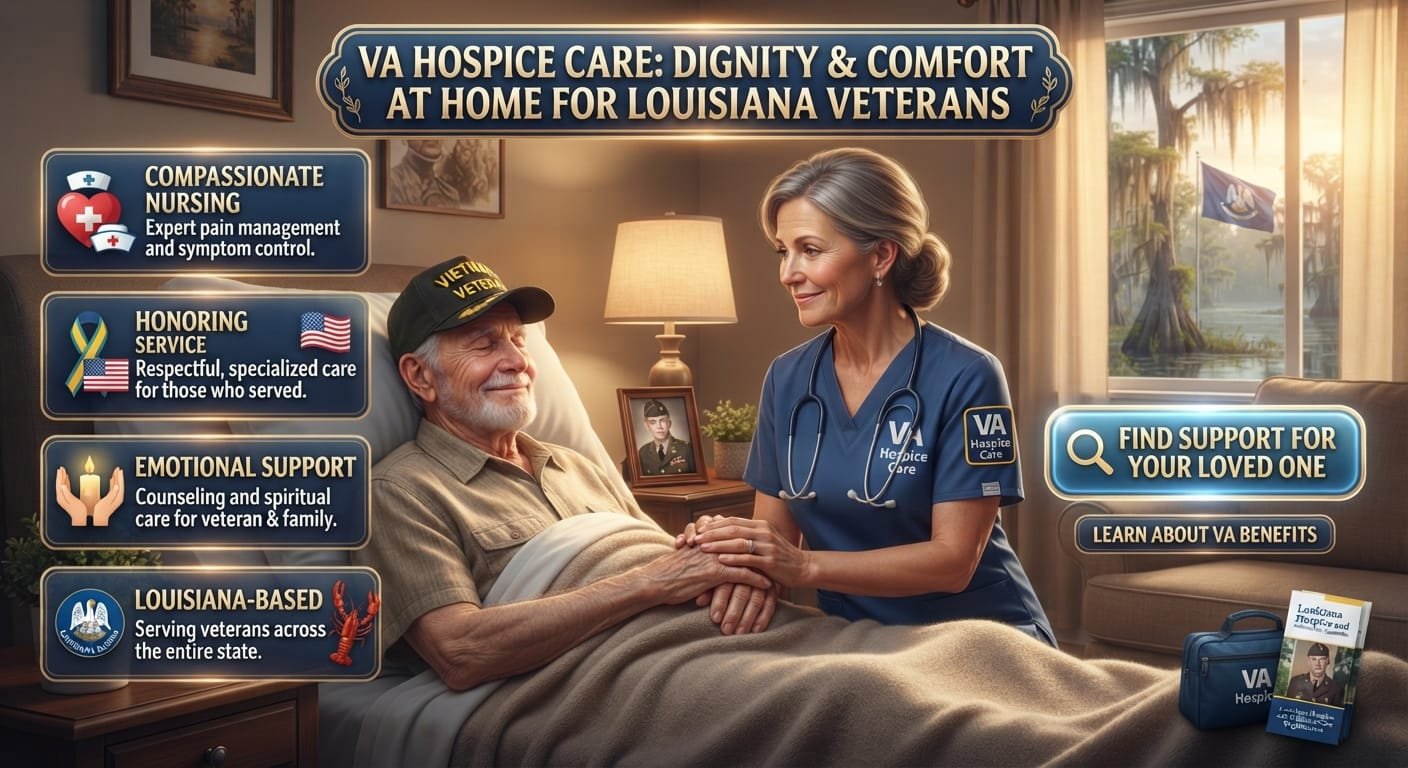
Hospice Care Benefits for Veterans in Louisiana: 2026 Complete Guide
Hospice care for veterans in Louisiana is available through VA benefits, Medicare, Medicaid, and TRICARE. VA hospice care requires no copays and does not require the terminal illness to be service-connected. Veterans can receive care at home, in a VA Community Living Center, or through community hospice agencies across Louisiana.
Quick Facts
| Item | Details |
|---|---|
| Benefit | End-of-life comfort care, pain management, family support, and bereavement services |
| Eligibility | Veterans enrolled in VA health care with a terminal prognosis of 6 months or less |
| Application | Referral from VA primary care provider, social worker, or care team |
| Processing Time | Most complete referrals reviewed within 24 hours; may take up to one business week |
| Official Agency | U.S. Department of Veterans Affairs (VA) |
| Required Forms | Hospice election statement; physician certification of terminal illness |
| Updated For | September 2026 |
What Is VA Hospice Care?
VA hospice care is specialized medical care for veterans in the final months of life. It focuses on comfort, dignity, and quality of life rather than curative treatment. Care is delivered by an interdisciplinary team including doctors, nurses, social workers, chaplains, and therapists .

Why it matters for veterans: VA hospice care addresses the unique physical and psychological needs of veterans, including PTSD, traumatic grief, and survival guilt that may resurface at end of life .

What to do next: If you or a loved one may need hospice care, contact your VA primary care provider or care team to request a referral.
Who Qualifies for VA Hospice Care in Louisiana?
All veterans enrolled in VA health care qualify for hospice care if they have a terminal prognosis of 6 months or less. The terminal illness does not need to be service-connected .
Eligibility Requirements
To receive VA hospice care, a veteran must:
Be enrolled in VA health care
Have a terminal prognosis of 6 months or less if the disease runs its normal course, certified by a VA physician
Make an informed decision to receive hospice care rather than curative treatment
Who Qualifies for Free Care
VA hospice care is provided at no cost to the veteran. There are no copays for hospice services, regardless of the veteran’s financial situation or disability rating .
Veterans Without VA Health Care Enrollment
Veterans May Qualify for Extra Benefits
Check available financial assistance, healthcare programs and other opportunities that may apply to you.
Check EligibilityVeterans who are not currently enrolled in VA health care may still qualify for hospice benefits. VA medical facilities can assist with enrollment and expedite the process for veterans with terminal illnesses. Contact the nearest VA medical center in Louisiana to begin the enrollment process.
How VA Hospice Care Differs from Medicare Hospice
The key difference between VA hospice care and Medicare hospice is that VA allows concurrent care—veterans can continue certain treatments while receiving hospice, which Medicare does not permit .
Comparison Table: VA vs. Medicare Hospice
| Feature | VA Hospice | Medicare Hospice |
|---|---|---|
| Cost to Veteran | No copays | May have copays for medications/respite |
| Service Connection Required | No | No |
| Concurrent Treatment | Allowed for certain conditions | Not allowed (must forgo curative treatment) |
| Dialysis While in Hospice | Allowed | Not allowed (if ESRD is terminal diagnosis) |
| Care Settings | Home, VA facility, community hospice | Home, nursing facility, inpatient hospice |
| Bereavement Support | 13 months for family | 13 months for family |
Why this matters: A 2022 study found that veterans in VA-funded hospice were nearly twice as likely to receive concurrent dialysis compared to those in Medicare-funded hospice (46% vs. 26%) . This “terrible choice” between comfort and continued treatment does not apply under VA policy.
Louisiana VA Medical Centers That Provide Hospice Care
Louisiana has three VA medical centers that provide or coordinate hospice care services. Each facility offers palliative care consultation and can arrange hospice services either within VA or through community partners.
Alexandria VA Health Care System
Location: 2495 Shreveport Highway, Pineville, LA 71360
Services: Palliative care consultation, hospice coordination, Community Living Center (CLC) hospice services
Contact: Main number (318) 473-0010
Southeast Louisiana Veterans Health Care System (New Orleans)
Location: 2400 Canal Street, New Orleans, LA 70119
Services: Inpatient hospice unit, palliative care consult team, home hospice coordination through community agencies
Contact: Main number (504) 507-2000 or (800) 935-8387
Overton Brooks VA Medical Center (Shreveport)
Location: 510 East Stoner Avenue, Shreveport, LA 71101
Services: Palliative care consultation, hospice referral coordination, Community Living Center services
Contact: Main number (318) 221-8411 or (800) 644-8375
Note: Veterans living outside these service areas can receive hospice care through community agencies paid for by VA. Contact your nearest VA facility to arrange services closer to home.
How to Apply for VA Hospice Care in Louisiana
Step 1: Request a Referral
Hospice care begins with a referral from a VA physician or care team member. The veteran, family member, or caregiver can request this referral by contacting the VA primary care provider.
Who can initiate a referral:
VA primary care provider
VA social worker
VA palliative care consult team
Hospital discharge planner (if currently hospitalized)
Family member or caregiver (who then contacts the VA care team)
Step 2: Clinical Assessment
A VA physician or palliative care specialist will assess the veteran’s condition to determine if hospice eligibility criteria are met (terminal prognosis of 6 months or less).
Step 3: Certification of Terminal Illness
Two physicians must certify the terminal illness—including a VA physician. This certification documents that the veteran’s prognosis is 6 months or less if the disease runs its normal course .
Step 4: Hospice Election Statement
The veteran or their legal surrogate must sign a hospice election statement. This document confirms the veteran’s informed decision to receive hospice care rather than curative treatment.
Important: Under VA policy, signing the hospice election does not waive the right to concurrent palliative care or VA benefits for conditions unrelated to the terminal illness .
Step 5: Choose Care Setting
The veteran and family choose where hospice care will be provided:
Home (private residence, assisted living, or family member’s home)
VA Community Living Center (if available and appropriate)
Community nursing home (contracted with VA)
Inpatient hospice unit (at a VA facility or community hospice)
Step 6: Begin Care
Once the election statement is signed and certifications are complete, hospice services begin. Most complete referrals are reviewed within 24 hours, though the process may take up to one business week if additional clinical information is needed .
Required Documents and Forms
| Document | Purpose | Who Completes |
|---|---|---|
| Hospice Election Statement | Confirms veteran’s informed choice of hospice over curative treatment | Veteran or legal surrogate |
| Certification of Terminal Illness | Documents prognosis of 6 months or less | Two physicians (at least one VA physician) |
| Advance Directive | Documents veteran’s wishes for care | Veteran (recommended, not required for hospice) |
| VA Form 10-10EZ | VA health care enrollment application (if not already enrolled) | Veteran |
Note: Veterans do not need a DNR (Do Not Resuscitate) order to receive hospice care .
Louisiana Community Hospice Agencies That Accept VA Payment
Many Medicare-certified hospice agencies in Louisiana accept VA payment for veteran hospice care. Here are confirmed Medicare-certified agencies:
Louisiana Hospice & Palliative Care of New Orleans
Location: 2400 Veterans Memorial Blvd, Suite 510, Kenner, LA 70062
Phone: (504) 483-9792
Services: Nursing care, home health aide, counseling, medical social services, physical/occupational therapy, inpatient care coordination
Quality Metrics: This agency scores above national average in pain assessment timeliness (93.5 vs. 77.7 national) and shortness of breath treatment (100 vs. 94.6 national)
How to Find a VA-Accepting Hospice in Your Parish
Contact your VA care team and ask for a list of community hospices with VA contracts
Visit Medicare.gov‘s Hospice Compare tool to research quality ratings
Ask the hospice agency directly: “Do you accept VA payment for veteran hospice care?”
Request that your VA social worker coordinate the referral
Important: Veterans receiving VA-paid hospice through a community agency still maintain access to their other VA benefits, including care for conditions unrelated to the terminal illness .
Services Covered by VA Hospice Care
VA hospice care includes comprehensive services at no cost to the veteran:
Medical Services
Physician services
Skilled nursing care
Pain and symptom management
Medications for the terminal diagnosis
Medical equipment and supplies
Support Services
Social work support
Chaplaincy and pastoral care
Psychological counseling
Bereavement counseling for family
Respite care for caregivers
Therapy Services
Physical therapy
Occupational therapy
Speech and language pathology
Nutrition support
Family Services
Caregiver education
Family meetings
Bereavement support for 13 months after death
What VA Hospice Does Not Cover
The following services are generally not covered under VA hospice benefits:
Curative treatment of the terminal illness (except concurrent care under VA policy)
Room and board for hospice care received at home
Custodial care unrelated to the terminal illness
Care for conditions unrelated to the terminal illness (these may be covered under other VA benefits)
Important distinction: Under VA policy, veterans can receive concurrent care—certain treatments for the terminal illness that would be prohibited under Medicare hospice rules .
Hospice Care Settings in Louisiana
Home Hospice
Most veterans receive hospice care at home. VA pays for the hospice agency’s services, and the veteran remains in familiar surroundings. The hospice team makes regular visits and is available 24/7 by phone.
Best for: Veterans who have a caregiver at home and prefer familiar surroundings.
VA Community Living Center (CLC)
Some VA facilities have dedicated hospice beds in Community Living Centers. VA CLC hospice care receives higher family satisfaction ratings than community hospice (87% vs. 81% rate care 9 or 10 out of 10) .
Best for: Veterans whose symptoms cannot be managed at home or who lack home caregivers.
Inpatient Hospice Unit
When pain or symptoms require continuous monitoring, veterans may be admitted to an inpatient hospice unit. VA has inpatient hospice units at some medical centers, or may contract with community inpatient hospices.
Best for: Crisis symptom management or when home care is no longer possible.
Respite Care
Respite care provides short-term relief for family caregivers. The veteran is admitted to a facility for up to 5 days so the caregiver can rest. Respite is limited to no more than 5 days at a time .
Best for: Family caregivers who need temporary relief.
Common Mistakes to Avoid
1. Assuming hospice means giving up all treatment. Under VA policy, veterans can receive concurrent palliative care and even certain disease-modifying treatments while in hospice. This differs from Medicare rules .
2. Thinking the illness must be service-connected. VA hospice care is available to all enrolled veterans regardless of whether the terminal illness is related to military service .
3. Believing VA hospice only happens at VA facilities. Veterans can receive VA-paid hospice at home, in community nursing homes, or through community hospice agencies .
4. Not asking about concurrent care. If a veteran wants to continue certain treatments (like dialysis) while in hospice, they should specifically discuss this with their VA care team. VA policy allows concurrent care that Medicare prohibits.
5. Waiting too long to request hospice. Hospice is most effective when started early enough to establish comfort and build relationships. Families often say they wish they had started sooner.
6. Assuming Medicare and VA hospice are the same. The Medicare hospice benefit requires forgoing curative treatment and has copays. VA hospice has no copays and allows concurrent care .
Bereavement Services After Death
VA provides bereavement support to families for 13 months after the veteran’s passing .
What’s Included
Grief counseling (individual or group)
Support for family members and caregivers
Connection to VA survivor benefits
Assistance with burial and memorial benefits
VA Survivor Benefits
Surviving spouses and dependents may qualify for:
Dependency and Indemnity Compensation (DIC) if the veteran’s death was service-connected
VA burial benefits including plot allowance and headstone
Survivors’ pension for low-income surviving spouses
Contact the VA regional office in Louisiana or visit VA.gov for assistance with survivor benefits.
Costs and Financial Considerations
VA hospice care is provided at no cost to the veteran. There are no copays, deductibles, or coinsurance for hospice services under VA .
What This Covers
All hospice team visits (nursing, physician, aide, social work, chaplain)
Medications for the terminal diagnosis
Medical equipment and supplies related to the terminal diagnosis
Respite care (up to 5 days at a time)
Bereavement support for family
What Might Have Costs
Care for conditions unrelated to the terminal illness (covered under regular VA benefits with standard copays if applicable)
Room and board if receiving hospice in a facility (if not covered by VA or Medicare)
Services not authorized by VA
Financial assistance: Veterans facing financial hardship can apply for VA financial hardship assistance. Contact the VA medical center’s eligibility office.
Common Questions
Does the veteran’s illness have to be service-connected to get VA hospice care?
No. VA hospice care is available to all enrolled veterans regardless of whether the terminal illness is related to military service. The veteran must be enrolled in VA health care and have a prognosis of 6 months or less .
Can a veteran receive hospice at home in Louisiana?
Yes. Most veterans receive hospice care at home. VA pays a community hospice agency to provide services in the veteran’s private residence, assisted living facility, or family member’s home anywhere in Louisiana .
What is concurrent care under VA hospice?
Concurrent care means veterans can receive certain treatments for their terminal illness while enrolled in hospice—something Medicare does not allow. For example, a veteran with end-stage renal disease can continue dialysis while in VA-funded hospice .
Does Medicare cover hospice if the veteran uses VA?
Veterans eligible for both Medicare and VA can choose which benefit pays for hospice. Under Medicare hospice, the veteran must forgo curative treatment. Under VA hospice, concurrent care is allowed. The veteran chooses which benefit to use .
How long can a veteran receive hospice care?
Hospice care is provided as long as the veteran meets eligibility criteria. Medicare hospice benefit periods are two 90-day periods followed by unlimited 60-day periods. VA hospice has no time limit—care can last more than 180 days if the veteran continues to meet criteria .
What if the veteran’s condition improves?
If the veteran’s condition improves and they want to resume curative treatment, they can revoke the hospice election. Under Medicare, revoking hospice forfeits the remaining days in that election period. Under VA, the veteran can return to regular VA care .
Does VA pay for hospice in a nursing home?
Yes. VA can pay for hospice services in a community nursing home or state veterans home. The hospice agency provides hospice services, and room and board may be covered by Medicaid, Medicare, or private funds depending on the veteran’s situation .
What is respite care and how often can it be used?
Respite care provides short-term relief for family caregivers. The veteran is admitted to a facility for up to 5 days at a time. Medicare limits respite to no more than 5 days at a time. VA respite follows similar guidelines .
Can a veteran change hospice agencies?
Yes. Under Medicare, a patient may change hospice programs one time during each election period. Under VA, veterans can request a change if they are dissatisfied with their hospice agency. Contact the VA care coordinator to arrange a change .
What happens to VA disability compensation during hospice?
VA disability compensation continues during hospice care. Receiving hospice does not affect the veteran’s VA disability rating, compensation payments, or other VA benefits. The veteran’s family should notify VA of any changes in dependents or banking information .
Key Takeaways
VA hospice care is free for enrolled veterans with a terminal prognosis of 6 months or less, regardless of service connection
Concurrent care is allowed under VA hospice—veterans can continue certain treatments that Medicare prohibits
Louisiana has three VA medical centers (Alexandria, New Orleans, Shreveport) that coordinate hospice services
Home hospice is most common—VA pays community agencies to provide care wherever the veteran lives
VA CLC hospice care receives higher family satisfaction than community hospice (87% vs. 81% rate 9/10)
Referrals are reviewed within 24 hours for complete cases, though may take up to one week
Bereavement support lasts 13 months after the veteran’s death
No DNR order is required for hospice care
Veterans can revoke hospice if their condition improves and they want to resume curative treatment
Contact your VA primary care provider to request a hospice referral
Official Resources
VA.gov — Palliative and Hospice Care: va.gov/health-care/health-needs-conditions/palliative-hospice-care
VA Geriatrics and Extended Care: va.gov/geriatrics
Medicare.gov — Hospice Compare: medicare.gov/care-compare
VA Caregiver Support: caregiver.va.gov
VA News — End-of-Life Care: news.va.gov

🇺🇸 IMPORTANT DISCLAIMER – Veterans Benefits Information
This site provides general information about U.S. Department of Veterans Affairs (VA) benefits for educational and informational purposes only.
- Not Official: We are NOT affiliated with, endorsed by, or connected to the U.S. Department of Veterans Affairs (VA), the Veterans Benefits Administration (VBA), the Veterans Health Administration (VHA), or any other government agency.
- No Legal/Financial Advice: The content on this website is for informational purposes only and does not constitute legal, financial, or medical advice. VA benefits rules change frequently – always consult with an accredited Veterans Service Officer (VSO) or a qualified professional for your specific situation.
- Official Sources: For official, binding information and to apply for benefits, always visit official .gov websites: VA.gov, Benefits.VA.gov, or SSA.gov.
- No Data Collection: This site does not collect, store, or process any personal information. It does not have login forms, contact forms, or any system to capture user data. We never ask for your Social Security Number, bank details, or any personal information.
- 🚨 Scam Alert: The VA and other government agencies never charge fees for benefit applications. If anyone asks for money to "process" your VA claim, it is a scam. Report it to the VA Office of Inspector General at VA.gov/OIG.
- Advertising: This site uses third-party advertising (Adsterra) to cover operational costs. We do not endorse or guarantee any products or services advertised.
📌 Information provided as of June 2026. Always verify current eligibility and rules with official .gov sources.
This site is not affiliated with the U.S. Department of Veterans Affairs or any government agency. All information is for educational purposes only. Please visit VA.gov for official information.
