
VA Disability Benefits by State Comparison 2026
VA disability benefits are the same nationwide: a 100% disabled veteran receives $3,938.58 per month in 2026 regardless of where they live. However, each of the 50 states offers additional benefits—property tax exemptions, education waivers, vehicle registration fee reductions, and more—that can be worth $15,000–$25,000 per year on top of federal compensation. State benefits vary widely, with Florida, Texas, and Virginia offering the strongest overall packages.
Quick Facts
| Item | Details |
|---|---|
| Benefit | VA Disability Compensation + State-Specific Supplemental Benefits |
| Eligibility | Veteran with honorable discharge and service-connected disability rating from 0% to 100% |
| Application | File VA Form 21-526EZ online at VA.gov, by mail, or in person at a VA Regional Office |
| Processing Time | Initial claims average 120–150 days; supplemental claims average 120 days |
| Official Agency | U.S. Department of Veterans Affairs (VA.gov) |
| Required Forms | VA Form 21-526EZ (initial claim), VA Form 20-0995 (supplemental), VA Form 21-8940 (TDIU) |
| Updated For | 2026 (rates effective December 1, 2025, with 2.8% COLA) |
Federal VA Disability Benefits Are the Same in All States
Understanding what the federal government provides is essential before comparing state benefits. The federal VA disability compensation program pays monthly, tax-free benefits to veterans with service-connected disabilities. These payments are identical regardless of which state you live in—a veteran in California receives the same federal compensation as a veteran in Mississippi .

2026 VA Disability Compensation Rates
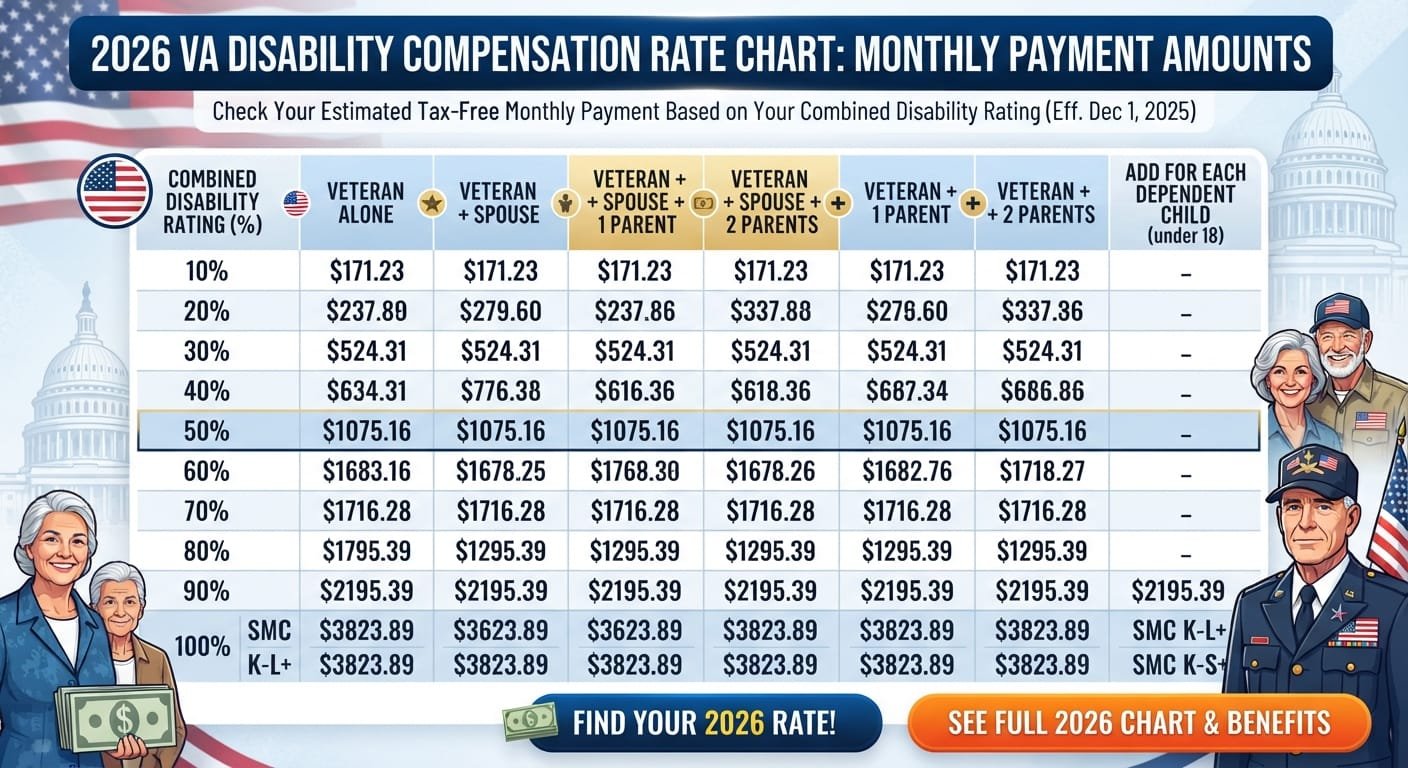
The 2026 rates reflect the 2.8% Cost-of-Living Adjustment that took effect December 1, 2025 . VA disability compensation is not taxable at the federal or state level and does not count as income for Social Security or Medicaid purposes.
| Disability Rating | Veteran Alone | With Spouse | With Spouse + 1 Child |
|---|---|---|---|
| 10% | $180 | — | — |
| 20% | $357 | — | — |
| 30% | $552 | $617 | $666 |
| 40% | $796 | $883 | $948 |
| 50% | $1,133 | $1,242 | $1,323 |
| 60% | $1,435 | $1,566 | $1,663 |
| 70% | $1,808 | $1,961 | $2,074 |
| 80% | $2,102 | $2,277 | $2,406 |
| 90% | $2,362 | $2,559 | $2,704 |
| 100% | $3,939 | $4,158 | $4,319 |

The table above shows the monthly 2026 VA disability compensation rates. Each additional child beyond the first adds $34 per month. Veterans with dependents who are parents may qualify for additional monthly amounts .
What Is “VA Math” and How Does It Affect Your Rating?
VA uses a combined rating system that is not additive. For example, a 50% rating combined with a 30% rating does not equal 80%. Instead, VA applies the higher rating first, then the next rating to the remaining “able” percentage. The formula follows 38 CFR § 4.25: 50% + 30% = 65%, which rounds to 70% . This system often produces a lower combined rating than veterans expect. Use a VA combined rating calculator before filing a claim to understand what rating you may receive.
Additional Federal Benefits for 100% Disabled Veterans
Veterans rated 100% permanently and totally disabled (P&T) qualify for additional federal benefits that state benefits do not replace:
Dependency and Indemnity Compensation (DIC): Surviving spouses receive approximately $1,600+ per month in 2026. This benefit is for survivors of veterans who died from a service-connected condition or who were 100% P&T at the time of death .
Special Monthly Compensation (SMC): Additional compensation for specific conditions, including SMC-K ($130.94/month add-on for conditions like service-connected erectile dysfunction) .
Clothing Allowance: $1,053.19 per year if you have a qualifying skin condition or prosthetic that damages clothing .
State-by-State Comparison of Veteran Benefits
Every state offers additional benefits for disabled veterans. These are not automatic—you must apply through your state’s veterans affairs office or county assessor . The table below compares the most valuable state benefits across all 50 states.
Top 10 Best States for Disabled Veterans in 2026
Veterans May Qualify for Extra Benefits
Check available financial assistance, healthcare programs and other opportunities that may apply to you.
Check EligibilityBased on overall benefit value, cost of living, and quality of life factors, these states rank highest for disabled veterans :
| Rank | State | Property Tax Benefit | Income Tax on Retired Pay | Education Benefit | Other Key Benefit |
|---|---|---|---|---|---|
| 1 | Florida | Full exemption (100% P&T) | No state income tax | Free tuition for dependents (20%+ disability) | Free hunting/fishing license |
| 2 | Texas | Full exemption (100% or IU) | No state income tax | Hazlewood Act (150 hours transferable) | Free driver’s license (60%+) |
| 3 | Virginia | Full exemption (100% S/C or P&T) | Yes, taxed | No state-level tuition waiver | Free state parks |
| 4 | Illinois | Full exemption (100% disabled) | Yes, taxed | Illinois Veterans Grant (dependents) | Free hunting/fishing license |
| 5 | South Dakota | Full exemption (100% or P&T) | No state income tax | No tuition waiver | Free state parks admission |
| 6 | Hawaii | Full exemption (100% disabled) | Yes, taxed | $5,000 home purchase/accessibility grant | Vehicle registration fee waived |
| 7 | Maine | $6,000–$50,000 exemption | Yes, taxed | 100% tuition waiver for dependents (UMaine system) | Free vehicle registration |
| 8 | West Virginia | Full exemption (P&T) | Yes, taxed | None | Free hunting/fishing license |
| 9 | New Hampshire | $700+ tax credit | No state income tax (wages) | None | Free vehicle registration |
| 10 | North Dakota | $8,100 credit or $120,000 full exemption (paraplegic) | Yes, taxed | None | 10-point hiring preference |
Florida ranked first overall, with Virginia second and Texas third, according to a recent SmileHub survey. Florida was the only state to rank in the top five in both Health and Rehabilitation Access and Economic Stability categories . The gap between Florida and Virginia (63.98 vs. 60.20 overall score) was the largest of the survey .
Property Tax Exemptions: The Highest-Value State Benefit
Property tax exemptions are the most valuable state benefit for disabled veterans, often saving $3,000–$15,000+ per year .
| State | Benefit for 100% Disabled Veterans | Application Required |
|---|---|---|
| Florida | Full homestead exemption | County assessor |
| Texas | Full homestead exemption | County appraisal district |
| Virginia | Full homestead exemption | County commissioner of revenue |
| California | $180,671 exemption (2026); $271,009 for low-income ($81,131 limit) | County assessor |
| Illinois | Full homestead exemption | County assessor |
| South Carolina | Full homestead exemption | County auditor |
| Oklahoma | Full property tax exemption + state sales tax exemption | County assessor + Oklahoma Veterans Registry |
| New Mexico | Proportional exemption based on rating percentage (2026 expansion) | County assessor |
| Louisiana | Full exemption (100% rating) or partial up to $12,000 (lower ratings) | Parish assessor |
| Georgia | Homestead exemption up to $109,986 | County tax commissioner |
| North Carolina | $45,000 assessed value reduction | County assessor |
| Connecticut | Full exemption for P&T veterans (2026 fiscal year) | Local tax assessor |
| Pennsylvania | Full exemption for 100% wartime disability (income below $114,637 in 2025) | County assessor |
| Ohio | Homestead exemption (rates vary by location) | County auditor |
| New Hampshire | $700+ tax credit (varies by municipality) | County assessor |
Twenty-two states currently offer a full homestead property tax exemption for veterans rated 100% P&T . In states with high property tax rates like Texas (2.5% average) and Florida (1.0% average), the savings can be substantial. Texas, for example, on a home with a $400,000 taxable value at 2.5%, saves $10,000 per year . Florida waives full property taxes for 100% disabled veterans—a benefit that alone can make Florida one of the most financially attractive states .
Important: Property tax exemptions are not automatic. They are applied through your county assessor or appraisal district, not through the VA and not through your state veterans agency . You must provide your VA rating letter showing your disability percentage. Most states require annual reapplication or recertification .
State Income Tax Treatment of Military Pay and VA Benefits
VA disability compensation is tax-free at the federal level. The majority of states also exempt VA disability compensation from state income tax .
| Category | States |
|---|---|
| No state income tax | Alaska, Florida, Nevada, New Hampshire (wages only), South Dakota, Tennessee, Texas, Washington, Wyoming |
| Military retirement pay fully exempt | Alabama, Arkansas, Connecticut, Hawaii, Illinois, Iowa, Kansas, Louisiana, Maine, Massachusetts, Michigan, Minnesota, Mississippi, Missouri, Nebraska, New Jersey, New York, North Carolina, Ohio, Oregon (partial), Pennsylvania, Rhode Island, West Virginia, Wisconsin, and others |
| Military retirement pay taxed | Most states not listed above; check with your state’s department of revenue |
Nine states have no state income tax, meaning military retirement pay and other income are untaxed by default . If you are a military retiree receiving both VA disability compensation and military retired pay, understand how your state treats each, as some states that exempt VA compensation still tax retirement pay .
Education Benefits by State
Many states offer free or reduced in-state tuition for disabled veterans and their dependents. These benefits can save $10,000–$30,000+ per year .
| State | Benefit | Eligibility |
|---|---|---|
| Texas | Hazlewood Act: 150 hours of free tuition at Texas public colleges | 100% disabled veterans (transferable to dependents) |
| Florida | Free tuition at Florida public colleges | Veterans with 20%+ disability; dependents of P&T veterans |
| Illinois | Illinois Veterans Grant: free tuition and fees | Veterans, some dependents |
| Georgia | HERO Scholarship for children of National Guard members | Georgia National Guard members and dependents |
| Louisiana | Educational benefits for spouses and children | Eligibility varies by veteran’s disability and status |
| Connecticut | Tuition waiver at public colleges | Honorably discharged wartime veterans (90+ days) and some dependents |
| Maine | 100% tuition waiver for dependents at University of Maine system | Veterans 100% P&T |
| California | Tuition and fee waivers at California State University and UC campuses | Veterans with 0%–100% disability (CalVet Fee Waiver) |
| New York | Tuition assistance | Veterans and dependents (criteria vary) |
Vehicle Registration and Driver’s License Benefits
Most states offer reduced or waived fees for disabled veterans .
| State | Benefit |
|---|---|
| Florida | Vehicle registration fee waived for 100% disabled veterans (all vehicles) |
| Texas | Free driver’s license or ID for veterans with 60%+ disability |
| Louisiana | Free driver’s license and ID for veterans with 50%+ disability |
| North Dakota | Reduced license fees ($3.00) for 100% disabled veterans |
| Connecticut | Standard and campaign-specific veteran license plates available |
| Hawaii | $45 annual vehicle registration fee waived for 100% disabled veterans |
| New Hampshire | Free vehicle registration and disability plates for P&T veterans |
Hunting and Fishing License Benefits
The majority of states offer free or discounted hunting and fishing licenses to veterans, particularly those with service-connected disabilities .
| State | Benefit | Eligibility |
|---|---|---|
| Florida | Free Gold Sportsman license (hunting/fishing) | 100% disability |
| Georgia | Free honorary hunting/fishing license | 50%+ disability |
| Louisiana | Free hunting and fishing license (includes deer, turkey, waterfowl, WMA access) | 50%+ permanent disability |
| Texas | Free hunting and fishing licenses | 50%+ disability |
| South Dakota | Free state parks admission | 100% disabled veterans |
| Illinois | Free hunting/fishing license | 10%+ disability |
| West Virginia | Free licenses | 100% disabled veterans |
How to Apply for State Veteran Benefits
State benefits are not automatic. Follow these steps to claim what you’re entitled to :
Step 1: Determine Your VA Disability Rating
Your VA rating letter (also called the award letter or decision letter) is the document you will need for most state benefit applications. This letter comes from the VA after your claim is decided and shows your disability percentage, effective date, and any P&T status.
If you do not have your rating letter, you can download it through the VA.gov portal or request a copy from your local VA Regional Office.
Step 2: Locate Your State’s Veterans Affairs Office
Every state has a department or agency that administers state veteran benefits. The National Association of State Directors of Veterans Affairs (NASDVA) links to every state agency on its website .
Step 3: Apply Through the Correct Agency
Property tax exemptions: Applied through your county assessor or appraisal district, not the VA .
Education benefits: Applied through the state’s higher education or veterans affairs department.
Vehicle registration: Applied through the state’s DMV or Department of Motor Vehicles.
Hunting/fishing licenses: Applied through the state’s Department of Wildlife or Fish and Game.
Step 4: Provide Your VA Rating Letter and Other Documentation
For property tax exemptions, you will need your VA rating letter showing your disability rating and effective date . Other documentation may include:
DD-214 (Certificate of Release or Discharge from Active Duty)
Proof of residency in the state
Proof of ownership of the property (for property tax exemptions)
Income documentation (for means-tested benefits)
Step 5: Reapply Annually if Required
Some states require annual reapplication or recertification for property tax exemptions . Mark your calendar and stay ahead of deadlines.
Common Mistakes to Avoid
Assuming benefits are automatic. They are not. You must apply .
Applying through the wrong agency. Property tax exemptions are handled by the county assessor, not the VA.
Missing state deadlines. Some states have application deadlines for property tax exemptions.
Not keeping your VA rating letter updated. If your rating changes, you may need to update your state benefit application.
Recent Changes and Updates for 2026
2026 VA Disability Rate Increase
The 2.8% COLA increase took effect December 1, 2025, with the first payment at the new rate arriving January 1, 2026 . A 100% disabled veteran without dependents now receives $3,938.58 per month, up from $3,831.72 .
New Mexico 2026 Expansion
New Mexico expanded eligibility in 2026 so that any veteran with a VA disability rating—not just 100%—qualifies for a proportional property tax exemption based on their rating percentage .
Connecticut 2026 Legislation
Connecticut passed legislation to provide a full property tax exemption for veterans with permanent and total disability ratings, effective for tax bills from fiscal year 2026 onward . Previously, Connecticut offered only a $1,000 exemption for wartime veterans.
California 2026 Updates
California increased its basic property tax exemption for 100% disabled veterans to $180,671 in 2026, with a low-income exemption of $271,009 for households earning under $81,131 .
Frequently Asked Questions
1. Are VA disability benefits the same in every state?
Yes. Federal VA disability compensation is the same regardless of where you live. A 100% disabled veteran receives $3,938.58 per month in every state . State benefits are additional.
2. Which state has the best benefits for 100% disabled veterans?
Florida, Texas, and Virginia consistently rank as the top states for disabled veterans . Florida offers full property tax exemption, no state income tax, free tuition for dependents, and free hunting/fishing licenses .
3. Do I have to pay state taxes on VA disability compensation?
No. VA disability compensation is not taxable at the federal level, and the majority of states also exempt it from state income tax .
4. How much does a 100% disabled veteran get per month in 2026?
A 100% disabled veteran with no dependents receives $3,938.58 per month. With a spouse, the rate is $4,158.17 per month. With a spouse and one child, it is $4,318.99 per month .
5. What is the PACT Act and how does it affect state benefits?
The PACT Act expanded VA disability eligibility for veterans exposed to toxic substances. Veterans who receive a VA rating through the PACT Act can then apply for state benefits based on that rating, including property tax exemptions, education benefits, and more.
6. How long does a VA disability claim take in 2026?
Initial claims average 120–150 days. Supplemental claims average about 120 days. You can check your claim status on VA.gov .
7. Can I receive both VA disability compensation and Social Security disability benefits?
Yes. VA disability compensation is not considered income for Social Security, Medicaid, or most other means-tested programs. You may receive both .
8. What is TDIU and how does it affect state benefits?
Total Disability Individual Unemployability (TDIU) pays at the 100% rate even when your schedular rating is lower. Veterans receiving TDIU are often eligible for the same state benefits as those rated 100% P&T. File VA Form 21-8940 to apply .
9. Do property tax exemptions apply to all properties I own?
No. Most property tax exemptions apply only to your primary residence (homestead). Check your state’s rules .
10. How do I find my state’s VA regional office?
The VA maintains a state-by-state directory at benefits.va.gov/benefits/offices.asp. Each state has at least one VA Regional Office (VARO) that provides in-person services .
Key Takeaways
Federal VA disability benefits are the same in all states. The monthly compensation a veteran receives is determined by their VA rating, not their location. In 2026, a 100% disabled veteran without dependents receives $3,938.58 per month .
State benefits vary widely and can be worth $15,000–$25,000+ annually. Property tax exemptions are the most valuable state benefit, with 22 states offering full exemptions for 100% P&T veterans .
Florida, Texas, and Virginia are consistently ranked the best states for disabled veterans. Florida ranked first in 2026 for its combination of property tax, income tax, and education benefits .
State benefits are not automatic. You must apply through your state’s veterans affairs office or county assessor .
VA disability compensation is not taxable at the federal or state level. It also does not count as income for Social Security, Medicaid, or most means-tested programs .
Twenty-two states offer full property tax exemptions for 100% P&T veterans. These include Texas, Florida, Virginia, California (with a dollar cap), Illinois, South Carolina, Oklahoma, Louisiana, West Virginia, and others .
Most states offer free or discounted hunting and fishing licenses, vehicle registration fee reductions, and education benefits for disabled veterans and their dependents .
The 2026 rates incorporate a 2.8% COLA increase effective December 1, 2025 .
The PACT Act has expanded VA eligibility for veterans exposed to toxic substances. Veterans who receive new ratings through the PACT Act should apply for state benefits based on those ratings.
Official Resources
VA.gov – Apply for federal VA disability compensation: https://www.va.gov
VA Regional Office Locator – Find your local VA office: https://www.va.gov/find-locations
VA 2026 Compensation Rate Tables – https://www.va.gov/disability/compensation-rates
Veterans Benefits Administration (VBA) – https://www.benefits.va.gov
State Veterans Affairs Offices (NASDVA) – https://www.nasdva.us
IRS Tax Information for Veterans – https://www.irs.gov/individuals/military
Military.com State Benefit Directory – https://www.military.com/benefits/veteran-state-benefits
eBenefits – https://www.ebenefits.va.gov

🇺🇸 IMPORTANT DISCLAIMER – Veterans Benefits Information
This site provides general information about U.S. Department of Veterans Affairs (VA) benefits for educational and informational purposes only.
- Not Official: We are NOT affiliated with, endorsed by, or connected to the U.S. Department of Veterans Affairs (VA), the Veterans Benefits Administration (VBA), the Veterans Health Administration (VHA), or any other government agency.
- No Legal/Financial Advice: The content on this website is for informational purposes only and does not constitute legal, financial, or medical advice. VA benefits rules change frequently – always consult with an accredited Veterans Service Officer (VSO) or a qualified professional for your specific situation.
- Official Sources: For official, binding information and to apply for benefits, always visit official .gov websites: VA.gov, Benefits.VA.gov, or SSA.gov.
- No Data Collection: This site does not collect, store, or process any personal information. It does not have login forms, contact forms, or any system to capture user data. We never ask for your Social Security Number, bank details, or any personal information.
- 🚨 Scam Alert: The VA and other government agencies never charge fees for benefit applications. If anyone asks for money to "process" your VA claim, it is a scam. Report it to the VA Office of Inspector General at VA.gov/OIG.
- Advertising: This site uses third-party advertising (Adsterra) to cover operational costs. We do not endorse or guarantee any products or services advertised.
📌 Information provided as of June 2026. Always verify current eligibility and rules with official .gov sources.
This site is not affiliated with the U.S. Department of Veterans Affairs or any government agency. All information is for educational purposes only. Please visit VA.gov for official information.
