
U.S. Military Ranks in Order: Complete Guide for All Six Branches
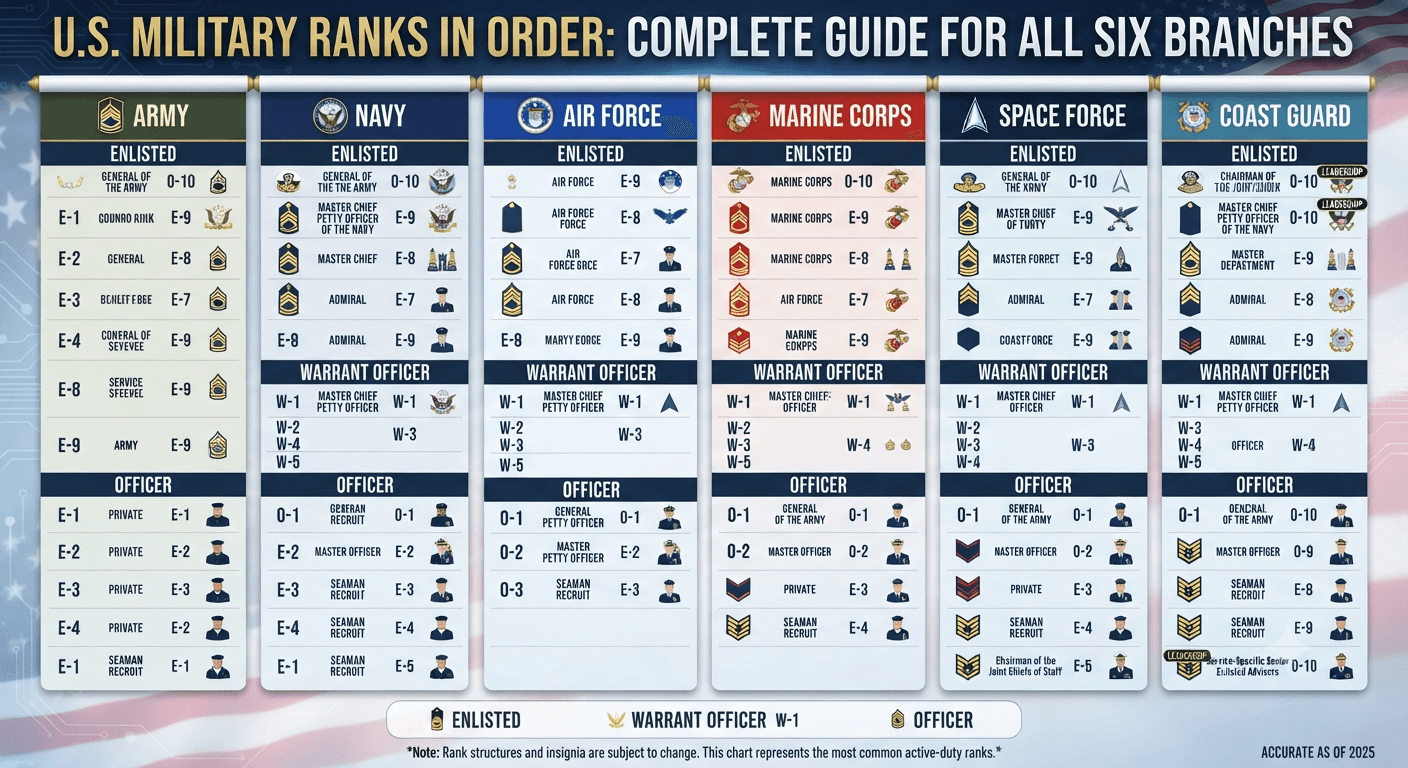
U.S. military ranks are divided into three categories: enlisted (E-1 to E-9), warrant officers (W-1 to W-5), and commissioned officers (O-1 to O-10). Each rank corresponds to a pay grade, which determines a service member’s pay and level of responsibility. The highest rank is O-10 (General or Admiral), and the lowest enlisted rank is E-1 (Private or Seaman Recruit).
Quick Facts
| Item | Details |
|---|---|
| Number of Branches | 6 (Army, Navy, Air Force, Marine Corps, Coast Guard, Space Force) |
| Rank Categories | Enlisted (E-1–E-9), Warrant Officer (W-1–W-5), Officer (O-1–O-10) |
| Highest Rank | O-10 (General / Admiral) |
| Lowest Rank | E-1 (Private / Seaman Recruit / Airman Basic / Specialist 1) |
| Governing Authority | U.S. Department of Defense |
| Legal Authority | Title 10, U.S. Code |
| Updated For | 2026 |
Understanding Military Ranks and Pay Grades
Military ranks are organized using a uniform pay grade system. The system uses letters to identify rank category and numbers to identify seniority level :

E = Enlisted (E-1 through E-9)
W = Warrant Officer (W-1 through W-5)
O = Officer (O-1 through O-10)
Each pay grade corresponds to the same pay rate across all branches, though the actual rank names vary by service. For example, an E-7 is a Sergeant First Class in the Army, a Gunnery Sergeant in the Marine Corps, and a Chief Petty Officer in the Navy .

The U.S. Code Title 10, Section 741 establishes the legal order of rank for commissioned officers across all services <span class=””>. General (Army, Air Force, Marine Corps, Space Force) and Admiral (Navy, Coast Guard) are equivalent and the most senior grades, while Second Lieutenant and Ensign are equivalent and the most junior.
Enlisted Ranks by Pay Grade
Enlisted personnel form the backbone of the military. They perform hands-on work, receive specialized training, and advance through the ranks based on experience, leadership ability, and time in service. Enlisted ranks are divided into Junior Enlisted, Non-Commissioned Officers (NCOs), and Senior NCOs.
What Is an Enlisted Rank?
An enlisted rank is the entry-level military rank category. Service members enter at E-1 and can advance to E-9 over their career. Enlisted personnel receive technical and tactical training and are responsible for day-to-day operations and mission execution.
Army Enlisted Ranks in Order
| Pay Grade | Rank | Abbreviation |
|---|---|---|
| E-1 | Private | PVT |
| E-2 | Private | PV2 |
| E-3 | Private First Class | PFC |
| E-4 | Specialist | SPC |
| E-4 | Corporal | CPL |
| E-5 | Sergeant | SGT |
| E-6 | Staff Sergeant | SSG |
| E-7 | Sergeant First Class | SFC |
| E-8 | Master Sergeant | MSG |
| E-8 | First Sergeant | 1SG |
| E-9 | Sergeant Major | SGM |
| E-9 | Command Sergeant Major | CSM |
| E-9 (Special) | Sergeant Major of the Army | SMA |
Source:
Marine Corps Enlisted Ranks in Order
| Pay Grade | Rank | Abbreviation |
|---|---|---|
| E-1 | Private | Pvt |
| E-2 | Private First Class | PFC |
| E-3 | Lance Corporal | LCpl |
| E-4 | Corporal | Cpl |
| E-5 | Sergeant | Sgt |
| E-6 | Staff Sergeant | SSgt |
| E-7 | Gunnery Sergeant | GySgt |
| E-8 | Master Sergeant | MGySgt |
| E-8 | First Sergeant | 1stSgt |
| E-9 | Master Gunnery Sergeant | MGySgt |
| E-9 | Sergeant Major | SgtMaj |
| E-9 (Special) | Sergeant Major of the Marine Corps | SgtMajMarCor |
Veterans May Qualify for Extra Benefits
Check available financial assistance, healthcare programs and other opportunities that may apply to you.
Check EligibilitySource:
Navy Enlisted Ranks in Order
| Pay Grade | Rank | Abbreviation |
|---|---|---|
| E-1 | Seaman Recruit | SR |
| E-2 | Seaman Apprentice | SA |
| E-3 | Seaman | SN |
| E-4 | Petty Officer Third Class | PO3 |
| E-5 | Petty Officer Second Class | PO2 |
| E-6 | Petty Officer First Class | PO1 |
| E-7 | Chief Petty Officer | CPO |
| E-8 | Senior Chief Petty Officer | SCPO |
| E-9 | Master Chief Petty Officer | MCPO |
| E-9 (Special) | Master Chief Petty Officer of the Navy | MCPON |
Source:
Air Force Enlisted Ranks in Order
The Air Force does not use warrant officers <span class=””>.
| Pay Grade | Rank | Abbreviation |
|---|---|---|
| E-1 | Airman Basic | AB |
| E-2 | Airman | Amn |
| E-3 | Airman First Class | A1C |
| E-4 | Senior Airman | SrA |
| E-5 | Staff Sergeant | SSgt |
| E-6 | Technical Sergeant | TSgt |
| E-7 | Master Sergeant | MSgt |
| E-8 | Senior Master Sergeant | SMSgt |
| E-9 | Chief Master Sergeant | CMSgt |
| E-9 (Special) | Chief Master Sergeant of the Air Force | CMSAF |
Source:
Coast Guard Enlisted Ranks in Order
The Coast Guard uses the same enlisted rank system as the Navy .
| Pay Grade | Rank | Abbreviation |
|---|---|---|
| E-1 | Seaman Recruit | SR |
| E-2 | Seaman Apprentice | SA |
| E-3 | Seaman | SN |
| E-4 | Petty Officer Third Class | PO3 |
| E-5 | Petty Officer Second Class | PO2 |
| E-6 | Petty Officer First Class | PO1 |
| E-7 | Chief Petty Officer | CPO |
| E-8 | Senior Chief Petty Officer | SCPO |
| E-9 | Master Chief Petty Officer | MCPO |
| E-9 (Special) | Master Chief Petty Officer of the Coast Guard | MCPOCG |
Source:
Space Force Enlisted Ranks in Order
The Space Force follows the Air Force rank system but uses the term “Specialist” instead of “Airman” for enlisted ranks .
| Pay Grade | Rank | Abbreviation |
|---|---|---|
| E-1 | Specialist 1 | Spc1 |
| E-2 | Specialist 2 | Spc2 |
| E-3 | Specialist 3 | Spc3 |
| E-4 | Specialist 4 | Spc4 |
| E-5 | Staff Sergeant | SSgt |
| E-6 | Technical Sergeant | TSgt |
| E-7 | Master Sergeant | MSgt |
| E-8 | Senior Master Sergeant | SMSgt |
| E-9 | Chief Master Sergeant | CMSgt |
| E-9 (Special) | Chief Master Sergeant of the Space Force | CMSSF |
Source:
Warrant Officer Ranks
Warrant officers are technical experts who serve between enlisted and commissioned officer ranks. They are specialized leaders in their field, such as aviation, intelligence, or logistics. All branches except the Air Force have warrant officers; the Air Force eliminated the warrant officer rank structure <span class=””>.
What Is a Warrant Officer?
A warrant officer is a service member who holds rank by warrant (rather than commission) and ranks above non-commissioned officers but below commissioned officers. Warrant officers have specialized expertise in a specific technical or tactical area.
Warrant Officer Ranks Across All Branches
| Pay Grade | Rank | Abbreviation |
|---|---|---|
| W-1 | Warrant Officer 1 | WO1 |
| W-2 | Chief Warrant Officer 2 | CW2 |
| W-3 | Chief Warrant Officer 3 | CW3 |
| W-4 | Chief Warrant Officer 4 | CW4 |
| W-5 | Chief Warrant Officer 5 | CW5 |
Source:
Commissioned Officer Ranks
Commissioned officers hold the highest levels of authority and responsibility. They receive their commission from the President and lead units ranging from platoons to entire theaters of war. Officer ranks are consistent across branches, though the Navy and Coast Guard use different titles.
What Is a Commissioned Officer?
A commissioned officer is a service member who holds authority from a commission issued by the President of the United States. Officers lead and manage units, plan missions, and are responsible for the welfare and effectiveness of their personnel. Officers hold O-1 through O-10 ranks.
Commissioned Officer Comparison Table
| Pay Grade | Army / Air Force / Marine Corps / Space Force | Navy / Coast Guard |
|---|---|---|
| O-10 | General (Gen.) | Admiral (ADM) |
| O-9 | Lieutenant General (Lt. Gen.) | Vice Admiral (VADM) |
| O-8 | Major General (Maj. Gen.) | Rear Admiral (RADM) |
| O-7 | Brigadier General (Brig. Gen.) | Rear Admiral (Lower Half) (RDML) |
| O-6 | Colonel (Col.) | Captain (CAPT) |
| O-5 | Lieutenant Colonel (Lt. Col.) | Commander (CDR) |
| O-4 | Major (Maj.) | Lieutenant Commander (LCDR) |
| O-3 | Captain (Capt.) | Lieutenant (LT) |
| O-2 | First Lieutenant (1st Lt.) | Lieutenant Junior Grade (LTJG) |
| O-1 | Second Lieutenant (2nd Lt.) | Ensign (ENS) |
Source:
Special Pay Grades
The O-10 grade may be held by special positions, including:
Chief of Staff of the Army
Chief of Naval Operations
Chief of Staff of the Air Force
Commandant of the Marine Corps
Chief of Space Operations
Commandant of the Coast Guard
These service chiefs typically hold the rank of General or Admiral (O-10) .
The Five-Star Rank
The rank of General of the Army (five-star) or Fleet Admiral (five-star) exists but has not been awarded since World War II. It is considered a wartime-only rank. Only nine Americans have held this rank, and the last living five-star officer was General Omar Bradley, who died in 1981 .
How to Address Military Personnel by Rank
Correct forms of address vary by rank and branch. Using the proper title shows respect and follows military protocol.
Key Addressing Rules
First reference: Use the full rank before the name (e.g., “Army Sgt. John Doe is a photographer”).
Subsequent references: You may use the rank alone (e.g., “Sergeant Doe”).
Conversational: Spell out the rank (e.g., “His grandfather was a lieutenant general”) .
Abbreviation Guide
Most rank abbreviations are formed by taking the first few letters of the rank name. Officers often use “Lt.” for Lieutenant, “Col.” for Colonel, and “Gen.” for General. The Department of Defense Visual Information Style Guide provides the definitive list of abbreviations .
Common Questions About Military Ranks
1. What are the military ranks in order from lowest to highest?
From lowest to highest, the ranks are: E-1 through E-9 (enlisted), W-1 through W-5 (warrant officers), and O-1 through O-10 (commissioned officers). The exact names vary by branch. The lowest rank is generally Private (Army/Marines), Seaman Recruit (Navy/Coast Guard), Airman Basic (Air Force), or Specialist 1 (Space Force) .
2. What is the highest rank in the U.S. military?
The highest rank is O-10, which is General in the Army, Air Force, Marine Corps, and Space Force, and Admiral in the Navy and Coast Guard. A five-star rank (General of the Army/Fleet Admiral) exists but has not been awarded since World War II .
3. What is the lowest rank in the military?
The lowest rank is E-1. It is called Private in the Army and Marine Corps, Seaman Recruit in the Navy and Coast Guard, Airman Basic in the Air Force, and Specialist 1 in the Space Force .
4. What is the difference between an officer and an enlisted service member?
Officers hold a commission from the President and serve as leaders and managers. Enlisted service members enter at the lowest ranks and are the hands-on workforce. Officers outrank all enlisted personnel and warrant officers .
5. What is a warrant officer?
A warrant officer is a technical expert who ranks above enlisted personnel but below commissioned officers. Warrant officers hold specialized knowledge in areas like aviation, intelligence, and logistics. The Air Force does not use warrant officers class=””>.
6. Do all branches have the same rank structure?
No. The Army, Marine Corps, Air Force, and Space Force share similar officer and enlisted titles, but the Navy and Coast Guard use different titles (e.g., Admiral instead of General, Petty Officer instead of Sergeant). All branches use the same pay grade system (E, W, O) .
7. What is a pay grade?
A pay grade is a numerical identifier that corresponds to a service member’s rank and determines their base pay. E-1 through E-9 are enlisted pay grades, W-1 through W-5 are warrant officer pay grades, and O-1 through O-10 are officer pay grades. Pay grades are uniform across all branches .
8. What are the Marine Corps ranks in order?
Marine Corps enlisted ranks are Private (E-1), Private First Class (E-2), Lance Corporal (E-3), Corporal (E-4), Sergeant (E-5), Staff Sergeant (E-6), Gunnery Sergeant (E-7), Master Sergeant/First Sergeant (E-8), and Master Gunnery Sergeant/Sergeant Major (E-9) .
9. What are the Navy ranks in order?
Navy enlisted ranks are Seaman Recruit (E-1), Seaman Apprentice (E-2), Seaman (E-3), Petty Officer Third Class (E-4), Petty Officer Second Class (E-5), Petty Officer First Class (E-6), Chief Petty Officer (E-7), Senior Chief Petty Officer (E-8), and Master Chief Petty Officer (E-9) .
10. What are the Air Force ranks in order?
Air Force enlisted ranks are Airman Basic (E-1), Airman (E-2), Airman First Class (E-3), Senior Airman (E-4), Staff Sergeant (E-5), Technical Sergeant (E-6), Master Sergeant (E-7), Senior Master Sergeant (E-8), and Chief Master Sergeant (E-9). The Air Force does not have warrant officers .
11. What are the Space Force ranks in order?
Space Force enlisted ranks are Specialist 1 (E-1), Specialist 2 (E-2), Specialist 3 (E-3), Specialist 4 (E-4), Staff Sergeant (E-5), Technical Sergeant (E-6), Master Sergeant (E-7), Senior Master Sergeant (E-8), and Chief Master Sergeant (E-9). Officer ranks follow the Air Force system .
12. How do I address someone by their military rank?
Use the full rank before their name on first reference (e.g., “Army Sgt. John Doe”). In subsequent references, use the rank alone (e.g., “Sergeant Doe”). For conversational references, spell out the rank. The abbreviation should match the service branch .
Key Takeaways
U.S. military ranks are organized into three categories: enlisted (E-1 to E-9), warrant officer (W-1 to W-5), and commissioned officer (O-1 to O-10) .
All six branches use the same pay grade system, but rank titles vary. The Army, Marine Corps, Air Force, and Space Force use similar titles; the Navy and Coast Guard use maritime titles .
The highest rank is O-10 (General or Admiral). A five-star rank exists but is reserved for wartime and has not been awarded since World War II .
The lowest rank is E-1, which is Private (Army/Marines), Seaman Recruit (Navy/Coast Guard), Airman Basic (Air Force), or Specialist 1 (Space Force) .
Rank determines responsibility and pay. Higher ranks have greater leadership duties and higher base pay.
The Air Force does not use warrant officers. All other branches have warrant officer ranks .
Rank abbreviations are standardized by the Department of Defense and vary by branch .
Addressing service members correctly requires using the appropriate rank and abbreviation for their branch .
Commissioned officers hold authority from the President through a commission, while enlisted personnel enter service directly and advance through experience.
The legal basis for rank order is Title 10, U.S. Code, Section 741, which establishes that General and Admiral are equivalent and highest, and Second Lieutenant and Ensign are equivalent and lowest .
Official Resources
U.S. Department of Defense: www.defense.gov – Official DoD information on policies, structure, and personnel.
U.S. Army: www.army.mil – Official Army website with rank and personnel information.
U.S. Navy: www.navy.mil – Official Navy website with rank and personnel information.
U.S. Air Force: www.af.mil – Official Air Force website with rank and personnel information.
U.S. Marine Corps: www.marines.mil – Official Marine Corps website with rank and personnel information.
U.S. Coast Guard: www.uscg.mil – Official Coast Guard website with rank and personnel information.
U.S. Space Force: www.spaceforce.mil – Official Space Force website with rank and personnel information.
U.S. Code Title 10: www.govinfo.gov – The legal basis for military rank and command structure .
USA.gov: www.usa.gov – Official guide to government services and benefits.
U.S. Military Ranks in Order: Complete Guide for All Six Branches
U.S. military ranks are organized into three categories: enlisted (E-1 to E-9), warrant officers (W-1 to W-5), and commissioned officers (O-1 to O-10). Each rank corresponds to a pay grade that determines a service member’s base pay and level of responsibility. The highest rank is O-10 (General or Admiral), and the lowest enlisted rank is E-1 (Private or Seaman Recruit). All six branches—Army, Navy, Air Force, Marine Corps, Coast Guard, and Space Force—use this uniform pay grade system, though rank titles vary by branch.
Quick Facts
| Item | Details |
|---|---|
| Number of Branches | 6 (Army, Navy, Air Force, Marine Corps, Coast Guard, Space Force) |
| Rank Categories | Enlisted (E-1–E-9), Warrant Officer (W-1–W-5), Officer (O-1–O-10) |
| Highest Rank | O-10 (General / Admiral) |
| Lowest Rank | E-1 (Private / Seaman Recruit / Airman Basic / Specialist 1) |
| Governing Authority | U.S. Department of Defense |
| Updated For | 2026 |
What Are Military Ranks and Why Do They Matter?
Military ranks are the official hierarchy that establishes authority, responsibility, and pay for every service member in the U.S. Armed Forces. The rank system ensures clear lines of command, defines leadership roles, and creates a structured career progression path from entry-level to the highest levels of strategic command.
Why ranks matter:
Establish authority: Higher ranks carry greater decision-making power and leadership responsibility
Determine pay: Each pay grade (E, W, or O) corresponds to a specific base salary
Define career progression: Promotions follow a structured path based on time in service, performance, and leadership ability
Clarify roles: Ranks indicate a service member’s expertise level and assigned duties
Maintain order: The chain of command ensures effective communication and mission execution
What veterans and service members should know: Understanding the rank structure is essential for career planning, knowing your entitlements, and navigating military culture. Whether you’re active duty, transitioning to civilian life, or a family member supporting a service member, knowing how ranks work helps you advocate for yourself and understand military operations.
How Do Military Ranks Work? Understanding Pay Grades
The U.S. military uses a uniform pay grade system that applies across all six branches. Each pay grade consists of a letter and a number that indicate rank category and seniority level.
Three Primary Pay Grade Categories
| Category | Pay Grades | Description |
|---|---|---|
| Enlisted (E) | E-1 through E-9 | Entry-level personnel who perform hands-on work and advance through experience and training |
| Warrant Officer (W) | W-1 through W-5 | Technical experts who bridge the gap between enlisted and commissioned officers |
| Commissioned Officer (O) | O-1 through O-10 | Leaders who hold a commission from the President and manage units and missions |
Why this matters: Pay grades are the foundation of military compensation and career advancement. All service members in the same pay grade receive the same base pay, regardless of branch. Promotions to higher pay grades come with increased responsibility, authority, and financial compensation.
What to do next: If you’re considering military service, research the career progression for your desired branch. If you’re already serving, understand the promotion requirements for your current pay grade and the next level. Work with your chain of command and use resources like your branch’s personnel office to plan your career advancement.
Enlisted Ranks from Lowest to Highest: E-1 to E-9
Enlisted personnel are the backbone of the military. They perform the hands-on work necessary to complete missions, receive specialized technical training, and advance through the ranks based on experience, leadership ability, and time in service.
Enlisted Rank Groups
| Group | Pay Grades | Description |
|---|---|---|
| Junior Enlisted | E-1 through E-3 (sometimes E-4) | Entry-level personnel who do the “work” of the military in specialties like rifleman, medic, or armorer |
| Non-Commissioned Officers (NCOs) | E-5 through E-6 | First-line leaders, the “backbone” of the military. They lead missions, train personnel, and drive results |
| Senior NCOs | E-7 and above | Leaders of other NCOs and senior advisors to officers at all levels |
Army Enlisted Ranks in Order
| Pay Grade | Rank | Abbreviation |
|---|---|---|
| E-1 | Private | PVT |
| E-2 | Private | PV2 |
| E-3 | Private First Class | PFC |
| E-4 | Specialist | SPC |
| E-4 | Corporal | CPL |
| E-5 | Sergeant | SGT |
| E-6 | Staff Sergeant | SSG |
| E-7 | Sergeant First Class | SFC |
| E-8 | Master Sergeant | MSG |
| E-8 | First Sergeant | 1SG |
| E-9 | Sergeant Major | SGM |
| E-9 | Command Sergeant Major | CSM |
| E-9 (Special) | Sergeant Major of the Army | SMA |
Marine Corps Enlisted Ranks in Order
| Pay Grade | Rank | Abbreviation |
|---|---|---|
| E-1 | Private | Pvt |
| E-2 | Private First Class | PFC |
| E-3 | Lance Corporal | LCpl |
| E-4 | Corporal | Cpl |
| E-5 | Sergeant | Sgt |
| E-6 | Staff Sergeant | SSgt |
| E-7 | Gunnery Sergeant | GySgt |
| E-8 | Master Sergeant | MGySgt |
| E-8 | First Sergeant | 1stSgt |
| E-9 | Master Gunnery Sergeant | MGySgt |
| E-9 | Sergeant Major | SgtMaj |
| E-9 (Special) | Sergeant Major of the Marine Corps | SgtMajMarCor |
Navy Enlisted Ranks in Order
| Pay Grade | Rank | Abbreviation |
|---|---|---|
| E-1 | Seaman Recruit | SR |
| E-2 | Seaman Apprentice | SA |
| E-3 | Seaman | SN |
| E-4 | Petty Officer Third Class | PO3 |
| E-5 | Petty Officer Second Class | PO2 |
| E-6 | Petty Officer First Class | PO1 |
| E-7 | Chief Petty Officer | CPO |
| E-8 | Senior Chief Petty Officer | SCPO |
| E-9 | Master Chief Petty Officer | MCPO |
| E-9 (Special) | Master Chief Petty Officer of the Navy | MCPON |
Air Force Enlisted Ranks in Order
Note: The Air Force does not use warrant officers.
| Pay Grade | Rank | Abbreviation |
|---|---|---|
| E-1 | Airman Basic | AB |
| E-2 | Airman | Amn |
| E-3 | Airman First Class | A1C |
| E-4 | Senior Airman | SrA |
| E-5 | Staff Sergeant | SSgt |
| E-6 | Technical Sergeant | TSgt |
| E-7 | Master Sergeant | MSgt |
| E-8 | Senior Master Sergeant | SMSgt |
| E-9 | Chief Master Sergeant | CMSgt |
| E-9 (Special) | Chief Master Sergeant of the Air Force | CMSAF |
Coast Guard Enlisted Ranks in Order
Note: The Coast Guard uses the same enlisted rank system as the Navy.
| Pay Grade | Rank | Abbreviation |
|---|---|---|
| E-1 | Seaman Recruit | SR |
| E-2 | Seaman Apprentice | SA |
| E-3 | Seaman | SN |
| E-4 | Petty Officer Third Class | PO3 |
| E-5 | Petty Officer Second Class | PO2 |
| E-6 | Petty Officer First Class | PO1 |
| E-7 | Chief Petty Officer | CPO |
| E-8 | Senior Chief Petty Officer | SCPO |
| E-9 | Master Chief Petty Officer | MCPO |
| E-9 (Special) | Master Chief Petty Officer of the Coast Guard | MCPOCG |
Space Force Enlisted Ranks in Order
Note: The Space Force follows the Air Force rank system but uses “Specialist” instead of “Airman” for enlisted ranks.
| Pay Grade | Rank | Abbreviation |
|---|---|---|
| E-1 | Specialist 1 | Spc1 |
| E-2 | Specialist 2 | Spc2 |
| E-3 | Specialist 3 | Spc3 |
| E-4 | Specialist 4 | Spc4 |
| E-5 | Staff Sergeant | SSgt |
| E-6 | Technical Sergeant | TSgt |
| E-7 | Master Sergeant | MSgt |
| E-8 | Senior Master Sergeant | SMSgt |
| E-9 | Chief Master Sergeant | CMSgt |
| E-9 (Special) | Chief Master Sergeant of the Space Force | CMSSF |
Warrant Officer Ranks: W-1 to W-5
Warrant officers are technical experts who serve between enlisted personnel and commissioned officers. They hold specialized knowledge in fields like aviation, intelligence, logistics, and cybersecurity. All branches except the Air Force have warrant officers; the Air Force eliminated its warrant officer rank structure.
What Is a Warrant Officer?
A warrant officer is a service member who holds rank by warrant (rather than commission) and ranks above enlisted personnel but below commissioned officers. Warrant officers are technical experts in a specific field and serve as advisors to commanders on matters within their specialty.
Becoming a Warrant Officer
To become a warrant officer, an individual typically must:
Achieve the rank of at least Sergeant (E-5)
Accumulate significant experience in their chosen technical field
Receive recommendations from superiors
Complete specialized training and selection processes
Why warrant officers matter: Warrant officers bring deep technical expertise to their units. Unlike enlisted personnel who may rotate through various roles, warrant officers refine their skills within a single specialty throughout their careers, making them invaluable resources for mission planning and execution.
Warrant Officer Ranks
| Pay Grade | Rank | Abbreviation |
|---|---|---|
| W-1 | Warrant Officer 1 | WO1 |
| W-2 | Chief Warrant Officer 2 | CW2 |
| W-3 | Chief Warrant Officer 3 | CW3 |
| W-4 | Chief Warrant Officer 4 | CW4 |
| W-5 | Chief Warrant Officer 5 | CW5 |
Commissioned Officer Ranks: O-1 to O-10
Commissioned officers hold the highest levels of authority and responsibility. They receive their commission from the President of the United States and lead units ranging from platoons to entire theaters of war. Officer ranks are consistent across branches, though the Navy and Coast Guard use different titles.
What Is a Commissioned Officer?
A commissioned officer is a service member who holds authority from a commission issued by the President. Officers lead and manage units, plan missions, and are responsible for the welfare and effectiveness of their personnel. Commissioned officers hold O-1 through O-10 ranks.
Becoming a Commissioned Officer
There are several pathways to becoming a commissioned officer:
Service academies: U.S. Military Academy (West Point), U.S. Naval Academy, U.S. Air Force Academy, U.S. Coast Guard Academy
ROTC programs: Reserve Officers’ Training Corps at civilian universities
Officer Candidate School (OCS): For college graduates who enlist and then apply for a commission
Direct commission: For professionals with specialized skills (e.g., medical, legal, chaplain)
Commissioned Officer Groups
| Group | Pay Grades | Description |
|---|---|---|
| Junior Officers | O-1 through O-3 | Leaders of leaders, typically run larger organizations and drive unit direction—often leading teams from 10 to 200+ personnel |
| Field Grade Officers | O-4 through O-6 | Leaders of junior officers and NCOs, command larger organizations with teams ranging from 100 to 1,000+ personnel |
| General & Flag Officers | O-7 through O-10 | Generals and Admirals who run entire divisions, fleets, and militaries—the highest-ranking military executives |
Commissioned Officer Comparison Table
| Pay Grade | Army / Air Force / Marine Corps / Space Force | Navy / Coast Guard |
|---|---|---|
| O-10 | General (Gen.) | Admiral (ADM) |
| O-9 | Lieutenant General (Lt. Gen.) | Vice Admiral (VADM) |
| O-8 | Major General (Maj. Gen.) | Rear Admiral (RADM) |
| O-7 | Brigadier General (Brig. Gen.) | Rear Admiral (Lower Half) (RDML) |
| O-6 | Colonel (Col.) | Captain (CAPT) |
| O-5 | Lieutenant Colonel (Lt. Col.) | Commander (CDR) |
| O-4 | Major (Maj.) | Lieutenant Commander (LCDR) |
| O-3 | Captain (Capt.) | Lieutenant (LT) |
| O-2 | First Lieutenant (1st Lt.) | Lieutenant Junior Grade (LTJG) |
| O-1 | Second Lieutenant (2nd Lt.) | Ensign (ENS) |
The Highest Rank: What Is the Highest Rank in the Military?
The highest military rank is O-10, which is General in the Army, Air Force, Marine Corps, and Space Force, and Admiral in the Navy and Coast Guard.
Five-Star Ranks (Honorific Only): The ranks of General of the Army, Fleet Admiral, and General of the Air Force (five-star ranks) exist but are considered honorary wartime ranks. These ranks have not been awarded since World War II, and no one currently holds them in active service.
General of the Armies (six-star equivalent) is the highest possible rank, awarded only to George Washington (posthumously) and John J. Pershing
Fleet Admiral (five-star) was awarded to Navy admirals during WWII
General of the Army (five-star) was awarded to Army generals during WWII
Current active-duty highest rank: General (O-10) is the highest rank held by active service members today.
Special O-10 Positions
The O-10 grade may be held by special positions, including:
Chief of Staff of the Army
Chief of Naval Operations
Chief of Staff of the Air Force
Commandant of the Marine Corps
Chief of Space Operations
Commandant of the Coast Guard
Comparing Ranks Across All Six Branches
While all six branches use the same pay grade system, the titles vary significantly. Understanding these differences is essential for anyone working across branches or transitioning between services.
Enlisted Rank Comparison Table
| Pay Grade | Army | Marine Corps | Navy | Air Force | Coast Guard | Space Force |
|---|---|---|---|---|---|---|
| E-1 | Private | Private | Seaman Recruit | Airman Basic | Seaman Recruit | Specialist 1 |
| E-2 | Private | Private First Class | Seaman Apprentice | Airman | Seaman Apprentice | Specialist 2 |
| E-3 | Private First Class | Lance Corporal | Seaman | Airman First Class | Seaman | Specialist 3 |
| E-4 | Specialist/Corporal | Corporal | Petty Officer Third Class | Senior Airman | Petty Officer Third Class | Specialist 4 |
| E-5 | Sergeant | Sergeant | Petty Officer Second Class | Staff Sergeant | Petty Officer Second Class | Staff Sergeant |
| E-6 | Staff Sergeant | Staff Sergeant | Petty Officer First Class | Technical Sergeant | Petty Officer First Class | Technical Sergeant |
| E-7 | Sergeant First Class | Gunnery Sergeant | Chief Petty Officer | Master Sergeant | Chief Petty Officer | Master Sergeant |
| E-8 | Master Sergeant/First Sergeant | Master Sergeant/First Sergeant | Senior Chief Petty Officer | Senior Master Sergeant | Senior Chief Petty Officer | Senior Master Sergeant |
| E-9 | Sergeant Major/Command Sergeant Major | Master Gunnery Sergeant/Sergeant Major | Master Chief Petty Officer | Chief Master Sergeant | Master Chief Petty Officer | Chief Master Sergeant |
Officer Rank Comparison Table
| Pay Grade | Army/Air Force/Marines/Space Force | Navy/Coast Guard |
|---|---|---|
| O-1 | Second Lieutenant | Ensign |
| O-2 | First Lieutenant | Lieutenant Junior Grade |
| O-3 | Captain | Lieutenant |
| O-4 | Major | Lieutenant Commander |
| O-5 | Lieutenant Colonel | Commander |
| O-6 | Colonel | Captain |
| O-7 | Brigadier General | Rear Admiral (Lower Half) |
| O-8 | Major General | Rear Admiral |
| O-9 | Lieutenant General | Vice Admiral |
| O-10 | General | Admiral |
How Military Ranks Affect Promotions and Career Progression
Military ranks are directly tied to promotion opportunities and career advancement. Each rank has specific requirements for time in service, time in grade, performance evaluations, and professional military education.
Promotion Criteria by Branch
Promotion criteria vary by branch, but common requirements include:
Time in service: Minimum years of service required for promotion
Time in grade: Minimum time spent in current rank
Performance evaluations: Ratings from supervisors and promotion boards
Professional military education: Completion of required training courses
Examinations: Job proficiency and leadership knowledge tests (required for some ranks)
Branch-Specific Promotion Processes
| Branch | Key Promotion Features |
|---|---|
| Army | Structured Self-Development program; promotion boards evaluate performance records |
| Navy | Emphasizes merit and seniority; advancement exams required for many enlisted ranks |
| Air Force | Weighted Airman Promotion System (WAPS) for enlisted; board selection for officers |
| Marine Corps | Competitive promotion process; physical fitness and leadership are heavily weighted |
| Coast Guard | Similar to Navy; performance and testing determine advancement |
| Space Force | Follows Air Force model; still developing branch-specific promotion policies |
What to do next: Work with your chain of command to understand promotion requirements for your current rank and the next level. Complete required professional military education courses on time. Maintain strong performance evaluations and seek leadership opportunities that demonstrate your readiness for advancement.
How to Address Military Personnel by Rank
Using the correct form of address shows respect for the service member and follows military protocol. Rules vary by branch and rank.
Basic Addressing Rules
First reference: Use the full rank before the name (e.g., “Army Sgt. John Doe is a photographer”)
Subsequent references: Use the rank alone (e.g., “Sergeant Doe”)
Conversational: Spell out the rank (e.g., “His grandfather was a lieutenant general”)
Important Addressing Notes
Navy and Coast Guard officers: Use “Captain” for O-6, not to be confused with the Army/Air Force/Marine Corps O-3 Captain
Non-commissioned officers: Use “Sergeant” for all Army, Marine Corps, and Air Force NCOs
Petty officers: Use “Petty Officer” followed by their rating (e.g., “Petty Officer Smith”)
Common Questions About Military Ranks
1. What are the military ranks in order from lowest to highest?
From lowest to highest, ranks are: E-1 through E-9 (enlisted), W-1 through W-5 (warrant officers), and O-1 through O-10 (commissioned officers). The exact names vary by branch. The lowest rank is typically Private (Army/Marines), Seaman Recruit (Navy/Coast Guard), Airman Basic (Air Force), or Specialist 1 (Space Force). The highest rank is O-10 (General or Admiral).
2. What is the highest rank in the military?
The highest rank is O-10, which is General in the Army, Air Force, Marine Corps, and Space Force, and Admiral in the Navy and Coast Guard. A five-star rank (General of the Army/Fleet Admiral) exists but has not been awarded since World War II and is considered an honorary wartime rank.
3. What is the lowest rank in the military?
The lowest rank is E-1. It is called Private in the Army and Marine Corps, Seaman Recruit in the Navy and Coast Guard, Airman Basic in the Air Force, and Specialist 1 in the Space Force. Service members enter at this rank during basic training.
4. What is the difference between an officer and an enlisted service member?
Officers hold a commission from the President and serve as leaders and managers. They are responsible for planning, decision-making, and overall unit effectiveness. Enlisted service members enter at the lowest ranks and are the hands-on workforce. Officers outrank all enlisted personnel and warrant officers.
5. What is a warrant officer?
A warrant officer is a technical expert who ranks above enlisted personnel but below commissioned officers. Warrant officers hold specialized knowledge in fields like aviation, intelligence, and logistics. They receive their rank by warrant rather than commission. The Air Force does not use warrant officers.
6. Do all branches have the same rank structure?
No. The Army, Marine Corps, Air Force, and Space Force share similar officer and enlisted titles, but the Navy and Coast Guard use different titles (e.g., Admiral instead of General, Petty Officer instead of Sergeant). All branches use the same pay grade system (E, W, O), so E-7 in the Army (Sergeant First Class) and E-7 in the Navy (Chief Petty Officer) receive the same base pay.
7. What is a pay grade?
A pay grade is a numerical identifier that corresponds to a service member’s rank and determines their base pay. E-1 through E-9 are enlisted pay grades, W-1 through W-5 are warrant officer pay grades, and O-1 through O-10 are officer pay grades. Pay grades are uniform across all six branches.
8. What are the Marine Corps ranks in order?
Marine Corps enlisted ranks: Private (E-1), Private First Class (E-2), Lance Corporal (E-3), Corporal (E-4), Sergeant (E-5), Staff Sergeant (E-6), Gunnery Sergeant (E-7), Master Sergeant/First Sergeant (E-8), and Master Gunnery Sergeant/Sergeant Major (E-9). Officer ranks follow the standard O-1 through O-10 structure.
9. What are the Navy ranks in order?
Navy enlisted ranks: Seaman Recruit (E-1), Seaman Apprentice (E-2), Seaman (E-3), Petty Officer Third Class (E-4), Petty Officer Second Class (E-5), Petty Officer First Class (E-6), Chief Petty Officer (E-7), Senior Chief Petty Officer (E-8), and Master Chief Petty Officer (E-9). Officer ranks use maritime titles: Ensign through Admiral.
10. What are the Air Force ranks in order?
Air Force enlisted ranks: Airman Basic (E-1), Airman (E-2), Airman First Class (E-3), Senior Airman (E-4), Staff Sergeant (E-5), Technical Sergeant (E-6), Master Sergeant (E-7), Senior Master Sergeant (E-8), and Chief Master Sergeant (E-9). The Air Force does not have warrant officers. Officer ranks follow the standard Army/Air Force system.
11. What are the Space Force ranks in order?
Space Force enlisted ranks: Specialist 1 (E-1), Specialist 2 (E-2), Specialist 3 (E-3), Specialist 4 (E-4), Staff Sergeant (E-5), Technical Sergeant (E-6), Master Sergeant (E-7), Senior Master Sergeant (E-8), and Chief Master Sergeant (E-9). Officer ranks follow the Air Force system. The Space Force does not have warrant officers.
12. How do I address someone by their military rank?
Use the full rank before their name on first reference (e.g., “Army Sgt. John Doe”). In subsequent references, use the rank alone (e.g., “Sergeant Doe”). For conversational references, spell out the rank. The abbreviation should match the service branch. When in doubt, ask the service member how they prefer to be addressed.
Key Takeaways
U.S. military ranks are organized into three categories: enlisted (E-1 to E-9), warrant officer (W-1 to W-5), and commissioned officer (O-1 to O-10).
All six branches use the same pay grade system, but rank titles vary. The Army, Marine Corps, Air Force, and Space Force use similar titles; the Navy and Coast Guard use maritime titles.
The highest rank is O-10 (General or Admiral). A five-star rank exists but is reserved for wartime and has not been awarded since World War II.
The lowest rank is E-1, which is Private (Army/Marines), Seaman Recruit (Navy/Coast Guard), Airman Basic (Air Force), or Specialist 1 (Space Force).
Rank determines responsibility and pay. Higher ranks have greater leadership duties and higher base pay.
The Air Force does not use warrant officers. All other branches have warrant officer ranks from W-1 through W-5.
Rank abbreviations are standardized by the Department of Defense and vary by branch. Use the correct abbreviation for the service member’s branch.
Addressing service members correctly requires using the appropriate rank and abbreviation for their branch. When in doubt, ask.
Commissioned officers hold authority from the President through a commission, while enlisted personnel enter service directly and advance through experience and leadership.
The legal basis for rank order is Title 10, U.S. Code, Section 741, which establishes that General and Admiral are equivalent and highest, and Second Lieutenant and Ensign are equivalent and lowest.
Official Resources
U.S. Department of Defense: www.defense.gov – Official DoD information on policies, structure, and personnel
U.S. Army: www.army.mil – Official Army website with rank and personnel information
U.S. Navy: www.navy.mil – Official Navy website with rank and personnel information
U.S. Air Force: www.af.mil – Official Air Force website with rank and personnel information
U.S. Marine Corps: www.marines.mil – Official Marine Corps website with rank and personnel information
U.S. Coast Guard: www.uscg.mil – Official Coast Guard website with rank and personnel information
U.S. Space Force: www.spaceforce.mil – Official Space Force website with rank and personnel information
U.S. Code Title 10: www.govinfo.gov – The legal basis for military rank and command structure
USA.gov: www.usa.gov – Official guide to government services and benefits
🇺🇸 IMPORTANT DISCLAIMER – Veterans Benefits Information
This site provides general information about U.S. Department of Veterans Affairs (VA) benefits for educational and informational purposes only.
- Not Official: We are NOT affiliated with, endorsed by, or connected to the U.S. Department of Veterans Affairs (VA), the Veterans Benefits Administration (VBA), the Veterans Health Administration (VHA), or any other government agency.
- No Legal/Financial Advice: The content on this website is for informational purposes only and does not constitute legal, financial, or medical advice. VA benefits rules change frequently – always consult with an accredited Veterans Service Officer (VSO) or a qualified professional for your specific situation.
- Official Sources: For official, binding information and to apply for benefits, always visit official .gov websites: VA.gov, Benefits.VA.gov, or SSA.gov.
- No Data Collection: This site does not collect, store, or process any personal information. It does not have login forms, contact forms, or any system to capture user data. We never ask for your Social Security Number, bank details, or any personal information.
- 🚨 Scam Alert: The VA and other government agencies never charge fees for benefit applications. If anyone asks for money to "process" your VA claim, it is a scam. Report it to the VA Office of Inspector General at VA.gov/OIG.
- Advertising: This site uses third-party advertising (Adsterra) to cover operational costs. We do not endorse or guarantee any products or services advertised.
📌 Information provided as of June 2026. Always verify current eligibility and rules with official .gov sources.
This site is not affiliated with the U.S. Department of Veterans Affairs or any government agency. All information is for educational purposes only. Please visit VA.gov for official information.
