
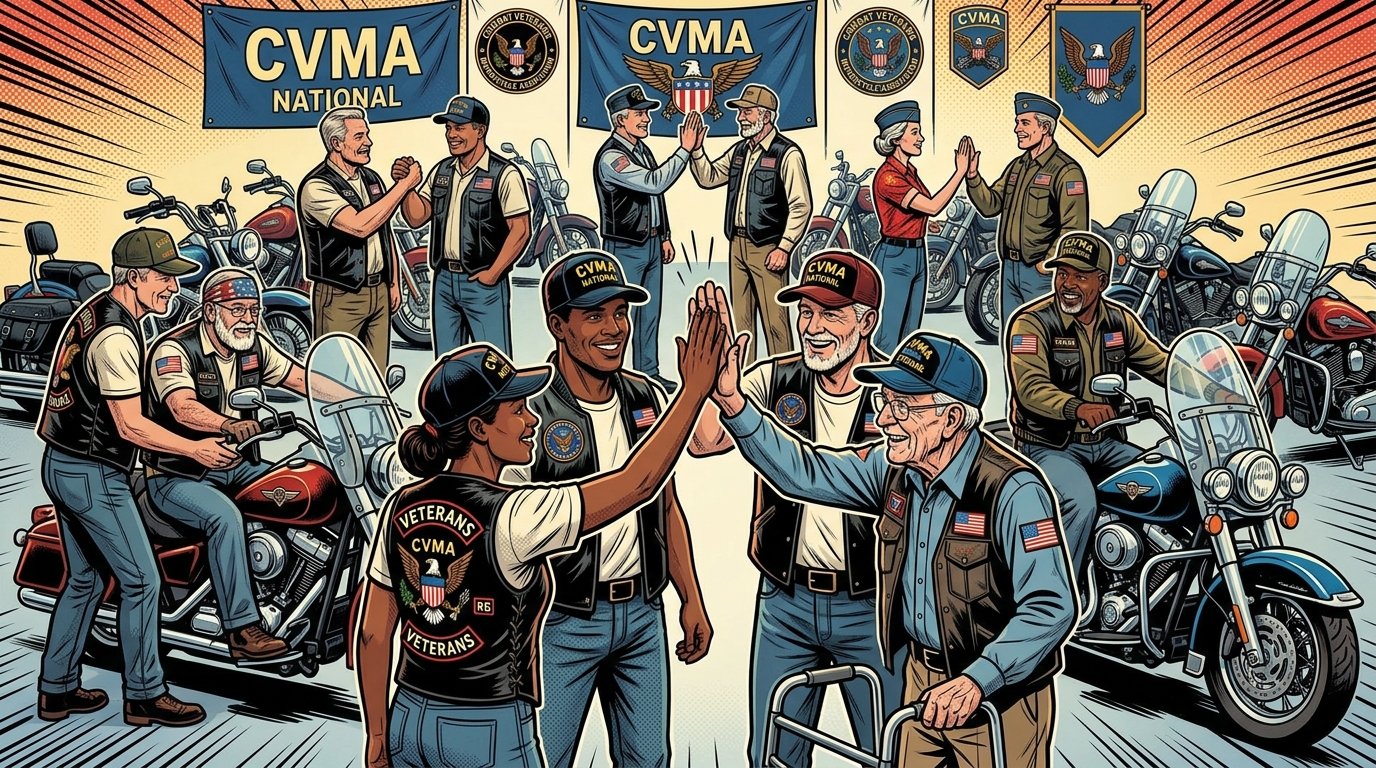
Combat Veterans Motorcycle Association (CVMA): Membership, Rules, and Mission
Featured Snippet Answer: The Combat Veterans Motorcycle Association (CVMA) is a 501(c)(19) veterans’ nonprofit for combat veterans and supporters who ride motorcycles. Full membership requires verified combat service and a motorcycle of 500cc or larger. The CVMA focuses on “Vets Helping Vets” through charity rides, veteran facility support, and PTSD/TBI awareness.
Quick Facts
| Item | Details |
|---|---|
| Organization | Combat Veterans Motorcycle Association® (CVMA®) |
| Type | Veterans’ nonprofit association (not a motorcycle club) |
| Founded | May 1, 2001 |
| Tax Status | 501(c)(19) veterans’ charity |
| Eligibility (Full) | Verified combat veterans with a motorcycle of 500cc or larger |
| Eligibility (Support) | Non-combat veterans with a motorcycle of 500cc or larger (capped at 10% of full membership) |
| Eligibility (Auxiliary) | Spouses, widows, or widowers of Full or Support members (no motorcycle required) |
| Motorcycle Rule | 500cc minimum for Full and Support members; valid license and insurance required |
| Application | Contact a local chapter; submit DD-214 and required documents |
| Official Website | combatvet.us |
| Updated For | 2026 membership standards and chapter operations |
What Is the Combat Veterans Motorcycle Association?
The Combat Veterans Motorcycle Association (CVMA) is a nonprofit association of veterans from all branches of the U.S. Armed Forces who share a love of motorcycle riding and a commitment to supporting fellow veterans. It was established as a nonprofit organization on May 1, 2001. The CVMA is not a motorcycle club (MC). It does not prospect members, claim territory, or wear “colors” in the traditional MC sense.

The organization’s mission is to support and defend those who have defended the country and its freedoms. Its focus is to provide assistance to individual veterans, veteran care facilities, other veteran organizations, and registered charities. The CVMA’s motto is “Vets Helping Vets.”
What the CVMA Is Not

Understanding what the CVMA is not is as important as understanding what it is. The CVMA explicitly states it is an association, not a motorcycle club. This distinction affects how members interact with other riding groups, how the organization is structured, and what new members should expect.
It does not prospect. There is no prospecting period or prospect patch.
It does not claim territory. The CVMA is a non-territorial association.
It does not have clubhouses. Chapters operate without physical clubhouses.
It does not wear cuts or colors. Members wear vests with a one-piece back patch.
It does not engage in the patch wars or territorial disputes associated with some motorcycle clubs.
This distinction matters for veterans who may be familiar with traditional MC culture. The CVMA operates as a charitable veterans’ organization that happens to ride motorcycles, not as a riding club that happens to do charity.
CVMA Membership Eligibility: The Three Membership Classes
The CVMA has three membership classifications: Full Members, Support Members, and Auxiliary Members. Each class has distinct eligibility rules, rights, and responsibilities. Understanding these differences is essential before applying.
Full Membership: Combat Veterans
Full membership is reserved for veterans with verified combat service. Full Members are the only members who may vote in chapter elections, hold officer positions, and wear the full CVMA back patch.
Veterans May Qualify for Extra Benefits
Check available financial assistance, healthcare programs and other opportunities that may apply to you.
Check EligibilityEligibility requirements for Full Membership:
Must be a person of good character.
Must be a veteran of a foreign war with verified combat service.
Must provide acceptable proof of combat service. The only acceptable proof is a copy of the DD-214, Official Military Personnel File, or officer/enlisted record brief, which must be submitted to the National Board of Directors for verification.
Must own and operate a motorcycle of 500cc or greater.
Must possess a valid motorcycle driver’s license endorsed by their state and proof of current motorcycle insurance.
Must read and abide by all CVMA bylaws applicable to them.
Must pay annual dues.
Some chapters require that combat service be verified by the CVMA National Board of Directors before membership is finalized. The CVMA defines “combat service” as service in a combat zone or foreign war, verified through official military records.
Support Membership: Non-Combat Veterans
Support membership is open to veterans who served in the U.S. Armed Forces but do not have verified combat service. Support Members are veterans who have a strong dedication to helping veterans and want to participate in the CVMA’s mission.
Eligibility requirements for Support Membership:
Must be a person of good character.
Must be a veteran of the U.S. Armed Forces.
Must provide a copy of the DD-214 or other service record for verification.
Must own and operate a motorcycle of 500cc or greater.
Must possess a valid motorcycle license and proof of insurance.
Must pay annual dues.
Key limitations for Support Members:
Support membership is capped at 10% of the total CVMA full combat membership. This means the number of Support Members in any chapter cannot exceed 10% of the number of Full Members.
Support Members cannot vote or hold a position on the Board of Directors.
Support Members may be appointed by the Board of Directors as the Public Relations Officer.
The 10% cap is a structural feature of the CVMA that preserves the organization’s identity as a combat-veteran-led association. It ensures that Full Members retain control of the organization’s governance and direction.
Auxiliary Membership: Spouses and Surviving Spouses
Auxiliary membership is open to the spouses, widows, or widowers of Full and Support Members who are in good standing with the CVMA. Auxiliary Members support the organization’s mission without holding voting rights or officer positions.
Eligibility requirements for Auxiliary Membership:
Must be a person of good character.
Must be the spouse, widow, or widower of a Full or Support Member in good standing.
Must provide proof of marriage (marriage certificate).
Must support the efforts of all branches of the U.S. Armed Forces and the CVMA.
Must pay annual dues.
What Auxiliary Members are not required to do:
Auxiliary Members are exempt from the requirement to own and operate a motorcycle of 500cc or greater. Riding is not a requirement for Auxiliary membership, though it is welcome.
Auxiliary Members have no vote in CVMA business.
Auxiliary Members cannot hold a position on the Board of Directors.
Auxiliary membership allows military spouses and surviving spouses to participate in the CVMA community, attend events, and support the mission without the motorcycle ownership requirement that applies to Full and Support Members.
Membership Comparison Table
| Feature | Full Member | Support Member | Auxiliary Member |
|---|---|---|---|
| Combat service required | Yes (verified) | No | No |
| Veteran status required | Yes | Yes | No (spouse/widow/widower of member) |
| Motorcycle of 500cc+ required | Yes | Yes | No |
| Voting rights | Yes | No | No |
| Can hold officer position | Yes | No (may be appointed PRO) | No |
| Membership cap | None | 10% of Full Membership | None |
| Proof of marriage required | No | No | Yes |
| Annual dues | Yes | Yes | Yes |
The 500cc Rule: CVMA Motorcycle Requirements
All Full and Support Members must own and operate a motorcycle with an engine of 500 cubic centimeters (cc) or greater. This requirement is non-negotiable for Full and Support membership. Auxiliary Members are exempt.
What Counts as a Qualifying Motorcycle
The CVMA accepts all makes and styles of motorcycles that meet the 500cc minimum. This includes cruisers, touring bikes, sport bikes, standards, and trikes. According to CVMA chapter policies, trikes must meet specific configuration requirements, including either dual rear or dual front wheel configurations.
What Does Not Qualify
Motorcycles below 500cc — including many scooters, mopeds, and smaller-displacement bikes — do not meet the requirement. A veteran who owns only a smaller motorcycle would need to upgrade to a qualifying motorcycle before applying for Full or Support membership.
License and Insurance Requirements
In addition to the 500cc minimum, applicants must possess:
A valid resident state motorcycle license or endorsement.
Proof of current motorcycle insurance.
Ownership and registration of the motorcycle.
Some chapters verify the motorcycle, license, and insurance in person before processing an application. This verification ensures that applicants can legally and safely operate a qualifying motorcycle.
Why the 500cc Rule Exists
The 500cc rule serves several purposes. It ensures that members can comfortably participate in group rides, including highway travel and long-distance events. It also reflects the CVMA’s identity as a motorcycle association rather than a general veterans’ group. The rule is a membership standard, not a judgment about riding ability or commitment to the mission.
How to Join the CVMA: Step-by-Step
Joining the CVMA requires contacting a local chapter, submitting documentation, and completing the chapter’s membership process. The exact steps vary by chapter, but the general process is consistent across the organization.
Step 1: Identify Your Local Chapter
The CVMA has chapters across all 50 states and members living abroad. Chapter numbering typically follows a state-based system (for example, Chapter 27-2 in Virginia, Chapter 23-7 in Texas, or Chapter 33-1 in California). To find a chapter near you, visit the national CVMA website at combatvet.us or search for CVMA chapters in your state.
Step 2: Attend a Chapter Event or Meeting
The CVMA encourages prospective members to attend chapter events, bike nights, rides, and meetings before applying. This allows both the chapter and the prospective member to get to know each other. The CVMA is looking for active participants in supporting veterans’ issues, not “patch hunters” who are only interested in wearing the patch.
Step 3: Review and Sign the Patch Agreement
Before receiving a patch, members must complete and sign a patch agreement. This agreement acknowledges that the patch is the physical property of the CVMA and must be returned in good condition upon leaving the organization or membership termination. The patch agreement also commits the member to the proper care and display of the patch.
Step 4: Submit Your Application and Documentation
Applicants must submit a completed application form along with supporting records. The required documentation varies by membership class:
Full Members: DD-214 or other official military record showing combat service; proof of motorcycle ownership, license, and insurance.
Support Members: DD-214 or other military record; proof of motorcycle ownership, license, and insurance.
Auxiliary Members: Marriage certificate or proof of marriage to a Full or Support Member in good standing.
The National Board of Directors verifies combat service for Full Member applicants. This verification is a critical step in the application process.
Step 5: Pay Dues
Annual dues vary by chapter and membership class. Typical dues structures include:
National dues: Approximately $20 per year for Full Members.
Chapter dues: $10 to $20 per year, depending on the chapter.
Patch costs: The back patch is purchased separately and may cost $39.99 to $49.99 including shipping.
Dues are used to support chapter operations, national administration, and charitable activities.
Step 6: Receive Your Patch and Become a Member
After the application is approved and dues are paid, the member receives the patch commensurate with their membership class. Full Members receive the full CVMA back patch. Support Members and Auxiliary Members receive patches appropriate to their status.
CVMA Patch Rules and Symbolism
The CVMA patch is not a fashion accessory. It is a symbol of verified service, organizational membership, and a commitment to the mission. Understanding the patch rules and symbolism is essential for anyone considering membership.
What the Patch Looks Like
The CVMA emblem is in the shape of a skull encompassed by specific colors. The patch is one piece, worn on the back of a vest. The CVMA does not wear “cuts” or “colors” in the traditional motorcycle club sense; members wear vests with the one-piece back patch.
The Meaning of the Colors and Symbols
The CVMA patch incorporates specific colors and symbols, each with a defined meaning:
Red represents the blood that has been shed on the battlefield.
Military Gold represents all branches of the U.S. military service.
Black represents the heavy hearts possessed for those who gave their lives and for those considered missing in action or prisoners of war.
The Skull and Ace of Spades represent the death that war leaves in its wake.
These symbols are not decorative. They carry the weight of service, loss, and remembrance. Members are expected to treat the patch with respect and to understand its meaning before wearing it.
Patch Ownership and Return Policy
The patch remains the physical property of the CVMA. Members must sign a patch agreement acknowledging this before receiving the patch. Upon leaving the organization or having membership terminated, the member must return the patch in good condition (less normal wear) to the CVMA. This policy reinforces that the patch is a symbol of membership, not a personal possession to be kept or transferred.
Rules About Representing the CVMA
Members must not represent the CVMA or its chapters as a motorcycle club. They must not prospect, represent that the CVMA engages in prospecting, or claim that the CVMA “has colors” as that phrase is commonly understood in the motorcycle community. These rules protect the CVMA’s identity as a veterans’ association and distinguish it from traditional motorcycle clubs.
What the CVMA Does: Charity, Community, and Veteran Support
The CVMA’s charitable work is the core of its mission. As a 501(c)(19) veterans’ charity, the organization is organized exclusively for charitable purposes, including assisting disabled and needy war veterans, their dependents, and the widows and orphans of deceased veterans.
Types of Charitable Activities
CVMA chapters sponsor and participate in many veteran-related motorcycle and other charity events each year. Common activities include:
Charity rides and poker runs to raise funds for veteran causes.
Fundraisers for veteran care facilities, including VA hospitals and state veterans homes.
Support for individual veterans facing financial hardship, housing instability, or medical needs.
Donations to other veteran organizations and registered charities that serve veterans.
Educational and patriotic activities, including flag etiquette presentations and Veterans Day programs.
Where the Money Goes
CVMA chapters emphasize that funds raised go directly to veterans and veteran service organizations. Some chapters state that 100% of donations go to support local veterans and veteran service organizations in their community. The CVMA’s 501(c)(19) status means that donations to chapters are generally tax-deductible, though donors should confirm the tax status of the specific chapter they are supporting.
PTSD and TBI Awareness
The CVMA includes PTSD and TBI awareness in its objectives. Chapter bylaws state that the organization aims to raise awareness for the plight of POWs, MIAs, and post-traumatic stress disorder (PTSD) of veterans returning from combat theaters, as well as the impact on their families, friends, and society. This focus reflects the CVMA’s identity as an organization led by combat veterans who understand the challenges of returning from war.
Examples of Chapter-Level Impact
Individual chapters document their charitable activities and financial contributions. For example, CVMA Chapter 33-1 in San Diego states that it raises thousands of dollars each year, 100% of which goes back into veterans organizations in the San Diego area. Other chapters sponsor annual events such as the Fallen Heroes Ride and Biketoberfest, with proceeds supporting veterans.
CVMA vs. Other Veterans Motorcycle Organizations
The CVMA is one of several organizations that combine motorcycle culture with veteran support. Understanding how it differs from other groups helps prospective members choose the right organization and helps the public understand the CVMA’s distinct identity.
CVMA vs. Patriot Guard Riders
The Patriot Guard Riders (PGR) is a separate organization founded in 2005, primarily to protect the families of fallen service members from funeral protests and to honor veterans at memorial services. Key differences:
Membership requirements: The PGR has no requirement to be a veteran or to own a motorcycle. The CVMA requires veteran status for Full and Support members and motorcycle ownership for Full and Support members.
Mission focus: The PGR focuses on funeral honors and memorial services. The CVMA focuses on charitable support for living veterans and veteran facilities.
Organizational structure: The PGR operates as a loose network of volunteers. The CVMA has a formal chapter structure, bylaws, and a National Board of Directors.
CVMA vs. American Legion Riders
The American Legion Riders (ALR) is a program of the American Legion. ALR membership generally requires American Legion eligibility, which includes veterans who served during qualifying wartime periods. The ALR is affiliated with a traditional veterans service organization (VSO). The CVMA is an independent 501(c)(19) organization not affiliated with a larger VSO.
CVMA vs. Rolling Thunder
Rolling Thunder is best known for its annual demonstration in Washington, D.C., focused on POW/MIA awareness. While Rolling Thunder has chapters and engages in charitable work, its primary identity is tied to POW/MIA advocacy. The CVMA’s mission is broader, encompassing charitable support, veteran facility assistance, and PTSD/TBI awareness.
Comparison Table
| Organization | Veteran Required? | Motorcycle Required? | Primary Focus | Structure |
|---|---|---|---|---|
| CVMA | Yes (Full/Support) | Yes (500cc+ for Full/Support) | Veteran charity, facility support, PTSD/TBI awareness | Formal chapters, national board |
| Patriot Guard Riders | No | No | Funeral honors, memorial protection | Loose volunteer network |
| American Legion Riders | Yes (AL eligibility) | Yes | Veteran support through American Legion | Program of American Legion |
| Rolling Thunder | Varies by chapter | Varies | POW/MIA advocacy | Chapter-based |
Common Mistakes Prospective Members Make
Prospective CVMA members often misunderstand the organization’s requirements or approach. These are the most common mistakes and how to avoid them.
Assuming the CVMA is a motorcycle club. The CVMA is an association, not an MC. It does not prospect, claim territory, or operate like a traditional club. Understanding this distinction prevents friction during the application process.
Applying without a qualifying motorcycle. Full and Support Members must own and operate a motorcycle of 500cc or greater. Showing up to apply with a smaller bike or no bike will delay or prevent membership.
Submitting incomplete military documentation. The only acceptable proof of combat service for Full Membership is a DD-214, OMPF, or officer/enlisted record brief submitted to the National Board of Directors. Incomplete or unofficial documentation will not be accepted.
Skipping chapter events before applying. The CVMA wants active participants, not patch hunters. Attending events and meetings before applying helps both parties confirm the fit.
Misunderstanding the Support Member cap. Support membership is limited to 10% of Full Membership. A chapter with 20 Full Members can have at most 2 Support Members. Prospective Support Members should be aware that space may be limited.
Assuming Auxiliary Members can vote or hold office. Auxiliary Members have no vote in CVMA business and cannot hold positions on the Board of Directors.
Failing to sign the patch agreement. The patch remains CVMA property and must be returned upon leaving. Members must sign the patch agreement before receiving the patch.
Common Questions
1. What is the Combat Veterans Motorcycle Association?
The CVMA is a 501(c)(19) veterans’ nonprofit for combat veterans and supporters who ride motorcycles. It was founded in 2001 and focuses on “Vets Helping Vets” through charity rides, veteran facility support, and PTSD/TBI awareness. It is an association, not a motorcycle club.
2. Who can join the CVMA?
There are three membership classes. Full Members must be combat veterans with verified service and a motorcycle of 500cc or larger. Support Members must be non-combat veterans with a 500cc+ motorcycle. Auxiliary Members must be spouses, widows, or widowers of Full or Support Members and do not need a motorcycle.
3. What is the 500cc rule?
All Full and Support Members must own and operate a motorcycle with an engine of 500 cubic centimeters or greater. Auxiliary Members are exempt. The rule ensures members can participate in group rides and reflects the CVMA’s identity as a motorcycle association.
4. Is the CVMA a motorcycle club?
No. The CVMA explicitly states it is an association, not a motorcycle club. It does not prospect, claim territory, have clubhouses, or wear “colors” in the traditional MC sense. Members wear vests with a one-piece back patch.
5. How do I prove combat service for Full Membership?
The only acceptable proof is a copy of your DD-214, Official Military Personnel File, or officer/enlisted record brief submitted to the National Board of Directors for verification. Other documents may not be accepted.
6. What does the CVMA patch mean?
The patch features a skull and ace of spades surrounded by red, military gold, and black. Red represents blood shed on the battlefield, military gold represents all branches of service, and black represents heavy hearts for those killed or missing. The skull and ace of spades represent the death war leaves in its wake.
7. How much does CVMA membership cost?
Annual dues vary by chapter but typically include national dues (around $20) and chapter dues ($10–$20). The back patch is purchased separately and may cost $39.99–$49.99. Contact your local chapter for exact dues.
8. Can women join the CVMA?
Yes. Women can join as Full Members if they are combat veterans with verified service and a 500cc+ motorcycle. Women can also join as Support Members if they are non-combat veterans, or as Auxiliary Members if they are spouses, widows, or widowers of members.
9. Does the CVMA help individual veterans?
Yes. CVMA chapters provide assistance to individual veterans, veteran care facilities, other veteran organizations, and registered charities. The focus is on “Vets Helping Vets,” which includes financial support, facility assistance, and community events.
10. How do I find a CVMA chapter near me?
Visit the national CVMA website at combatvet.us or search for CVMA chapters in your state. Chapters are numbered by state and region. Attending a local event or meeting is the best way to learn about a chapter’s culture and activities.
11. Is the CVMA a tax-deductible charity?
The CVMA is organized as a 501(c)(19) veterans’ charity. Donations to chapters are generally tax-deductible, but donors should confirm the specific chapter’s tax status and consult a tax professional for their situation.
12. What is the difference between CVMA and Patriot Guard Riders?
The CVMA requires veteran status and motorcycle ownership for Full and Support members and focuses on charitable support for living veterans. The Patriot Guard Riders focus on funeral honors and memorial protection and do not require veteran status or motorcycle ownership.
Key Takeaways
The CVMA is a 501(c)(19) veterans’ nonprofit, not a motorcycle club. It was founded in 2001 and focuses on “Vets Helping Vets” through charity and community support.
Full Membership requires verified combat service and a motorcycle of 500cc or larger. The DD-214 or equivalent military record is the only acceptable proof.
Support Membership is for non-combat veterans and is capped at 10% of Full Membership. Support Members cannot vote or hold board positions.
Auxiliary Membership is for spouses, widows, and widowers of Full and Support Members. No motorcycle is required, but Auxiliary Members cannot vote or hold office.
The 500cc rule applies to Full and Support Members. All makes and styles of motorcycles are accepted, including trikes that meet configuration requirements.
The CVMA patch is the property of the organization and must be returned upon leaving. Members must sign a patch agreement before receiving the patch.
The CVMA is distinct from the Patriot Guard Riders and American Legion Riders. It has formal chapters, a national board, and a charity-focused mission.
Prospective members should attend chapter events before applying. The CVMA seeks active participants, not patch hunters.
Charitable funds go to veteran causes, including veteran care facilities, individual veterans, and PTSD/TBI awareness.
Official Resources
Combat Veterans Motorcycle Association National Website: combatvet.us
CVMA Membership Information: combatvet.us/become-a-member
VA PTSD and TBI Resources: va.gov/health-care/health-needs-conditions/mental-health/ptsd
USA.gov — Veterans Benefits: usa.gov/veterans-benefits
IRS — 501(c)(19) Veterans Organizations: irs.gov/charities-non-profits/other-non-profits/veterans-organizations
🇺🇸 IMPORTANT DISCLAIMER – Veterans Benefits Information
This site provides general information about U.S. Department of Veterans Affairs (VA) benefits for educational and informational purposes only.
- Not Official: We are NOT affiliated with, endorsed by, or connected to the U.S. Department of Veterans Affairs (VA), the Veterans Benefits Administration (VBA), the Veterans Health Administration (VHA), or any other government agency.
- No Legal/Financial Advice: The content on this website is for informational purposes only and does not constitute legal, financial, or medical advice. VA benefits rules change frequently – always consult with an accredited Veterans Service Officer (VSO) or a qualified professional for your specific situation.
- Official Sources: For official, binding information and to apply for benefits, always visit official .gov websites: VA.gov, Benefits.VA.gov, or SSA.gov.
- No Data Collection: This site does not collect, store, or process any personal information. It does not have login forms, contact forms, or any system to capture user data. We never ask for your Social Security Number, bank details, or any personal information.
- 🚨 Scam Alert: The VA and other government agencies never charge fees for benefit applications. If anyone asks for money to "process" your VA claim, it is a scam. Report it to the VA Office of Inspector General at VA.gov/OIG.
- Advertising: This site uses third-party advertising (Adsterra) to cover operational costs. We do not endorse or guarantee any products or services advertised.
📌 Information provided as of June 2026. Always verify current eligibility and rules with official .gov sources.
This site is not affiliated with the U.S. Department of Veterans Affairs or any government agency. All information is for educational purposes only. Please visit VA.gov for official information.
