
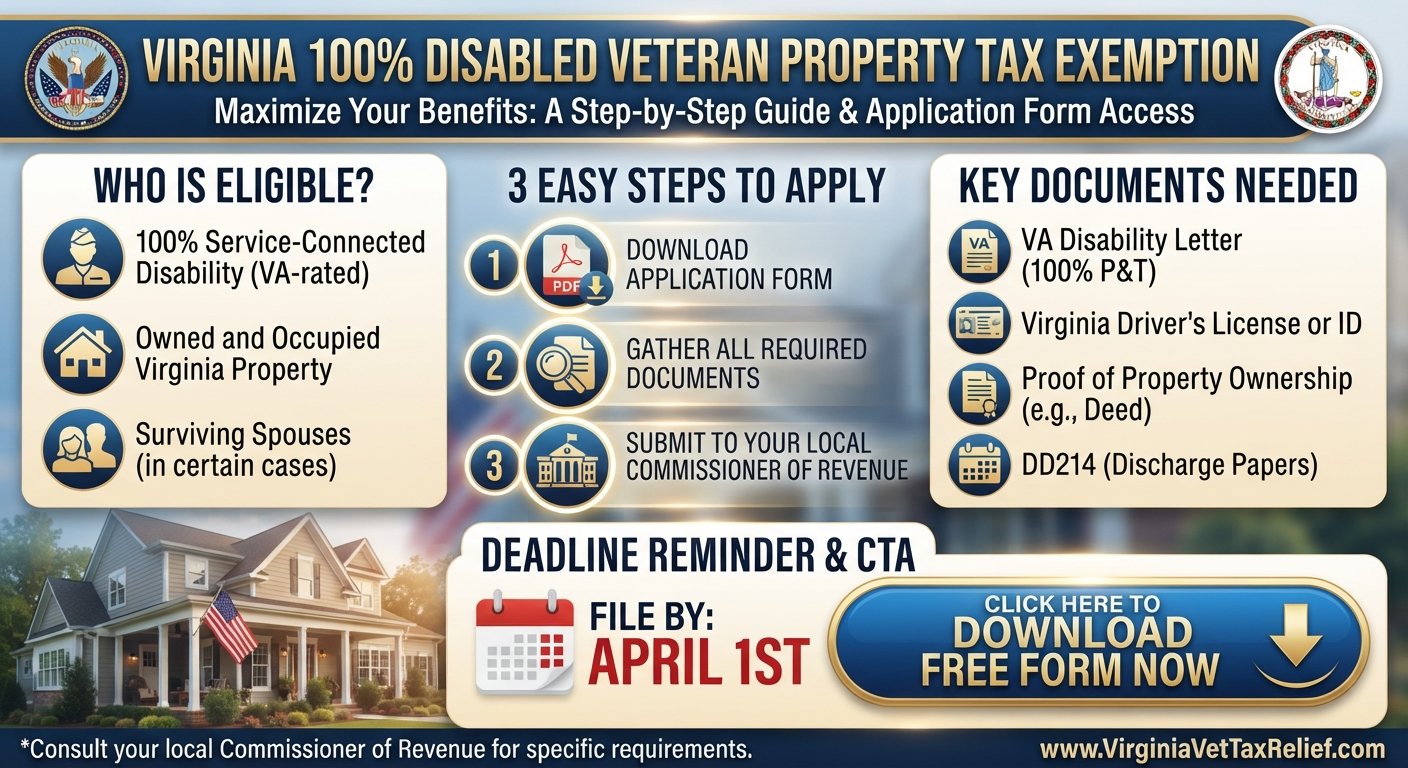
Virginia 100% Disabled Veteran Property Tax Exemption: What You Need to Know
Virginia exempts from real property taxation the primary residence of veterans rated by the U.S. Department of Veterans Affairs as having a 100 percent service-connected, permanent, and total disability. The exemption covers the dwelling and up to one acre of land. Surviving spouses who have not remarried may also qualify if the veteran’s death occurred on or after January 1, 2011.
Quick Facts
| Item | Details |
|---|---|
| Benefit | Full real property tax exemption on primary residence |
| Eligibility | Veterans with 100% VA service-connected, permanent, and total disability |
| Application | Local affidavit/application to Commissioner of the Revenue |
| Processing Time | Varies by locality; typically 30-60 days |
| Official Agency | Virginia Department of Veterans Services / Local Commissioner of the Revenue |
| Required Forms | Local exemption application, VA Summary of Benefits letter |
| Updated For | 2026 Tax Year |
What Is the Virginia 100% Disabled Veteran Property Tax Exemption?
The Virginia 100% disabled veteran property tax exemption is a complete elimination of real property taxes on a qualifying veteran’s primary residence. Under Article X, Section 6-A of the Virginia Constitution and Code of Virginia § 58.1-3219.5, veterans rated by the VA as having a 100 percent service-connected, permanent, and total disability qualify for this exemption .

This is not a partial exemption or tax reduction. It is a full exemption on the qualifying dwelling and up to one acre of land upon which it is situated . Qualifying veterans pay zero real property taxes on their primary residence.

Why this matters: Property taxes represent a significant annual expense for Virginia homeowners. For disabled veterans living on fixed incomes, eliminating property taxes can free up thousands of dollars each year.
What veterans should do next: Contact your local Commissioner of the Revenue to obtain the exemption application form and confirm local procedures.
Who Qualifies for the Virginia 100% Disabled Veteran Exemption?
To qualify for the full Virginia property tax exemption, a veteran must meet all of the following requirements:
VA Disability Rating: Be rated by the U.S. Department of Veterans Affairs as having a 100 percent service-connected, permanent, and total disability .
Property Ownership: Own the property for which the exemption is claimed, either alone or jointly with a spouse .
Primary Residence: The property must be the veteran’s principal place of residence .
Virginia Property: The property must be located in Virginia.
Important distinction: The veteran must be rated as 100% service-connected, permanent, AND total. A veteran with a 100% schedular rating that is not designated as permanent and total may not qualify. The VA Summary of Benefits letter must clearly indicate all three elements.
Who Does Not Qualify
Veterans with disability ratings below 100%
Veterans whose 100% rating is not designated as permanent and total
Veterans who do not own their primary residence
Veterans whose property is not used as their principal residence
Veterans who own multiple homes (exemption applies only to one primary residence)
Understanding the VA Rating Requirements
What Does “100% Service-Connected, Permanent, and Total” Mean?
Veterans May Qualify for Extra Benefits
Check available financial assistance, healthcare programs and other opportunities that may apply to you.
Check EligibilityThe VA uses specific terminology to describe disability ratings. For this exemption, all three elements must be present:
100%: The veteran’s combined disability rating equals 100%
Service-Connected: The disability is connected to military service
Permanent and Total: The disability is considered permanent in nature and total in severity
Documentation Required from the VA
Veterans must provide a summary of benefits letter issued by the VA indicating that they have a 100% service-connected, permanent, and total disability . This letter can be obtained through:
VA.gov account (download benefits summary letter)
Calling VA at 1-800-827-1000
Visiting a VA regional office
Filing VA Form 21-4138 with the Regional Office
Common mistake: Submitting a VA letter that does not clearly state “permanent and total.” Request a benefits summary letter that explicitly confirms all elements of your rating.
Virginia Property Tax Exemption for Disabled Veterans: What’s Covered
The Virginia exemption covers specific property elements. Here is what qualifies:
| Property Element | Coverage | Notes |
|---|---|---|
| Qualifying Dwelling | Full exemption | Primary residence |
| Land | Up to 1 acre | Upon which dwelling is situated |
| Accessory Structures | Exempt | If used for motor vehicles or household goods |
| Additional Land | Varies by locality | Some localities exempt more than 1 acre |
| Manufactured Home | Exempt | Even if veteran does not own the land |
What Is Not Covered
Land exceeding one acre (unless locality provides additional exemption)
Properties other than the primary residence
Rental properties or second homes
Cooperative association properties
How to Apply for the Virginia 100% Disabled Veteran Property Tax Exemption
Step-by-Step Application Process
Step 1: Contact Your Local Commissioner of the Revenue
Applications are filed with the Commissioner of the Revenue or other assessing official in the locality where the property is located . Contact your local office to obtain the required forms.
Step 2: Complete the Application
Fill out the affidavit or application form provided by your locality. The form will require:
Name of the veteran and spouse, if applicable
Whether the property is jointly owned by spouses
Certification that the property is occupied as the veteran’s principal place of residence
Step 3: Gather Required Documents
You will need:
VA Summary of Benefits letter showing 100% service-connected, permanent, and total disability
Proof of residence occupancy (such as Virginia driver’s license)
Completed application form
Step 4: Submit Your Application
Submit your completed application and supporting documents to your local Commissioner of the Revenue. There is no deadline to apply for this exemption .
Step 5: Wait for Processing
The assessing official will inform you by mail whether your application is approved and the amount of the exemption .
Pre-Purchase Application Option
Veterans may apply for the exemption before purchasing a qualifying dwelling by filing the required documentation along with valid documentation of the purchase agreement. The Commissioner of Revenue must process the application within 20 business days and send a letter stating whether the application is approved and the amount of the tax exemption .
Required Documents for the Virginia 100% Disabled Veteran Exemption
| Document | Purpose | Notes |
|---|---|---|
| VA Summary of Benefits Letter | Proves 100% service-connected, permanent, total disability | Must be current |
| Local Application/Affidavit | Formal request for exemption | Form provided by locality |
| Proof of Residence | Confirms primary residency | Virginia driver’s license or similar |
| Death Certificate | For surviving spouse applicants | Confirms death on or after Jan 1, 2011 |
| Marriage Certificate | For surviving spouse applicants | Proves relationship to veteran |
Important: The veteran or surviving spouse may complete the local tax exemption application before receiving the VA Summary of Benefits letter. However, the application is not complete without the required VA letter .
Online Application for Virginia Disabled Veteran Exemption
Virginia localities have varying approaches to online applications. Unlike some states with a centralized online system, Virginia’s exemption is administered at the local level.
Options for application submission:
In-person: Visit your local Commissioner of the Revenue office
By mail: Submit completed forms and documents by mail
Online: Some localities offer online submission through their websites
Note: First-time applicants in some localities may be required to show proof of identity in person .
Contact your specific locality’s Commissioner of the Revenue to determine available submission methods.
Processing Times for the Virginia 100% Disabled Veteran Exemption
Processing times vary by locality. Factors that affect processing time include:
Volume of applications received
Completeness of your application
Time of year
Typical processing times: 30-60 days from submission
Pre-purchase applications: Must be processed within 20 business days
When Does the Exemption Take Effect?
Existing homeowners: The exemption applies beginning January 1, 2011, or when the veteran qualifies, whichever is later
New purchases: The exemption begins on the date of acquisition
Rating after purchase: If the disability rating occurs after January 1, 2011, and the veteran has a qualified primary residence on the date of the rating, the exemption begins on the date of the rating
Refunds for Prior Tax Years
Veterans may be entitled to refunds for real property taxes paid in prior years. Under current regulations, localities may correct and refund past assessments for:
The current tax year
Up to three prior tax years after January 1, 2011
Important limitation: No county, city, or town is liable for interest on any refund due to the veteran for taxes paid prior to filing the application .
Recent Regulatory Change
The Virginia Department of Veterans Services amended 1VAC80-10-90 effective September 23, 2024, to remove a limitation period regarding when veterans are eligible for a refund of paid real property tax . This change ensures consistency with § 58.1-3219.5 of the Code of Virginia.
Surviving Spouse Benefits Under the Virginia Exemption
Who Qualifies as a Surviving Spouse?
The surviving spouse of a qualifying disabled veteran may continue receiving the exemption if:
The veteran qualified for the exemption at the time of death
The veteran’s death occurred on or after January 1, 2011
The surviving spouse does not remarry
The surviving spouse continues to occupy the real property as their principal place of residence
What Happens If the Surviving Spouse Moves?
The exemption applies without any restriction on the surviving spouse moving to a different principal place of residence . The surviving spouse must re-file the application in the new locality if they move within Virginia .
Required Documents for Surviving Spouse
Surviving spouses must provide:
VA Summary of Benefits letter showing the veteran had 100% service-connected, permanent, and total disability
Death certificate confirming the veteran’s death occurred on or after January 1, 2011
Certificate of marriage from the appropriate state office of records
Proof of residence occupancy
Remarriage Disqualification
If a surviving spouse remarries, they lose eligibility for the exemption. There is no exception to this rule .
Transferring the Exemption to a New Property
For 100% Disabled Veterans
If a 100% disabled veteran moves to a new primary residence in Virginia, they must:
Notify the previous jurisdiction of the change
File a new application with the Commissioner of the Revenue in the new locality
Provide updated proof of residence
The exemption applies to the new property once the application is approved.
For Surviving Spouses
Surviving spouses who move to a new principal residence must file a new application in the new locality. The exemption continues as long as the surviving spouse has not remarried and continues to occupy the property as their primary residence .
Virginia Veteran Property Tax Exemption Comparison
| Program | Eligible Veterans | Income Limits | Property Coverage |
|---|---|---|---|
| 100% Disabled Veteran Exemption | 100% service-connected, permanent, total | None | Primary residence + 1 acre |
| Surviving Spouse Exemption | Unremarried spouse of qualifying veteran | None | Primary residence + 1 acre |
| Elderly/Disabled Tax Relief | Age 65+ or permanently disabled | Income limits apply | Varies by locality |
Virginia vs. Other States: Disabled Veteran Property Tax Benefits
| State | 100% Disabled Veteran Benefit | Surviving Spouse Benefit |
|---|---|---|
| Virginia | Full exemption on primary residence + 1 acre | Full exemption (if not remarried) |
| Texas | Full exemption on homestead | Full exemption (if not remarried) |
| Florida | Full exemption on homestead | Full exemption (if not remarried) |
| California | Varies by income | Varies |
| New York | Partial exemption | Partial exemption |
Virginia is among the states offering a complete property tax exemption for 100% disabled veterans, with no income limits.
Common Mistakes When Applying for the Virginia Exemption
Insufficient VA documentation: The VA letter must clearly state “100% service-connected, permanent, and total.” General benefit letters may not be sufficient.
Address mismatch: Your proof of residence must show the same address as the property for which you are claiming the exemption.
Applying in the wrong locality: Applications must be filed with the Commissioner of the Revenue in the locality where the property is located.
Forgetting to notify of changes: If you move or your eligibility changes, you must notify the previous jurisdiction and file in the new locality.
Assuming automatic renewal without confirmation: While the exemption generally continues without annual reapplication, some localities may require annual confirmation of continued residence .
Missing refund opportunities: Veterans may be entitled to refunds for up to three prior tax years plus the current year .
Not providing all required documents for surviving spouse applications: Surviving spouses must provide death certification and marriage certificate in addition to the VA letter .
Appealing a Denied Exemption Application
If your application for the Virginia 100% disabled veteran property tax exemption is denied, you have options:
Step 1: Request an Explanation
Contact your local Commissioner of the Revenue to understand why your application was denied.
Step 2: Provide Additional Documentation
If the denial was due to missing or unclear documents, you may be able to resolve the issue by providing additional information.
Step 3: File an Appeal
Appeal procedures vary by locality. Contact your Commissioner of the Revenue for specific appeal options in your jurisdiction.
Step 4: Seek Assistance
The Virginia Department of Veterans Services may be able to provide guidance on the appeals process.
Latest Changes to Virginia Veteran Property Tax Exemptions
2024 Regulatory Amendment
The Virginia Department of Veterans Services amended 1VAC80-10-90 effective September 23, 2024. The amendment removed a limitation period regarding when veterans are eligible for a refund of paid real property tax that conflicted with § 58.1-3219.5 of the Code of Virginia .
Personal Property Tax Exemption
Effective January 1, 2021, disabled veterans may qualify for relief on one automobile or pickup truck owned and used primarily by or for the veteran. Neither leased vehicles nor motorcycles qualify for Disabled Veteran Tax Relief .
Continued Residence Confirmation
Localities may require annual confirmation of continued residence from qualifying veterans or surviving spouses .
Common Questions
1. Do I need to reapply for the Virginia 100% disabled veteran exemption every year?
No. The application is generally a one-time process. You only need to re-file if your principal place of residence changes . However, some localities may require annual confirmation of continued residence.
2. What is the deadline to apply for the Virginia disabled veteran exemption?
There is no deadline to apply for this exemption . Applications are accepted throughout the year.
3. Can I receive the exemption on a second home or rental property?
No. The exemption applies only to your primary residence. You must own and occupy the property as your principal place of residence .
4. What happens to the exemption if my spouse dies?
If you are the surviving spouse and have not remarried, the exemption carries over to you as long as the veteran’s death occurred on or after January 1, 2011, and you continue to occupy the property as your primary residence .
5. Can I transfer the exemption if I move to a new home in Virginia?
Yes. If you move to a new primary residence, you must notify the previous jurisdiction and file a new application with the Commissioner of the Revenue in your new locality .
6. Is there an income limit for the Virginia 100% disabled veteran exemption?
No. There are no income or asset limitations for this exemption .
7. What documentation do I need from the VA?
You need a summary of benefits letter indicating that you have a 100% service-connected, permanent, and total disability . This can be obtained through your VA.gov account or by contacting the VA.
8. Can I apply for the exemption before purchasing a home?
Yes. You may apply before purchasing a qualifying dwelling by filing the required documentation along with valid documentation of the purchase agreement. The Commissioner of Revenue must process the application within 20 business days .
9. What happens if I remarry as a surviving spouse?
If you remarry, you lose eligibility for the homestead exemption. There is no exception to this rule .
10. How much land is covered by the exemption?
The exemption covers the qualifying dwelling and up to one acre of land upon which it is situated. Some localities may provide exemption for additional acreage .
11. Can I get a refund for prior years’ taxes?
Yes. Localities may correct and refund past assessments for the current tax year plus up to three prior tax years after January 1, 2011 . However, no interest is paid on refunds for taxes paid prior to filing the application.
12. Does the exemption cover personal property taxes?
Effective January 1, 2021, disabled veterans may qualify for relief on one automobile or pickup truck. This is separate from the real estate exemption .
Key Takeaways
Virginia offers a full real property tax exemption on the primary residence for veterans rated 100% service-connected, permanent, and total disabled.
The exemption covers the qualifying dwelling and up to one acre of land.
Surviving spouses who have not remarried may qualify if the veteran’s death occurred on or after January 1, 2011.
Apply through your local Commissioner of the Revenue using the locality’s application form.
Required documents include a VA Summary of Benefits letter confirming 100% service-connected, permanent, and total disability.
There is no deadline to apply, and the exemption is generally a one-time application.
There are no income limits for the 100% disabled veteran exemption.
Veterans may be entitled to refunds for up to three prior tax years plus the current year.
The application must be re-filed if the principal place of residence changes.
Virginia localities may require annual confirmation of continued residence.
Official Resources
Virginia Department of Veterans Services: dvs.virginia.gov
Code of Virginia § 58.1-3219.5: law.lis.virginia.gov/vacode/title58.1/section58.1-3219.5/
Code of Virginia § 58.1-3219.6: law.lis.virginia.gov/vacode/title58.1/section58.1-3219.6/
Virginia Administrative Code 1VAC80-10: law.lis.virginia.gov/admincodefull/title1/agency80/chapter10/
U.S. Department of Veterans Affairs: va.gov
VA Benefits Summary Letter: Available through VA.gov account or by calling 1-800-827-1000
Local Commissioner of the Revenue: Contact your city or county government for local office information

🇺🇸 IMPORTANT DISCLAIMER – Veterans Benefits Information
This site provides general information about U.S. Department of Veterans Affairs (VA) benefits for educational and informational purposes only.
- Not Official: We are NOT affiliated with, endorsed by, or connected to the U.S. Department of Veterans Affairs (VA), the Veterans Benefits Administration (VBA), the Veterans Health Administration (VHA), or any other government agency.
- No Legal/Financial Advice: The content on this website is for informational purposes only and does not constitute legal, financial, or medical advice. VA benefits rules change frequently – always consult with an accredited Veterans Service Officer (VSO) or a qualified professional for your specific situation.
- Official Sources: For official, binding information and to apply for benefits, always visit official .gov websites: VA.gov, Benefits.VA.gov, or SSA.gov.
- No Data Collection: This site does not collect, store, or process any personal information. It does not have login forms, contact forms, or any system to capture user data. We never ask for your Social Security Number, bank details, or any personal information.
- 🚨 Scam Alert: The VA and other government agencies never charge fees for benefit applications. If anyone asks for money to "process" your VA claim, it is a scam. Report it to the VA Office of Inspector General at VA.gov/OIG.
- Advertising: This site uses third-party advertising (Adsterra) to cover operational costs. We do not endorse or guarantee any products or services advertised.
📌 Information provided as of June 2026. Always verify current eligibility and rules with official .gov sources.
This site is not affiliated with the U.S. Department of Veterans Affairs or any government agency. All information is for educational purposes only. Please visit VA.gov for official information.
