
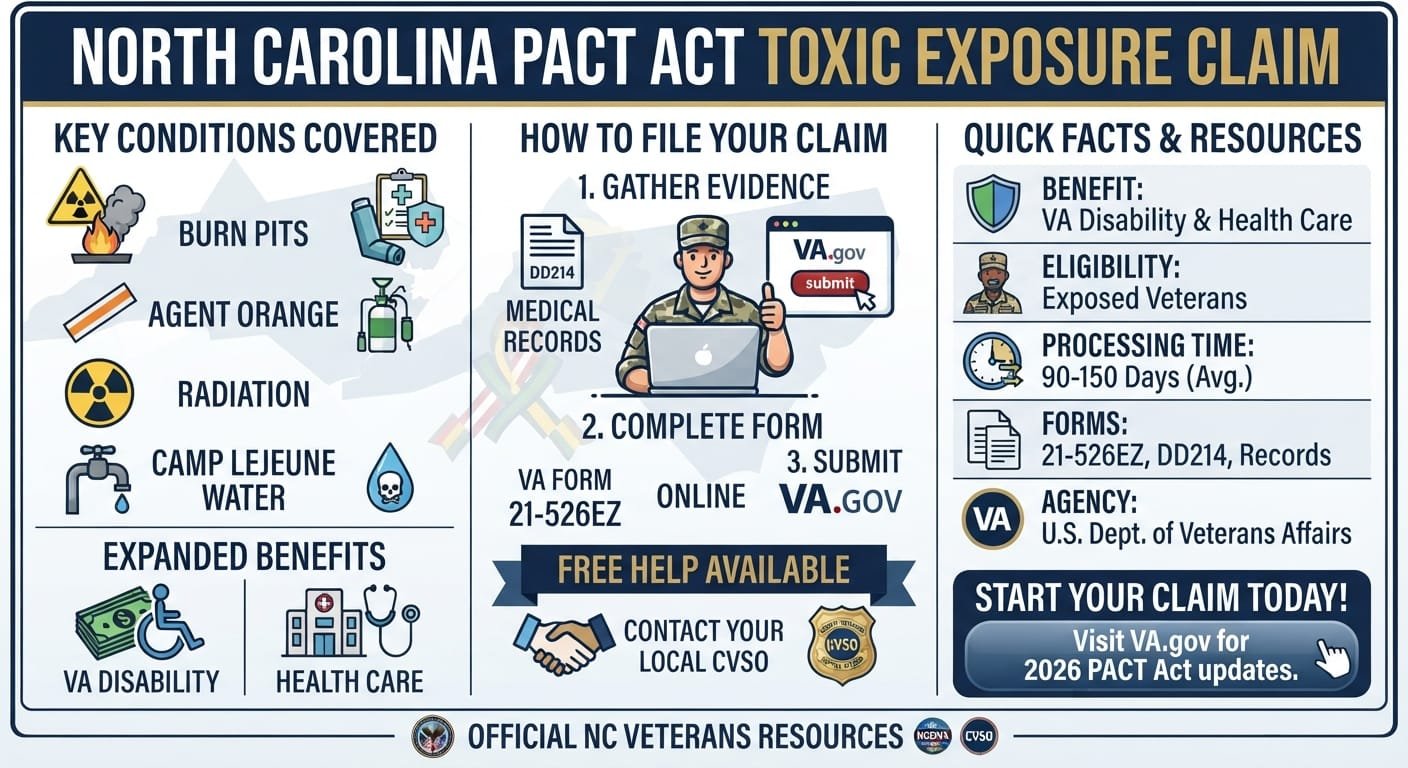
North Carolina PACT Act Toxic Exposure Claim
North Carolina veterans can file a PACT Act toxic exposure claim for service-connected conditions related to burn pits, Agent Orange, radiation, or contaminated water at Camp Lejeune. The PACT Act expanded VA disability benefits and health care for veterans exposed to toxins. To file, submit VA Form 21-526EZ online at VA.gov with evidence of qualifying service locations and a current diagnosis. North Carolina veterans can also get free help from County Veterans Service Officers (CVSOs) across the state .
Quick Facts
| Item | Details |
|---|---|
| Benefit | VA Disability Compensation and Health Care for toxic exposure |
| Eligibility | Veterans exposed to burn pits, Agent Orange, radiation, or Camp Lejeune water |
| Application | VA Form 21-526EZ filed online at VA.gov |
| Processing Time | 90-150 days average for PACT Act claims |
| Official Agency | U.S. Department of Veterans Affairs |
| Required Forms | VA Form 21-526EZ, DD214, medical records |
| Updated For | 2026 PACT Act claims and North Carolina-specific resources |
What Is the PACT Act?
The PACT Act (Promise to Address Comprehensive Toxics Act) is a 2022 federal law that expanded VA health care and disability benefits for veterans exposed to burn pits, Agent Orange, and other toxic substances during military service . It is one of the largest expansions of veterans’ benefits in U.S. history.

The Act added over 20 new presumptive conditions, expanded eligibility for health care, and created a system for toxic exposure screenings every five years . It also included the Camp Lejeune Justice Act, which opened a two-year window for veterans and families exposed to contaminated water at Camp Lejeune to file claims .

Who qualifies:
Veterans who served in Vietnam, the Gulf War, or post-9/11 eras
Veterans exposed to burn pits in Southwest Asia or Afghanistan
Veterans who served at Camp Lejeune, North Carolina between August 1, 1953, and December 31, 1987
National Guard and Reserve members who served in qualifying locations
Why it matters: Before the PACT Act, many veterans struggled to prove their illnesses were caused by toxic exposure. The law creates “presumptive conditions” – the VA assumes certain conditions are linked to service, eliminating the burden of proof for veterans .
What you should do next: Check your eligibility at VA.gov, gather your DD214 and medical records, and file a claim through VA.gov or with help from a County Veterans Service Officer (CVSO).
How North Carolina Veterans Are Affected
North Carolina is home to the 8th largest veteran population in the country, with over 700,000 veterans . The state also hosts Marine Corps Base Camp Lejeune, which is central to many PACT Act claims due to the historic water contamination .
Veterans May Qualify for Extra Benefits
Check available financial assistance, healthcare programs and other opportunities that may apply to you.
Check EligibilityKey North Carolina PACT Act issues:
Camp Lejeune Water Contamination (1953-1987): Between approximately 1953 and 1987, the drinking water at Camp Lejeune was contaminated with volatile organic compounds including trichloroethylene (TCE), perchloroethylene (PCE), benzene, and vinyl chloride . Concentrations at Hadnot Point were measured at 1,400 parts per billion (ppb) for TCE, far above the current safety limit of 5 ppb . An estimated 500,000 to 1 million people were exposed .
North Carolina Veterans’ Health Task Force: In July 2025, the North Carolina Institute of Medicine launched a 43-member Task Force on Veterans’ Health to improve community-based care, meet workforce needs, and help veterans navigate care . This initiative responds to increased demand on the VA health system following the PACT Act .
Statewide CVSO Support: Every North Carolina county has a County Veterans Service Officer (CVSO) who provides free, federally accredited assistance with PACT Act claims. For example, Watauga County’s Veterans Service Office helps veterans file claims for PACT Act benefits and appeals , and Halifax County’s Veterans Service Office assists with all VA benefit matters .
PACT Act Presumptive Conditions
A presumptive condition means the VA automatically assumes your condition is service-connected based on your service locations and dates . You do not need to prove a direct link between your military service and your illness.
New Conditions for Gulf War and Post-9/11 Veterans
Qualifying veterans who served in the Gulf War or post-9/11 era may receive presumption for these conditions :
Asthma (diagnosed after service)
Brain cancer
Chronic bronchitis
Chronic obstructive pulmonary disease (COPD)
Chronic rhinitis
Chronic sinusitis
Constrictive bronchiolitis or obliterative bronchiolitis
Emphysema
Gastrointestinal cancer of any type
Glioblastoma
Granulomatous disease
Head cancer of any type
Interstitial lung disease (ILD)
Kidney cancer
Lymphoma of any type
Melanoma
Neck cancer of any type
Pancreatic cancer
Pleuritis
Pulmonary fibrosis
Reproductive cancer of any type
Respiratory (breathing-related) cancer of any type
Sarcoidosis
Eligible service locations: Southwest Asia (including Iraq, Kuwait, Saudi Arabia), Afghanistan, and other locations where burn pits were used.
New Conditions for Vietnam Era Veterans
High blood pressure (hypertension)
Monoclonal gammopathy of undetermined significance (MGUS)
Eligible service locations: Vietnam, the Korean DMZ, and other locations where Agent Orange was used.
Camp Lejeune Presumptive Conditions
Service members who served at Marine Corps Base Camp Lejeune or Marine Corps Air Station New River, North Carolina, between August 1, 1953, and December 31, 1987, may be eligible for presumption for these conditions :
Adult leukemia
Aplastic anemia and other myelodysplastic syndromes
Bladder cancer
Kidney cancer
Liver cancer
Multiple myeloma
Non-Hodgkin’s lymphoma
Parkinson’s disease
The Camp Lejeune Justice Act: Claims and Deadlines
The Camp Lejeune Justice Act (CLJA), part of the PACT Act, allowed veterans and families exposed to contaminated water at Camp Lejeune to file claims with the Department of the Navy . The filing deadline was August 10, 2024, and the Department of the Navy is no longer accepting new claims .
What this means for North Carolina veterans:
If you already filed a claim by the deadline, here are your next steps :
| Situation | Action |
|---|---|
| Filed by Aug 10, 2024 | Check claim status through the Claims Management Portal |
| Claim denied by DON | You have six months from the denial date to file a lawsuit in U.S. District Court for the Eastern District of North Carolina |
| No response after 6 months | You may file a lawsuit in the same court |
| Did not file by deadline | The CLJA claims window has closed; you cannot file a new claim |
Fraud warning: The Department of Justice and the Navy will never request money or payment from you. Emails from the Navy come from the us.navy.mil domain. If you receive suspicious communications, contact the Camp Lejeune Claims Unit at (757) 241-6020 or CLClaims@us.navy.mil .
Important: Veterans who have received VA disability benefits may still file a lawsuit for damages such as lost wages and pain and suffering. However, any compensation awarded will be offset by the amount of any disability award, payment, or benefit provided to the individual .
How to File a PACT Act Claim in North Carolina
Step 1: Confirm Eligibility
Review your service history against PACT Act qualifying locations and dates. You may be eligible if you served in:
Vietnam (Agent Orange)
Southwest Asia (burn pits, Gulf War)
Afghanistan (burn pits)
Camp Lejeune (contaminated water)
Other qualifying locations
Step 2: Gather Required Documents
Prepare the following documents:
DD214 (Certificate of Release or Discharge from Active Duty)
Current medical records showing your diagnosed condition
Service records showing your duty locations and dates
Lay statements from fellow service members (if needed)
If you don’t have your DD214, your County Veterans Service Officer can help you obtain it.
Step 3: File Your Claim
Submit VA Form 21-526EZ online at VA.gov. This is the fastest and most reliable method.
Filing options in North Carolina:
Online: VA.gov – recommended for speed and tracking
By mail: Submit forms and documents to the VA
In person with help: Visit any North Carolina County Veterans Service Office for free assistance
VSO assistance: Accredited organizations like the DAV, VFW, or American Legion can also help
Step 4: Understand the Appeals Process
If your claim is denied or you disagree with your rating, you have three appeal options under the Appeals Modernization Act (AMA):
Supplemental Claim (VA Form 20-0995): Submit new and relevant evidence
Higher-Level Review (VA Form 20-0996): A senior VA reviewer examines your claim
Board of Veterans’ Appeals (VA Form 10182): Your case goes before a Veterans Law Judge
Deadline: You have one year from the decision date to file an appeal and preserve your original effective date.
Common Questions
1. What is the PACT Act and how does it affect North Carolina veterans?
The PACT Act is a 2022 law that expanded VA disability benefits and health care for veterans exposed to toxins. It added over 20 new presumptive conditions and created the Camp Lejeune Justice Act for veterans and families exposed to contaminated water at Camp Lejeune. North Carolina has the 8th largest veteran population in the U.S., making this law especially significant for the state.
2. What are the Camp Lejeune presumptive conditions?
Service members who served at Camp Lejeune or MCAS New River between August 1, 1953, and December 31, 1987, may get presumption for eight conditions: adult leukemia, aplastic anemia and other myelodysplastic syndromes, bladder cancer, kidney cancer, liver cancer, multiple myeloma, non-Hodgkin’s lymphoma, and Parkinson’s disease .
3. Can I still file a Camp Lejeune claim under the PACT Act?
No. The Camp Lejeune Justice Act claim filing deadline was August 10, 2024, and the Department of the Navy is no longer accepting new claims . If you filed by the deadline and were denied, you have six months to file a lawsuit. If you missed the deadline, you cannot file a new CLJA claim, but you can still file a standard VA disability claim for service-connected conditions.
4. How do I get help with my PACT Act claim in North Carolina?
Every North Carolina county has a County Veterans Service Officer (CVSO) who provides free assistance with PACT Act claims . CVSOs are federally accredited professionals who can help you file claims, gather evidence, and appeal denials. You can also contact the Watauga County Veterans Service Office or Halifax County Veterans Service Office for help .
5. What is the difference between a VA disability claim and a Camp Lejeune lawsuit?
A VA disability claim provides monthly compensation and health care through the VA. A Camp Lejeune lawsuit seeks damages such as lost wages and pain and suffering through the federal court system. Veterans can pursue both. However, any lawsuit compensation will be reduced by the amount of VA disability benefits received . The CLJA lawsuit window is now closed for new filings.
6. Do I need a lawyer to file a PACT Act claim in North Carolina?
No. You can file a PACT Act claim yourself online at VA.gov, or with free help from a County Veterans Service Officer . If your claim is denied or you need help with an appeal, you may consider legal representation, but your CVSO provides free, federally accredited assistance for all stages of the claims process.
7. What toxic exposures are covered by the PACT Act in North Carolina?
The PACT Act covers burn pit exposure, Agent Orange exposure, radiation exposure, and contaminated water at Camp Lejeune . Burn pit exposure applies to veterans who served in Southwest Asia or Afghanistan. Agent Orange applies to Vietnam veterans. Camp Lejeune applies to those who served at the base between 1953-1987.
8. How long does a PACT Act claim take to process?
PACT Act claims typically process faster than standard VA claims, averaging 90-110 days for presumptive conditions. Standard VA disability claims average 130-150 days. Filing with a Fully Developed Claim (FDC) including all evidence upfront can speed up processing.
9. What is the North Carolina Task Force on Veterans’ Health?
In July 2025, the North Carolina Institute of Medicine launched a 43-member Task Force on Veterans’ Health to improve community-based care for veterans . The task force develops policy recommendations to meet veteran care workforce needs, help veterans navigate care, and address behavioral health needs through November 2026 .
10. Can I file a PACT Act claim if I’m already receiving VA disability benefits?
Yes. If you have a new condition that is presumptive under the PACT Act, you can file a new claim or a supplemental claim for that condition. Even if you are already rated for other conditions, you can seek an increased rating or additional compensation for PACT Act-related conditions. Your County Veterans Service Officer can help determine your options.
11. What documents do I need for a PACT Act claim?
You need your DD214, medical records showing your diagnosed condition, and service records showing your duty locations and dates . If you don’t have these documents, your CVSO can help you obtain them. Lay statements from fellow service members can also support your claim.
12. What should I do if my PACT Act claim is denied?
You have one year from the decision date to file an appeal under the Appeals Modernization Act (AMA). You have three options: a Supplemental Claim with new evidence, a Higher-Level Review by a senior reviewer, or a Board of Veterans’ Appeals hearing. Your County Veterans Service Officer can help you choose the best option.
Key Takeaways
The PACT Act is a 2022 law that expanded VA benefits for veterans exposed to burn pits, Agent Orange, radiation, and Camp Lejeune water .
North Carolina has the 8th largest veteran population in the U.S. and hosts Camp Lejeune, making the PACT Act especially significant for the state .
Over 20 new presumptive conditions were added, including respiratory cancers, asthma, chronic rhinitis, and various cancers for Gulf War and post-9/11 veterans .
The Camp Lejeune Justice Act claim filing deadline was August 10, 2024 – new claims are no longer being accepted .
Eight Camp Lejeune presumptive conditions include adult leukemia, bladder cancer, kidney cancer, liver cancer, multiple myeloma, non-Hodgkin’s lymphoma, Parkinson’s disease, and aplastic anemia .
North Carolina veterans can get free help from County Veterans Service Officers in every county .
File your PACT Act claim online at VA.gov using VA Form 21-526EZ with your DD214 and medical records.
The North Carolina Institute of Medicine launched a Task Force on Veterans’ Health in July 2025 to improve care and navigation for veterans .
You have one year to appeal if your PACT Act claim is denied, with three appeal options under the Appeals Modernization Act.
Veterans who received VA disability benefits can still pursue Camp Lejeune lawsuits (if filed by the deadline), but compensation will be offset by VA benefits received .
Official Resources
VA.gov – PACT Act – www.va.gov/resources/the-pact-act-and-your-va-benefits/
VA.gov – File a Claim – www.va.gov/disability/how-to-file-claim/
Camp Lejeune Claims Unit (Navy) – (757) 241-6020 or CLClaims@us.navy.mil
North Carolina Department of Military and Veterans Affairs – www.milvets.nc.gov
Watauga County Veterans Service Office – (828) 265-8068 or 126 Poplar Grove Connector, Rooms 206 & 207, Boone, NC
Halifax County Veterans Service Office – (252) 583-8201 or www.halifaxnc.com/231/Veterans-Service-Office
Veterans Crisis Line – 988 (press 1)
VA Veterans Benefits Hotline – 1-800-827-1000
🇺🇸 IMPORTANT DISCLAIMER – Veterans Benefits Information
This site provides general information about U.S. Department of Veterans Affairs (VA) benefits for educational and informational purposes only.
- Not Official: We are NOT affiliated with, endorsed by, or connected to the U.S. Department of Veterans Affairs (VA), the Veterans Benefits Administration (VBA), the Veterans Health Administration (VHA), or any other government agency.
- No Legal/Financial Advice: The content on this website is for informational purposes only and does not constitute legal, financial, or medical advice. VA benefits rules change frequently – always consult with an accredited Veterans Service Officer (VSO) or a qualified professional for your specific situation.
- Official Sources: For official, binding information and to apply for benefits, always visit official .gov websites: VA.gov, Benefits.VA.gov, or SSA.gov.
- No Data Collection: This site does not collect, store, or process any personal information. It does not have login forms, contact forms, or any system to capture user data. We never ask for your Social Security Number, bank details, or any personal information.
- 🚨 Scam Alert: The VA and other government agencies never charge fees for benefit applications. If anyone asks for money to "process" your VA claim, it is a scam. Report it to the VA Office of Inspector General at VA.gov/OIG.
- Advertising: This site uses third-party advertising (Adsterra) to cover operational costs. We do not endorse or guarantee any products or services advertised.
📌 Information provided as of June 2026. Always verify current eligibility and rules with official .gov sources.
This site is not affiliated with the U.S. Department of Veterans Affairs or any government agency. All information is for educational purposes only. Please visit VA.gov for official information.
